
The Waste Mountain Beside Abuja’s Highway: How Karu Residents Are Paying the Price
 Abah Felicity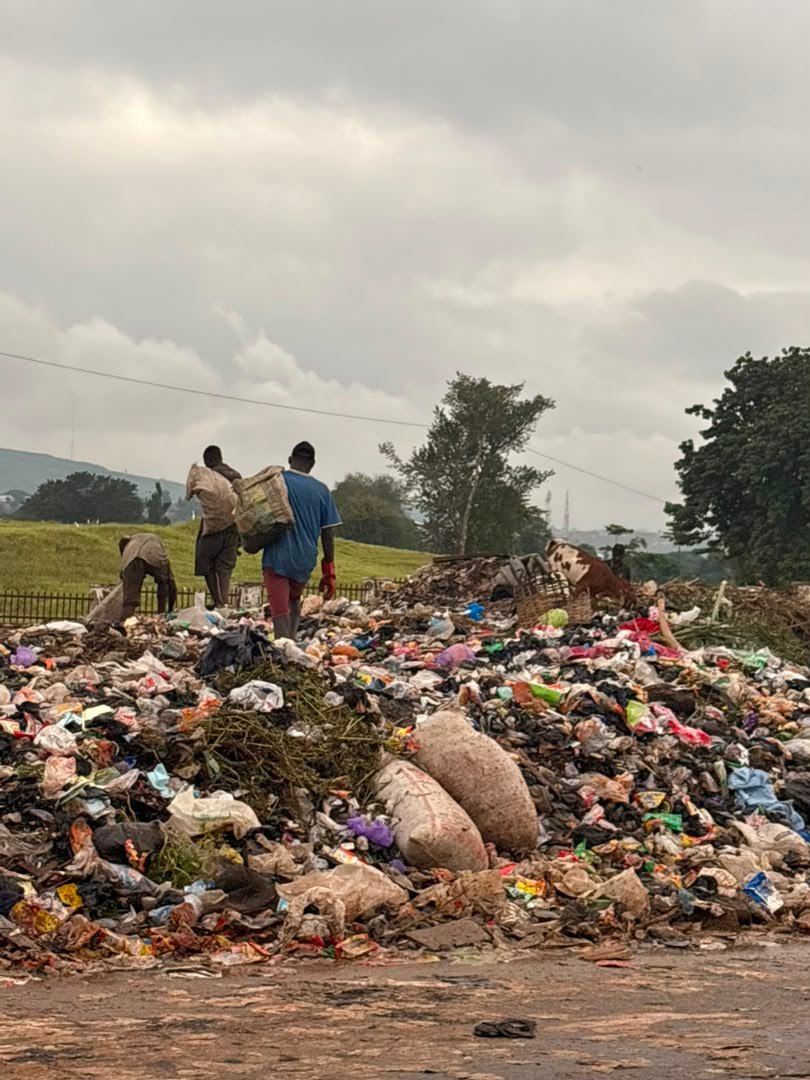
A refuse evacuation exercise takes place beside the Nyanya–Keffi Expressway in Karu, Abuja, after residents raised concerns about the growing waste pile. (Photo: Abah Felicity/AHR).
NASARAWA, Nigeria – The smell reaches motorists before they see the rubbish. Beside the Nyanya–Keffi Expressway in Karu, a mountain of discarded plastic, food waste and other refuse has become a permanent feature of a road used daily by thousands of people. For Abah Felicity of Africa Health Report, a visit to the site revealed more than an unsightly heap: residents and traders say irregular waste evacuation is affecting their businesses, polluting their surroundings and raising concerns about public health and road safety. But as the authorities periodically clear the site, a bigger question remains: who is responsible for ensuring the waste does not simply return?
The Question Behind the Waste
For years, the roadside refuse collection point opposite St Mary’s Catholic Church and close to the Central Mosque has served residents of Karu and surrounding communities.
But residents say what was intended to be a collection point has gradually become a dumping ground.
The refuse accumulates until the heap spills towards the roadside, exposing pedestrians, traders and motorists to offensive odours, smoke from burning waste and swarms of flies.
The location is difficult to miss.
It sits alongside one of Abuja’s busiest highways, where commuters, commercial vehicles and pedestrians pass throughout the day.
Yet the most troubling question is not simply why rubbish has accumulated.
It is why a collection system appears unable to prevent it from happening repeatedly.
Community Chairman of Karu, Omar Wagwada, says the problem worsened after waste management responsibilities were taken over from the community by the Federal Capital Development Authority (FCDA).
He recalls a time when refuse was evacuated approximately every two weeks.
Now, he says, residents sometimes wait three or four months.
“The situation poses serious health risks because many residents rely on water sources around the community for domestic use, while the overflowing refuse emits offensive odours and attracts flies,” he said.
Wagwada wants the Minister of the Federal Capital Territory to ensure that the waste is removed at least once every month.
He said community leaders sometimes move overflowing bins away from the roadside in an attempt to reduce the risk of accidents but lack the equipment and authority to properly evacuate the refuse themselves.
That leaves residents caught between a problem they cannot solve and an official system they say is not responding quickly enough.
Who Is Responsible?
When the Africa Health Report visited the location on Wednesday afternoon, an evacuation exercise was already underway.
Officials from the FCDA and Abuja Municipal Area Council (AMAC) were present.
The reporter requested an interview with the officials to establish the frequency of waste evacuation, the authority responsible for the collection point and why residents say refuse is sometimes left for months.
One of the officials contacted a director to inform her that a journalist wanted to speak with them.
The director said she was unavailable and declined the interview.
The reporter was permitted to record the evacuation exercise and interview residents but was not allowed to interview the officials.
The episode leaves several questions unanswered.
How frequently is the site supposed to be cleared? Who is responsible for monitoring the collection? Are there contractors involved? How many trucks serve the area? And what happens when the evacuation schedule fails?
Without answers to those questions, residents are left to measure government performance by what they see: a heap that grows, a truck that eventually arrives, and then another cycle of accumulation.
Ismail’s Shop Has Become a Front Row Seat to the Crisis
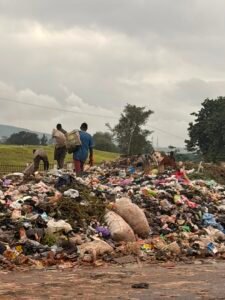
For Ismail, a trader who has lived and worked in Karu for about seven years, the waste problem is not an abstract environmental issue.
He experiences it from his shop.
The smell hangs around the market. Flies settle around businesses and goods. Smoke from burning rubbish sometimes drifts into the area.
And customers notice.
Ismail says the conditions discourage people from visiting the area and make it harder for traders to maintain clean and attractive stalls.
“The offensive odour affects everyone around the market,” he said.
He wants the government to relocate the refuse bins away from the expressway.
For him, the location is also a road-safety concern.
The waste, he says, contributes to obstruction around a busy transport corridor and could increase the risk of accidents.
For seven years, Ismail has watched the problem become part of everyday commercial life.
The traders clean.
The waste returns.
The smell returns.
And business continues around it.
When Waste Becomes a Public-Health Problem
The concerns in Karu reflect a wider challenge confronting rapidly expanding Nigerian cities.
As urban populations grow, so does the amount of solid waste generate by households, businesses and markets.
When collection systems fail to keep pace, refuse can remain exposed for extended periods.
Such conditions can attract flies, rodents and other disease vectors.
Open burning presents another concern because smoke from burning refuse can expose people nearby to pollutants.
During the rainy season, discarded plastics and other materials can also obstruct drainage channels, while rainwater flowing through accumulated waste may carry pollutants into surrounding areas.
Residents in Karu have raised concerns that decomposing waste and runoff could affect nearby water sources used by people in the community.
However, there is currently no environmental testing presented in this report to establish that the refuse has contaminated those water sources.
For Wagwada, however, the uncertainty is itself a reason for authorities to act.
Residents should not have to wait until contamination, or illness is scientifically confirmed before basic waste-management measures are put in place.
A Problem Bigger Than the Smell
Elder Sam Orji, a renewable-energy entrepreneur and Karu resident, says the refuse problem has existed for decades.
He is concerned about plastic waste and other debris being blown into nearby homes and businesses.
According to him, the dump has also created an environment where scavenging activity is common.
Orji recalled the theft of an MTN manhole cover near his office, which he linked to his wider concerns about insecurity around the area.
“The location of the refuse beside a major highway exposes residents, road users and business owners to health risks, while the persistent foul smell discourages customers from visiting nearby businesses,” Orji said.
His concerns highlight the multiple consequences of poorly managed urban waste.
The problem is simultaneously about sanitation, public health, road safety, the local economy and the quality of life of residents.
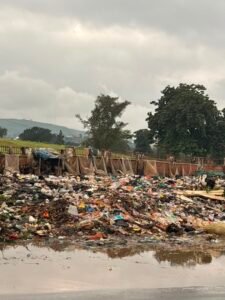
The Hidden Cost for Karu’s Businesses
For traders, the cost of the waste is not limited to discomfort.
A dirty environment can influence where customers choose to shop.
Business owners operating close to the dump say they must constantly clean their surroundings and protect their goods from dust, insects and smoke.
Yet there is little evidence publicly available to show exactly how much local businesses lose because of the waste.
That is another gap authorities and researchers could investigate.
How much revenue is lost?
How many businesses have relocated?
How much do traders spend on cleaning?
How frequently do customers complain?
These questions would help quantify what residents already describe as a financial burden.
The waste mountain therefore has an economic footprint that extends beyond the cost of removing rubbish.
From Emergency Clean-Up to a Working System
The evacuation exercise witnessed during the reporter’s visit offered temporary relief.
But clearing a mountain of rubbish after it has accumulated is not the same as preventing the mountain from forming.
Orji believes authorities should adopt modern waste-management practices, including the use of machinery for regular evacuation and the establishment of recycling facilities.
Such facilities, he argues, could transform some waste into useful products while creating jobs and generating revenue.
A more sustainable system would also require better sorting, reliable collection schedules and properly located waste facilities.
Residents should know when their waste will be collected and where they can report missed collections.
Most importantly, there should be a clear institution or contractor responsible for ensuring that a collection point does not become an uncontrolled dump.
Karu’s Waste Problem Is Abuja’s Warning
The story of Karu is ultimately a story about urban growth outpacing the systems designed to support it.
More people mean more homes.
More homes mean more businesses.
More businesses mean more waste.
Without a reliable system for collecting, transporting, sorting and disposing of that waste, the burden eventually falls on the communities where it accumulates.
In Karu, that burden is visible beside the highway.
It is in the smell that reaches motorists.
It is in the flies around traders’ stalls.
It is in the smoke from burning refuse.
It is in residents’ concerns about their surroundings and water sources.
And it is in the unanswered question of who will ensure the problem does not return.
The authorities cleared the waste during the Africa Health Report’s visit.
For the residents, however, that is only the beginning.
For Karu, the real test is therefore not whether authorities can clear the rubbish once. It is whether they can stop another mountain from forming.
About the Author


 Oluwatobi Adu

 Mirian Gom
 Korede Abdullah