When Your Data Vanishes: Inside Nigeria’s Costly Internet Crisis and the Battle for Consumer Trust
 Oluwafunbi Bello
ABUJA, Nigeria – Every tap, every scroll and every online transaction now come with an invisible calculation for millions of Nigerians: How much data is left? What was once an affordable gateway to work, education and communication have increasingly become a source of anxiety, as subscribers grapple with rising internet costs and the unsettling feeling that their data bundles disappear long before they should. Across the country, from bustling markets to university campuses, consumers are accusing telecommunications companies of charging more while delivering less, exposing a widening trust gap in one of Nigeria’s fastest-growing digital industries. Oluwafunbi Bello, writes.
For millions of Nigerians, mobile data has evolved from a convenience into an essential utility. It powers businesses, facilitates online banking, supports remote work, enables virtual classrooms and keeps families connected across vast distances. Yet, as the price of internet bundles continues to climb, so too has public frustration over what many describe as unusually rapid data depletion.
Social media platforms, consumer forums and customer service centres have become flooded with complaints from subscribers of Nigeria’s major telecommunications providers, particularly MTN, Airtel and Globacom. Many insist that their internet bundles now expire far quicker than they did only a few years ago, despite no noticeable change in their online habits.
Telecommunications companies maintain that their billing systems accurately calculate customers’ usage. But for many Nigerians, that assurance has done little to calm growing scepticism.
The timing of these complaints reflects Nigeria’s increasing dependence on digital connectivity.
According to figures from the Nigerian Communications Commission (NCC), Nigeria had more than 153.8 million internet subscribers and about 185.7 million active telecommunications subscribers as of March 2026. The regulator also reported that Nigerians consumed over 4.06 million terabytes of internet data during the first quarter of 2026 — the highest quarterly data usage ever recorded in the country’s telecommunications sector.
The figures paint a picture of a country becoming increasingly digital. But they also underscore why concerns over affordability and transparency have become matters of national significance.
Businesses Count the Cost
For entrepreneurs whose livelihoods depend on uninterrupted internet access, higher data bills are directly affecting their bottom line.
A fashion entrepreneur in Abuja, Aisha Musa, says nearly every customer interaction now takes place online.
“Before, I could buy a 10GB bundle and it would last me almost two weeks. Now, I hardly get one week from the same amount of data even though my online activities have not changed. Every day I have to think twice before uploading videos or responding to customers because data is expensive.”
For small businesses operating in an increasingly digital marketplace, slowing down online engagement often means losing potential customers.
That concern is shared by Chinedu Okafor, who runs a Point-of-Sale business in Kubwa, Abuja, where internet connectivity determines whether transactions succeed or fail.
“Every transfer depends on the internet. If the network is poor, customers get impatient, and if data finishes unexpectedly, business stops completely. We are spending more on data now, but we don’t see any improvement in service.”
For operators like Okafor, unreliable connectivity and expensive data combine to squeeze already thin profit margins.
Students Feel the Pressure
The impact extends beyond commerce.
Across Nigerian universities, students increasingly depend on digital platforms for lectures, assignments and academic collaboration. As education becomes more internet-driven, expensive data has become another obstacle to learning.
A 300-level undergraduate, Samuel Adekunle, says internet access is now one of his largest monthly expenses.
“Most of our assignments are online and lecturers share materials through WhatsApp and Google Classroom. Data is now one of my biggest monthly expenses. Sometimes I postpone downloading study materials because I don’t want to finish my bundle.”
His experience reflects the reality confronting thousands of students balancing tuition, accommodation and transportation costs with growing digital expenses.
“It’s Like Someone Is Sipping My Data”
Perhaps the most common complaint among subscribers is not simply the rising cost of data but how quickly it appears to disappear.
A recent university graduate, Emmanuel Arinde, says the change has been impossible to ignore.
“I don’t understand how MTN is moving anymore. It’s like there is a straw through which the data is being shipped out. I even switched to Airtel, but the network is not good, so I had no other option than to go back to MTN, which is very draining. Even when I was very active online, I didn’t use more than 3GB in a day but now I use more than 5GB.”
His frustration mirrors countless conversations taking place across Nigeria, where subscribers increasingly question whether they are receiving the value they pay for.
Although telecom operators insist that usage is measured accurately, persistent complaints have fuelled growing distrust.
The Telecoms’ Explanation
Industry experts and regulators argue that today’s smartphones consume considerably more internet data than earlier devices.
Consumer guidance from the NCC identifies several hidden sources of data usage, including automatic application updates, cloud backups, software updates, background app activity, high-definition video streaming and automatic media downloads through messaging applications.
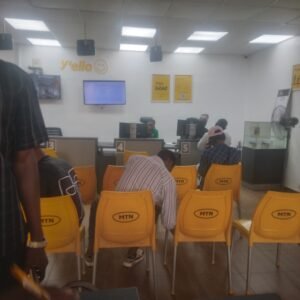
Responding to the complaints, AbdulRazaq Olawale, a customer service representative at MTN Connect, Garki II, believes many customers underestimate how much data their devices consume behind the scenes.
“Data consumption can be determined by the type of phone a customer is using, especially high-resolution smartphones. Some people don’t know there are other things they do that consume data. The App Store for iPhones and Play Store for Android phones are often set to auto-download and update applications. If these settings are not changed, the phone continues to consume data whether the user is actively using it or not.”
He says WhatsApp settings are another overlooked contributor.
“Some people belong to WhatsApp groups where many videos and pictures are shared daily. If auto-download is enabled, all those files are downloaded automatically. Subscribers need to adjust these settings if they want to reduce data consumption.”
Regarding the increase in data prices, Olawale points to wider economic pressures.
“I don’t really know what informed the decision on the new data prices, but considering the situation in Nigeria, including the increase in diesel prices used to power network infrastructure and other operational costs, data prices will change. It is similar to how fuel price increases affect transportation.”
An Airtel staff member, Ayomide Oluwagbenga, acknowledges that subscribers have also raised concerns about service quality.
“We’ve had complaints about bad networks, and we’re working towards giving Nigerians a better network for browsing.”
Beyond Perception
Technology analysts say there is truth on both sides of the debate.
Modern smartphones are designed to remain permanently connected, synchronising emails, photographs, cloud storage and applications almost continuously. Social media platforms increasingly prioritise video content, while streaming services automatically adjust video quality upwards on faster networks, consuming significantly more data than text or static images.
However, analysts also argue that transparency remains the industry’s biggest challenge.
Most subscribers have limited understanding of how their devices consume data, while telecommunications companies often provide only basic usage summaries rather than detailed, easy-to-understand breakdowns.
This information gap leaves room for suspicion.
Without greater visibility into real-time data consumption, many consumers are likely to continue believing they are paying more for less.
Rebuilding Trust in Nigeria’s Digital Future
Nigeria’s digital economy is expanding rapidly, with businesses, schools, financial institutions and government services increasingly moving online. Affordable and reliable internet access is therefore no longer merely a consumer issue—it is central to national development.
Consumer advocates say rebuilding public confidence will require more than explaining smartphone settings. They argue that operators must improve transparency, strengthen customer education and simplify data usage monitoring.
Regulators, meanwhile, face increasing pressure to ensure that billing systems remain independently verifiable and that subscribers receive clear information about how their data is consumed.
For millions of Nigerians, the question is no longer simply how much mobile data costs. It is whether every megabyte purchased genuinely delivers the value promised.
Until greater transparency bridges the widening trust deficit between operators and subscribers, every notification warning that “your data bundle has been exhausted” will continue to reinforce one of the country’s most persistent digital frustrations.
About the Author


 Korede Abdullah
 Mirian Gom
 Hope Ajayi