
From Chalkboards to Keyboards: Nigeria’s Digital Leap in Classrooms Faces Unequal Readiness
 Koko Maxwella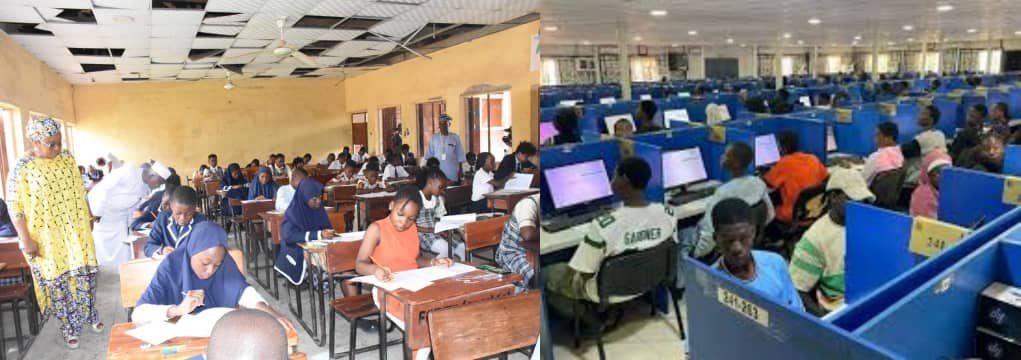
From chalkboards to keyboards — the digital divide in Nigerian education is stark. While students in rural schools still rely on pen-and-paper in crumbling halls, their peers in cities are already taking computer-based tests as the country prepares for full CBT implementation in WAEC and NECO by 2026.
ABUJA, Nigeria – When 16-year-old Aisha Muhammad, a JAMB candidate from Kachia Local Government Area of Kaduna State, sat for her computer-based test (CBT) at a centre in Abuja, she knew all the answers — but not how to use the computer fast enough.
“I was confident when I saw the questions,” she recalled. “But I didn’t finish because I was still trying to move the mouse when the time went off.”
Her story captures the unease many students feel as Nigeria prepares for one of its biggest education reforms in decades — the transition to full Computer-Based Testing for all WAEC and NECO examinations by 2026.
In this report, Koko Maxwella explores whether Nigeria’s schools are truly ready for this ambitious leap — and what it means for millions of students like Aisha.
Nigeria’s Big Digital Gamble
The Federal Government recently announced that the West African Examinations Council (WAEC) and National Examinations Council (NECO) will fully adopt CBT for both objective and essay questions.
Education Minister Dr. Tunji Alausa called it a “necessary modernisation” aimed at curbing examination malpractice, improving transparency, and aligning Nigeria’s education system with a fast-digitising world.
“The world has moved into a digital age,” Dr. Alausa said in Abuja. “We cannot continue to rely on outdated methods prone to inefficiency and malpractice. Nigeria must catch up,” he stated at a conference in Abuja.
Government data seems to support the optimism: reported examination malpractice cases dropped from 16.29% in 2023 to 9.70% in 2025. Officials believe computerisation will further reduce misconduct.
But beneath the enthusiasm lies a digital divide that may determine the success — or failure — of the reform.
Lessons from JAMB’s Decade of CBT
CBT isn’t new to Nigeria. The Joint Admissions and Matriculation Board (JAMB) introduced it more than a decade ago. The system largely succeeded, streamlining admissions and cutting down cheating.
Yet, JAMB’s model is a one-day exam, mostly multiple-choice and held in urban-based centres, where candidates often travel long distances.
WAEC and NECO, by contrast, span weeks of essay and theory papers, requiring sustained infrastructure and digital literacy. Experts warn this poses a bigger challenge, especially for rural communities where electricity and internet access remain unreliable.
Inside the Schools: Readiness and Reality
In separate interviews with Africa Health Report, (AHR) across schools in Abuja, Lagos, Kaduna, and other regions, a mix of anxiety and cautious optimism fills the air.
At Stella Marie’s Secondary School in Abuja, 13-year-old Sunshine, an SS1 student, grinned with excitement.
“Yes, I prefer computer-based examinations to paper,” she said. “It’s easier, transparent, and quicker. I can use the computer to type and even draw. It won’t be too hard to write WAEC like that.”
But not everyone shares Sunshine’s confidence.
Principal Mr. Akor Udeme, of another Abuja school, admitted the enthusiasm is clouded by logistical worries.
“Most of our students aren’t yet proficient with computers,” he said. “We’ve started organising computer drills during class hours, but our facilities are limited — both in systems and power supply.”
Abel Jonathan, a 16-year-old preparing for NECO, confessed his nerves:
“I can browse on my phone, but typing a long essay on a desktop computer feels strange. We need more practical training, not just theory.”
For many, even touching a computer remains a rare experience. In one Kaduna public school, students share one computer among four classmates during ICT classes.
“How can a child who’s never used a laptop write a computer-based essay in 2026?” asked a teacher. “It’s a good policy, but we must invest in training, hardware, and power first.”
Infrastructure Gaps and Power Woes
The transformation demands more than digital goodwill — it requires solid infrastructure.
Many urban schools boast computer labs, but rural and underfunded institutions struggle with even basic power supply. Generators are expensive to run, and frequent blackouts leave students in the dark — literally.
A Lagos principal described the resource gap vividly: “We have only 25 working computers for over 300 students. How do we meet the 2026 deadline without massive government support?”
Training Teachers, Empowering Learners
To bridge the gap, many schools are reinventing their teaching models. Teachers are doubling as ICT trainers, teaching students to use keyboards, navigate exam interfaces, and type essays efficiently.
Mr. Udeme explained:
“We’ve introduced weekly practice sessions for senior students. They practise on-screen multiple-choice tests and type short essays. It’s not perfect yet, but it’s helping.”
Some schools have formed partnerships with private ICT centres to expand access — though the added costs often fall on parents already struggling with fees.
Global Lessons in Digital Transition
Nigeria is not alone on this path. Kenya has partially digitised national exams, and Ghana has piloted CBT for placement tests. Globally, exams like the SAT and GRE are now fully computer based.
However, those transitions faced initial turbulence — from technical glitches to student anxiety. Over time, though, efficiency improved, marking consistency increased, and results were released faster.
Experts suggest Nigeria can learn from these experiences by adopting a phased rollout, prioritising teacher retraining and simulation exercises before nationwide implementation.
Government’s Assurances and Private Partnerships
Despite the visible gaps, the Ministry of Education remains confident. Dr. Alausa insists that partnerships with private tech firms and digital education providers will help equip schools and exam centres.
“We will not leave any child behind,” he reaffirmed. “This reform isn’t just about preventing malpractice — it’s about equipping our young people to thrive in a global digital economy.”
Already, pilot programmes are being planned in selected urban and semi-urban centres to test-run essay-based CBT exams by November 2025 before the full 2026 rollout, according to AHR findings.
Digital Divide or Digital Revolution?
As the countdown begins, the mood across Nigeria’s classrooms is a blend of hope, apprehension, and adaptation.
For digitally literate students like Sunshine, the reform represents progress and fairness. But for students like Aisha, who lost valuable time trying to move a mouse, it could mean exclusion if urgent interventions don’t follow.
Dr. Alausa’s vision of a “tech-driven classroom” will only succeed if access, training, and infrastructure catch up with policy.
Educationists argue that the government must prioritise ICT literacy from primary school while ensuring that every public school has at least one functioning computer lab before 2026.
The Race to 2026
With less than two years before the full transition, schools, teachers, and policymakers face a critical question:
Will Nigeria’s digital dream bridge its rural-urban divide — or deepen it?
For 16-year-old Christiana, the answer lies in preparation, not panic.
“We can’t run from it,” she said. “This is the future. We just have to be ready.”
Indeed, the road from chalkboards to keyboards may be bumpy — but for millions of Nigerian students, it’s a road that must be taken.
About the Author


 Mirian Gom
 Korede Abdullah

 Oluwatobi Adu