 Korede Abdullah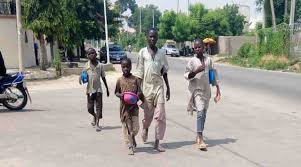
Out-of-school children walking on the street in Northern Nigeria, highlighting the country’s education crisis. (Photo Credit: Internet)
LAGOS, Nigeria – On a dusty roadside in northern Nigeria, a barefoot boy balances a tray of sachet water on his head, weaving through traffic instead of reciting lessons in a classroom—his story is not an exception but a portrait of a nation where millions of childhoods are quietly slipping through the cracks, as poverty, insecurity and policy failures converge to create what experts now warn is not just an education crisis, but a looming national emergency. Korede Abdullah, writes.
A Crisis That Refuses to Fade
Nigeria’s out-of-school crisis has grown from a policy concern into a defining national challenge. In 1999, about seven million children were out of school. By 2013, the figure had climbed to 10.5 million—nearly half of the global total at the time. Today, the number has surged to an estimated 18.3 million, according to data from UNICEF, UNESCO and the Federal Ministry of Education.
Of these, 10.2 million are of primary school age, while 8.1 million are at junior secondary level. The burden is unevenly distributed: roughly 66 per cent of affected children are concentrated in the North-West and North-East, regions grappling with deep poverty and persistent insecurity.
Behind these statistics lies a simple but unsettling truth: Nigeria is raising a generation without access to formal education.
A System Under Strain
The country’s education system is buckling under immense pressure. Data from the Universal Basic Education Commission (UBEC) reveals that 915,913 teachers are responsible for over 31.7 million pupils—translating to a pupil-to-teacher ratio of 35:1, significantly above UNESCO’s recommended 25:1.
In many classrooms, the reality is even more severe.
“Overcrowding is a major issue,” said Mr. Adeniyi Adeleye, former principal of Boltine Secondary School, Iyana-Ipaja, Lagos. “You find classes with 70, 80, even 100 students.”
Infrastructure deficits further compound the crisis. In Kano State alone, reports indicate that about 4.7 million pupils sit on bare floors during lessons—a stark symbol of systemic neglect.
Between 2018 and 2022, at least 17 states failed to recruit teachers, deepening shortages and weakening already fragile learning systems.
Funding Failures and Lost Opportunities
Education in Nigeria remains critically underfunded. Government allocations have consistently hovered between 5 and 8 per cent of the national budget—far below UNESCO’s recommended benchmark of 15–20 per cent.
Even more troubling is the inability of states to utilise available funds. UBEC records show that billions of naira earmarked for education were forfeited due to failure to provide counterpart funding: N1.4 billion in 2020, N2.8 billion in 2021, N14.4 billion in 2022, and N36.1 billion in 2023.
At the same time, experts estimate that roughly $345 million is required annually to reintegrate about 15 million children into school.
The contradiction is glaring funds exist, yet systems fail to deploy them effectively.
Poverty: The Invisible Barrier
While policies promise free education, the hidden costs of schooling continue to exclude millions.
Alhaji Kamaldeen Oluwatoki, Director in the Ekiti State Ministry of Education, explained the depth of the challenge:
“The issue is multi-layered. While Ekiti State performs relatively better than many parts of the country, the national picture reflects deep structural challenges—poverty, insecurity in some regions, cultural practices, and weak enforcement of compulsory education laws.”
He identified poverty as the most significant driver:
“Even when tuition is free, indirect costs—uniforms, books, transportation—can be prohibitive. Until we address household economic vulnerability, school enrolment gains will remain fragile.”
For many families, survival takes precedence over schooling.
“Sometimes my children have to trek longer distances or stay at home when there is no money for transport,” said Mrs. Bukola Adebayo, a parent in Lagos.
Mr. Sodiq Yusuf shared a harsher reality:
“I had to ask one of my children to stay at home for some time because I cannot meet daily expenses.”
When Policy Meets Poor Execution
Nigeria is not short of education policies. The Universal Basic Education programme, alongside state-level interventions such as school feeding schemes and infrastructure upgrades, was designed to bridge access gaps.
Yet implementation remains a persistent weakness.
“Policy design is often stronger than policy execution,” Oluwatoki said. “Delays in fund disbursement and weak monitoring systems limit impact.”
Governance inefficiencies further erode progress.
“Issues such as bureaucratic bottlenecks, duplication of projects, and, in some cases, mismanagement of resources undermine impact,” he added.
The result is a system where intentions rarely translate into outcomes.
Insecurity: Education Under Siege
In parts of northern Nigeria, education has become a dangerous pursuit.
“In the North-East and North-West, insecurity has made education almost impossible in some communities,” Adeleye said. “Schools have been destroyed, teachers have been displaced, and parents are afraid to send their children out.”
Years of attacks on schools have forced closures and disrupted learning, leaving entire communities without access to education.
For many parents, the choice is stark: risk their children’s safety or abandon schooling altogether.
Beyond the North: A Nationwide Crisis
Although often framed as a northern problem, the out-of-school crisis cuts across Nigeria.
Urban centres like Lagos face their own challenges—overcrowded classrooms, rising living costs, and overstretched infrastructure.
“People often assume this is only a northern issue, but poverty cuts across regions,” Adeleye noted.
The crisis, therefore, is not regional—it is national.
A Brewing Security Threat
Experts warn that the consequences of inaction could be severe.
Alhaji Yusuf Ibrahim, a public affairs analyst, described the situation as a ticking time bomb:
“When you have millions of children roaming the streets without education or skills, you are creating a ready pool for insecurity.”
He pointed to the distortion of the Almajiri system:
“Children are left to fend for themselves, often begging on the streets and exposed to criminal influences.”
The long-term risks are profound.
“Out-of-school children today can easily become instruments of violence tomorrow,” Ibrahim warned.
The Path Forward
Addressing the crisis requires more than incremental reforms—it demands a coordinated national response.
Ibrahim emphasised the need to modernise traditional systems:
“We must modernise and regulate the Almajiri system by integrating it into the formal education framework. These children should learn both religious and conventional subjects in a structured environment.”
He also called for increased investment and targeted support:
“The government must provide incentives such as school feeding, scholarships, and conditional cash transfers to encourage enrolment and retention.”
Community engagement, he argued, is equally critical:
“Traditional rulers and Islamic scholars must be part of the solution.”
Above all, safety must be guaranteed:
“Parents will not send their children to school if they feel unsafe.”
A Defining Moment
Nigeria stands at a crossroads. The growing number of out-of-school children is not merely an education issue—it is a test of governance, equity, and national priorities.
“If we fail to act now, we are only postponing a bigger security crisis,” Ibrahim said. “Education is not just a social service—it is a strategic tool for peace and development.”
For millions of children, the future depends on whether that warning is heeded—or ignored.
About the Author

 Hope Ajayi
 Mirian Gom