
Tinubu Education Reforms Slash Learning Crisis – Alausa Tells World Forum
 Otamere Gladness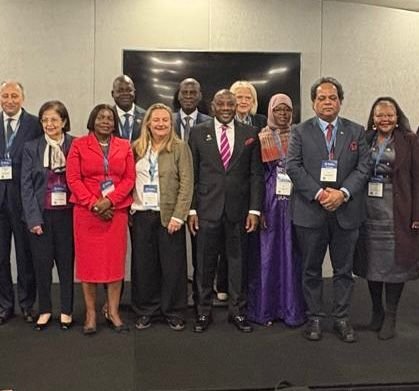
ABUJA, Nigeria – Education minister, Dr. Tunji Alausa has declared that education reforms under President Bola Tinubu are transforming Nigeria’s learning system and reducing foundational literacy deficiencies nationwide.
Alausa made the remarks on Monday during a special roundtable session at the Education World Forum in London, where he addressed global education ministers and stakeholders.
The minister highlighted Nigeria’s reforms in foundational literacy and numeracy, describing them as some of the country’s most ambitious education interventions in decades.
“We’re scaling RANA for Primary 1 to 3 and Teaching at the Right Level for Primary 4 to 6 across 15 states through UBEC,” Alausa said.
According to him, Nigeria has unified foundational literacy delivery across formal and non-formal education systems using a single national framework.
He disclosed that programmes such as EKOEXCEL, KwaraLEARN and BayelsaPRIME were already delivering measurable learning improvements through technology-driven teaching models.
“The impact is measurable. KwaraLEARN halved foundational learning deficiencies in less than two years, while BayelsaPRIME improved literacy by 20 percentage points in just 19 weeks,” he stated.
Alausa also revealed plans to double federal funding for basic education by increasing the Universal Basic Education Commission allocation from two per cent to four per cent of the Consolidated Revenue Fund.
The minister said the government was finalising a National Policy on Foundational Literacy and Numeracy to provide a long-term legal framework for reforms.
Speaking on Nigeria’s out-of-school children crisis, he explained that the Accelerated Basic Education Programme provides pathways for vulnerable children to transition into formal secondary education.
“With the National Policy on FLN nearly finalised and one standard across formal and non-formal systems, we are building a foundation that will outlast any single programme cycle,” Alausa added.
Education experts at the forum described Nigeria’s reforms as one of Africa’s most closely watched attempts to tackle learning poverty using data-driven systems.
About the Author

 Korede Abdullah
 Hope Ajayi
 Mirian Gom