


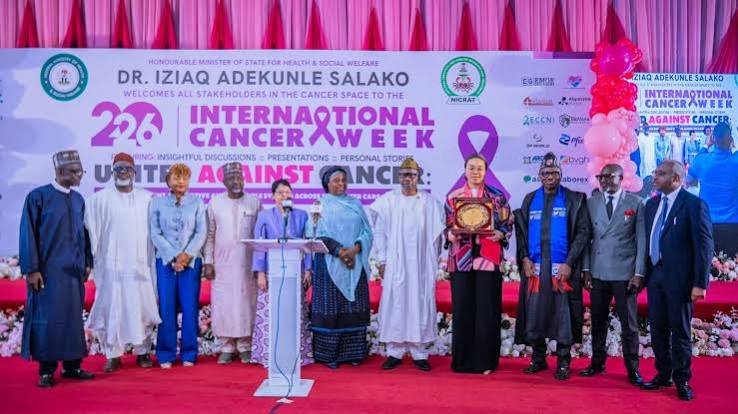
ABUJA, Nigeria – The Federal Government is expanding the use of artificial intelligence, digital health, telemedicine, molecular diagnostics, precision medicine and data analytics to strengthen cancer prevention, diagnosis and treatment in Nigeria.
The Minister of State for Health and Social Welfare, Dr Iziaq Salako, disclosed this on Tuesday in Abuja while opening the 2026 International Cancer Week.
The event was held under the theme, “United Against Cancer: Building Resilient, Innovative and Equitable Systems Across the Cancer Care Continuum.”
Salako said the technologies would help overcome geographical barriers, expand access to specialist care, improve referrals and support clinical decision-making.
He stressed, however, that innovation must be affordable, appropriate, scalable and sustainable to deliver meaningful results within Nigeria’s health system.
“The first priority under this year’s theme is resilience – building cancer-care systems that can withstand shocks, adapt and sustain essential services,” Salako said. “This requires investment in infrastructure, equipment, diagnostics, medicines, human resources and sustainable financing.”
Government expands cancer prevention
The government is also expanding cancer prevention and early detection through eight National Institute for Cancer Research and Treatment (NICRAT) Preventive Oncology Clinics across Nigeria’s six geopolitical zones.
Salako said the National Cancer Health Fund and Catastrophic Health Expenditure Fund were being used to improve financial protection for cancer patients and their families.
The Director-General of NICRAT, Prof. Usman Aliyu, said the institute had trained nearly 2,000 healthcare professionals across the six geopolitical zones.
The training covered cancer prevention, diagnosis, treatment, palliative care, research and programme implementation.
Aliyu said NICRAT was also advancing precision oncology through the Nigeria Cancer Genome Study.
He added that the SINCA project had trained more than 120 early-career oncology researchers.
According to Aliyu, the National Cancer Health Fund has supported more than 2,000 indigent and vulnerable cancer patients.
Another cancer assistance initiative has also provided lifesaving support to more than 10,000 patients, he said.
Lawmaker warns technology is not enough
However, Chairman of the House of Representatives Committee on Health, Rep. Amos Magaji, said technology alone would not address Nigeria’s growing cancer burden.
He called for stronger financing and investment in primary healthcare.
Magaji said Nigeria was losing approximately 1,000 people to cancer every month, while treatment costs were pushing many families into poverty. “We need to get to a point whereby we strengthen our primary healthcare centres, and that is where screening, health education campaigns and every other thing needs to start from,” he said.
The President of the Nigerian Cancer Society, Prof. Abidemi Omonisi, also called for stronger coordination among government institutions, health professionals, researchers, civil society, development partners, the private sector, communities, survivors and patients. “No single institution can address the cancer burden alone,” Omonisi said.
The event also featured the launch of the Standard Operating Procedure Manual for Cancer Registries in Nigeria and the Nigerian Journal of Cancer Research.

Join the conversation