


ABUJA, Nigeria – A pair of fashion glasses may complete an outfit, but for some young Nigerians, it is also becoming a substitute for the eye examination they cannot afford, fear or simply do not consider necessary. As people increasingly turn to ready-made spectacles and roadside purchases to manage blurred vision, experts warn that untreated eye conditions could lead to avoidable sight loss, lost productivity and lifelong consequences. From Abuja to Lagos, the choices are often driven by cost, convenience and misconceptions about eye care. But behind the decision to postpone an eye check is a growing public health concern: conditions that could be detected early may remain unnoticed until vision deteriorates. In this report, Oluwatobi Adu examines why Nigerians are bypassing professional eye examinations, the risks of relying on unsuitable glasses and the economic cost of a country struggling to protect its citizens’ sight.
When “I Can Manage” Becomes the Eye-Care Plan
For Opeyemi Joseph, a 30-year-old resident of Abuja’s Jabi-Utako area, difficulty seeing distant objects has become something he has learnt to tolerate.
The problem started when he was 27. However, financial constraints and fear of wearing prescription glasses have kept him from undergoing a professional eye examination. Instead, he buys fashion glasses, mainly for appearance and protection from sunlight, hoping his vision will not deteriorate.
Joseph recalled an experience at a roadside shop where he mistakenly tried on medicated glasses while shopping for fashion frames. His vision became blurred almost immediately, making him realise that the glasses were unsuitable. “One of the major reasons I have not gone for a proper eye check-up is money. I am also scared of using glasses, and I believe I can manage without them because I don’t consider the problem very serious.”
Although he hopes to undergo an examination eventually, his experience reflects how financial barriers and misconceptions can discourage people from seeking timely care.
Olatoun Adeyanju, a 22-year-old teacher in Lagos, faces a similar dilemma. She sometimes struggles in brightly lit environments and experiences eye pain when her phone screen is too bright. Despite noticing the symptoms earlier in 2026, she has yet to consult an eye specialist.
Instead, she relies on sunglasses when outdoors or entering brightly lit rooms. “I have never consulted an eye specialist about it, but I always wear my sunglasses whenever I am going into a bright room or when I am outside,” she said. Adeyanju said she plans to visit an eye specialist for an examination. However, not everyone who purchases ready-made glasses does so without professional advice.
Fatima, a 25-year-old self-employed woman in Lagos, said she had used ready-made glasses purchased from open markets for more than 10 years, despite undergoing regular eye examinations.
She said affordability and convenience influenced her decision. “Yes, I have visited an eye specialist for an examination. I buy ready-made glasses because they are more affordable and convenient.”
Fatima said she typically spends between ₦25,000 and ₦40,000 on glasses. Their experiences reveal different motivations behind the growing reliance on non-prescription eyewear. While some people use fashion glasses without knowing the cause of their vision problems, others choose cheaper alternatives despite having undergone examinations. But these glasses serve different purposes, and none should be treated as a universal solution to vision problems.
Nigeria’s Growing Burden of Avoidable Vision Loss
The consequences of delayed eye care extend beyond individual experiences. Nigeria’s National Blindness and Visual Impairment Survey found that 84 per cent of blindness cases were attributable to avoidable causes. It also identified uncorrected refractive errors as responsible for 57.1 per cent of moderate visual impairment among those examined, while cataract remained the leading cause of blindness.
In August 2026, the Ophthalmological Society of Nigeria reportedly warned that more than two million Nigerians were living with avoidable blindness.
Sightsavers has also estimated that approximately 4.25 million Nigerians aged 40 and above live with blindness or visual impairment, with a substantial proportion of blindness considered avoidable. These figures highlight the gap between available eye-care interventions and the number of Nigerians receiving timely diagnosis and treatment.
Professor Ada Aghaji, Professor of Ophthalmology and Eye Health Systems at the University of Nigeria, raised further concerns during the institution’s 254th Inaugural Lecture on October 29, 2026. She disclosed that Nigeria loses an estimated $1.6 billion annually in productivity because of vision impairment.
The economic consequences affect workers who struggle to perform their jobs, students whose learning suffers because of poor vision and families who bear the financial burden of advanced treatment. Findings from clinical records also illustrate the scale of the problem.
Olorunyomi Ann Funke, an Ophthalmic Nurse Specialist at Kwara State University Teaching Hospital (KWASUTH), shared findings from a study of medical records at KWASUTH and Sobi Specialist Hospital, Ilorin, covering June to December 2025.
The study found that 24.4 per cent of patients examined across both facilities had visual impairment. The prevalence was 27.5 per cent at Sobi Specialist Hospital and 19 per cent at KWASUTH. Among recorded visual impairment cases, glaucoma accounted for 37.2 per cent, followed by uncorrected refractive errors at 33 per cent and cataract at 23.2 per cent.
Although the findings are facility-based and do not represent a national estimate, they demonstrate the range of conditions confronting eye-care professionals. Funke attributed delayed examinations to misconceptions, poverty, limited awareness, poor access to quality services and self-medication.
She explained that some patients refuse examinations or prescribed glasses because they believe medication alone can resolve their vision problems. “Some people refuse to use glasses and instead ask for drugs during consultations. They do not understand that glasses are used to correct refractive errors. Some people who cannot see clearly from a distance or close up refuse to get their eyes checked until the problem becomes worse.”
She warned that unsuitable ready-made glasses could cause eye strain, headaches, dizziness and blurred vision, particularly when their lenses do not meet an individual’s visual needs. More importantly, relying on such glasses without professional assessment could delay the detection of underlying conditions, including glaucoma, which can cause irreversible vision loss if not properly managed.
What Optical Shops Are Seeing
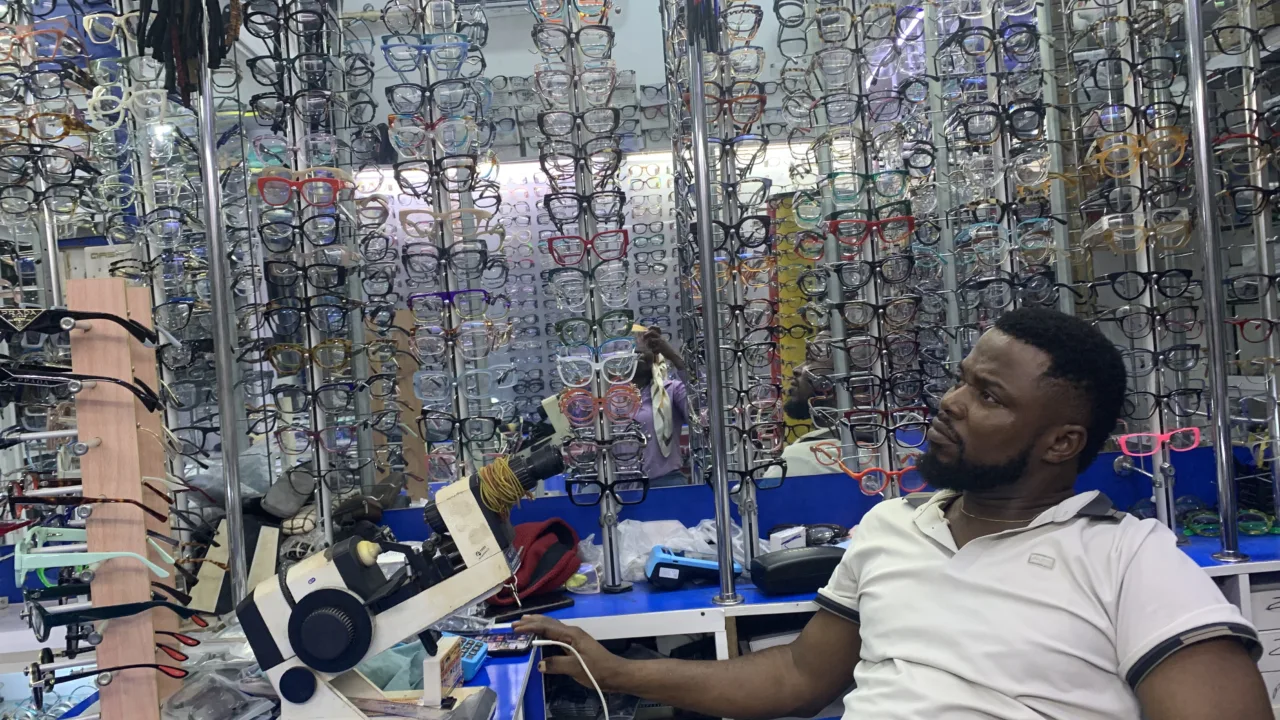
The demand for affordable eyewear is also reflected in the experiences of optical retailers, who say customers have different needs and budgets. Chike, who identified his business as Chike Optics, told Africa Health Report that his shop serves members of the public and optometrists.
He said glasses cost from ₦10,000 upwards, depending on the type selected, with options including clear, photochromic and blue-light-filtering lenses. However, he advised people experiencing vision difficulties to undergo professional examinations before purchasing corrective glasses. “It is advisable to go and see a doctor. If you have a complaint, I will advise you to go for an eye test so the doctor can examine you and explain the eye problem.”
He said ready-made reading glasses might serve as a temporary option for some people who cannot immediately access an examination, but stressed that they should not replace professional assessment. “If it is for reading, you can get a reading glass, but you cannot wear it for a long time. You still need to go for an eye test to know the level of your eye problem.”
Chike also advised people who wear fashion glasses despite experiencing difficulty seeing clearly to seek professional attention. He said customers could choose from different lens options based on their budgets and that he could direct them to facilities where eye examinations cost less than ₦5,000.
Christian Kozah John, a certified optician and owner of Kozah Optics in Utako, Abuja, said he had been selling eyeglasses for about five years. His business deals in medicated and non-medicated glasses, including frames and lenses.
He said ready-made glasses sold to patients cost from ₦25,000 upwards, while prescribed glasses could cost around ₦50,000 or more, depending on the prescription. “For the patients, a ready-made pair of glasses can cost from ₦25,000 upwards. For prescribed glasses, the cost depends on the prescription. It can be around ₦50,000.”
John explained that when customers bring old prescription glasses for replacement, his business uses a lensometer to measure the power of the existing lenses. However, customers buying prescription glasses for the first time without a prescription are referred to an eye clinic.
He added that while having lenses and frames available could speed up preparation, the examination and prescription process might take optometrists between three and five days. He also receives complaints from customers struggling to adapt to certain lenses, particularly progressive lenses, highlighting the importance of proper assessment and fitting.
According to Funke, basic eye examinations could cost between ₦3,000 and ₦8,000 at public facilities and ₦8,000 to ₦20,000 at private clinics. Prescription glasses could cost between ₦20,000 and ₦60,000 or more, depending on the lenses and other requirements. For Nigerians already struggling with rising living costs, these expenses can make postponing an eye examination appear to be the easier option.
Why Fashion Glasses Cannot Replace Eye Tests
Fashion glasses are primarily designed for appearance or specific protective functions. They cannot correct refractive errors unless fitted with appropriate prescription lenses.
Ready-made reading glasses are different. They generally have the same magnifying power in both lenses and may help some people with age-related difficulty reading close-up text.
However, they are not suitable for everyone and cannot address every cause of blurred vision.
A professional eye examination can identify refractive errors such as short-sightedness, long-sightedness and astigmatism. It can also help detect eye conditions that may not initially produce obvious symptoms.
Glaucoma is particularly concerning because it damages the optic nerve and can cause permanent vision loss. Some forms progress without noticeable early symptoms, making regular professional examinations important.
Consequently, people who rely on purchased glasses to manage blurred vision may miss the opportunity to identify an underlying condition requiring medical attention.
Eye-care professionals stress that not everyone who buys ready-made glasses will develop an eye disease. The concern is using them as a substitute for professional assessment when vision changes or symptoms persist.
Can Nigeria Make Eye Care More Affordable?
Nigeria has introduced policies and programmes aimed at improving access to eye-health services. The National Eye Health Strategic Development Plan (2024–2028) seeks to integrate eye care into primary healthcare and expand access to essential services.
The Federal Government has also promoted initiatives such as the Effective Spectacle Coverage Initiative, known as Jigi Bola 2.0, alongside programmes targeting screening, spectacle distribution and improved access to cataract surgery.
The programme’s stated targets include distributing five million pairs of spectacles and providing 25,000 subsidised cataract surgeries by 2027. It also seeks to train primary healthcare workers and integrate eye-care services with the Basic Health Care Provision Fund. However, the real test is whether these commitments translate into affordable services for Nigerians who cannot afford private examinations and prescription glasses.
Expanding affordable eye examinations, strengthening primary healthcare services and improving access to prescribed spectacles could help reduce delays in diagnosis and treatment.
Public awareness campaigns are equally important. Employers, schools and community organisations can support screening initiatives, particularly for people who spend long hours reading, using digital devices or performing visually demanding work. The experiences of Joseph, Adeyanju and Fatima show that the reasons for choosing non-prescription glasses differ. Some fear wearing spectacles, others struggle with costs, while some prioritise convenience even after professional examinations.
But blurred vision should not become something people simply learn to tolerate. Fashion frames may improve appearance, while ready-made reading glasses may serve limited purposes for some users. Neither should replace professional eye examinations when people experience persistent vision changes or other symptoms.
For Nigeria, the challenge is not only to persuade people to seek eye care but also to make examinations, treatment and prescribed spectacles affordable and accessible before preventable conditions cause permanent damage.
The estimated $1.6 billion annual productivity loss is a reminder that neglecting eye health comes at a cost to individuals, families and the wider economy. Without stronger access to professional examinations, affordable treatment and public education, more Nigerians may continue to say, “I can manage” until the problem becomes much harder to manage.






Join the conversation