Invisible Frontliners: The Hidden Risks Behind Nigeria’s Clean Streets
 Oluwatobi Adu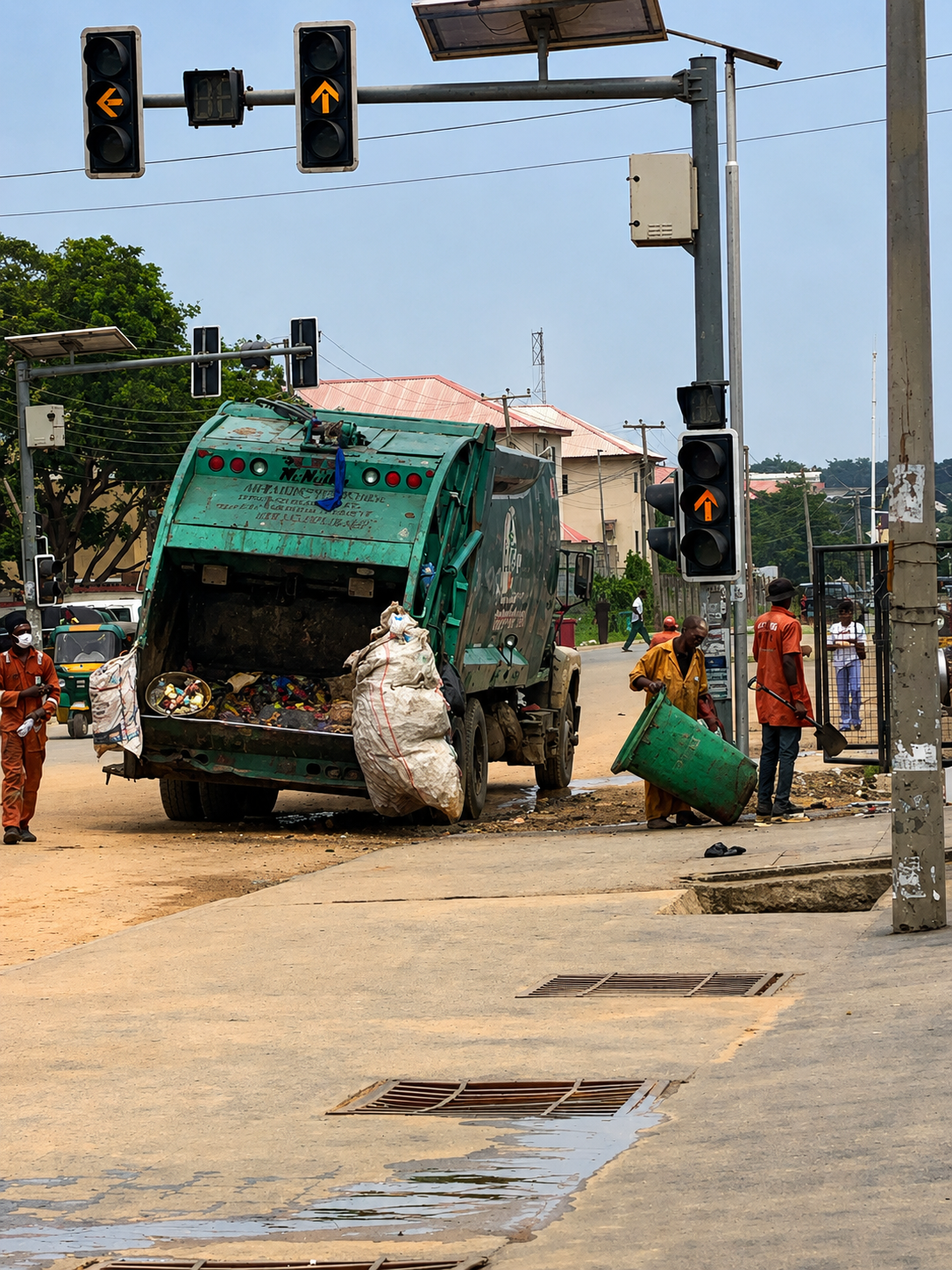
Waste disposal worker Hassan shares his experience of occupational health risks and healthcare challenges during an interview in Gwarinpa, Abuja. (Photo credit Oluwatobi Adu/ AHR).
ABUJA, Nigeria – Before dawn breaks across Abuja, thousands of environmental workers are already on the streets clearing refuse, sweeping roads and helping prevent disease outbreaks. Yet while they protect public health, many face daily exposure to injuries, infections and respiratory illnesses, often without adequate healthcare coverage beyond workplace accidents. In this report, Oluwatobi Adu investigates the hidden health risks confronting Nigeria’s environmental workforce, the gaps in healthcare protection, and why experts warn that neglecting these frontline workers could threaten both livelihoods and public health.
The Forgotten Frontline of Public Health
Public health is often associated with doctors, nurses and hospitals. Yet environmental health workers operate at an equally important frontline, tackling the root causes of disease before patients ever reach a clinic.
According to the Environmental Health Council of Nigeria (EHCON), environmental health officers are effectively the “general practitioners of public health”, working directly with the environmental factors that influence disease transmission and community wellbeing.
The Council notes:
“Environmental health officers today may be regarded as the general practitioners of public health since they are in daily contact with the source of ill health in the community, but their training, qualification and job evaluation put them at par with any other professional group with specific responsibility on environmental health control.”
The Council further stresses that more than 70 per cent of health challenges in Nigeria are environment-related, making environmental health workers indispensable to disease prevention and health promotion efforts.
The importance of their role is reinforced globally. The World Health Organization states that good health depends on clean air, safe water, proper sanitation, healthy workplaces, sound chemical management and a stable environment. WHO estimates that nearly a quarter of the global disease burden could be prevented through healthier environments.
Despite this critical contribution, environmental workers often remain among the least visible and least protected groups within the healthcare ecosystem.
Working in Harm’s Way
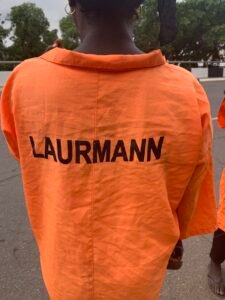
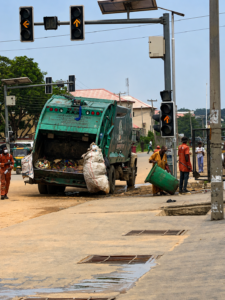
On Independence Avenue in Abuja, environmental workers employed by Laurmann Environmental Services begin their daily routine before traffic builds and temperatures rise.
Their work may appear routine to passers-by, but workers say every shift carries risks.
Victoria Nathaniel has spent a decade carrying out environmental sanitation duties.
While she acknowledges that support exists for workplace injuries, she says the nature of the job exposes workers to constant danger.
“They take care of any injured people, a colleague was once involved in an accident, and the company took care of it.”
Her testimony reflects a common arrangement across many organisations: workplace accidents are covered, but protection often ends there.
Another worker, Khanathu, who recently joined the organisation, expressed satisfaction with the working conditions and pride in the role environmental workers play.
“They pay us well; we are happy cleaning our environment.”
Yet beneath this optimism lies a broader concern about long-term healthcare protection for workers whose daily duties expose them to health hazards.
The Risks Hidden in Every Bag of Waste
For waste handlers and street sweepers, danger is often invisible.
A torn refuse bag may contain broken glass, used syringes, rusted metal or contaminated materials. Exposure to dust, fumes and biological waste can also increase vulnerability to respiratory diseases and infections.
Hassan, a waste disposal worker in Gwarinpa, described the realities many environmental workers encounter every day.
“Sometimes while handling waste, we get cuts from sharp objects hidden inside the refuse. There are also times when the smell and dust affect us, causing cough, catarrh and body pains. I have had to seek treatment after experiencing some of these health problems.”
His experience highlights the occupational hazards embedded within routine sanitation work.
However, the challenge extends beyond workplace exposure.
Hassan says workers frequently struggle to pay for treatment when illnesses occur outside official work-related incidents.
“If I fall sick outside work, I have to take care of myself. The company only assists when the incident is work-related. Any other sickness means I have to find money for treatment on my own.”
The consequences can be severe.
Like many low-income workers, he sometimes postpones treatment due to financial constraints.
“There have been times when I managed the sickness at home first because I did not have enough money to go to the hospital immediately. I only went when the condition became worse.”
The burden often extends to entire households.
“When sickness comes, the money meant for feeding, school expenses and other family needs is sometimes used for treatment. It puts pressure on the family, especially when the illness lasts for several days.”
Employer Support Ends at the Worksite
A supervisor working with the Abuja Environmental Protection Board (AEPB) confirmed that workers injured during official duties receive support from employers.
“If there is any injury or accident during work our company covers it, as long as you’re still wearing their uniforms. Any injury sustained during work hours is expected to be reported by the supervisor to the organisation to cover the expenses.”
However, he acknowledged a significant limitation.
“The company does not cater for outside work injuries or sickness.”
This distinction creates a healthcare protection gap affecting thousands of workers nationwide.
While compensation mechanisms may exist for workplace accidents, illnesses unrelated to work often become the responsibility of workers themselves, regardless of income level.
Experts Warn of Long-Term Consequences
Public health experts argue that this protection gap creates both health and economic risks.
Dr Agboola, a public health specialist, says environmental workers face multiple occupational threats.
“Environmental workers such as waste collectors and street sweepers are exposed to biological waste, sharp objects, toxic substances, and polluted air. This increases their risk of infections, injuries, respiratory diseases, and skin conditions.”
According to him, inadequate healthcare coverage often results in delayed medical intervention.
“Without health insurance, many workers delay seeking care because of cost. This often leads to late diagnosis, worsening conditions, higher treatment costs, and increased financial burden on individuals and families.”
The impact extends beyond individual workers.
Untreated illnesses can reduce productivity, increase absenteeism, deepen poverty and place additional pressure on already stretched healthcare systems.
Dr Agboola believes expanding insurance coverage for informal and low-income workers is essential.
He advocates stronger awareness campaigns, broader NHIA enrolment and greater employer responsibility in protecting environmental workers.
NHIA: Healthcare Coverage Should Not End With the Uniform
The National Health Insurance Authority (NHIA) argues that employers must do more.
In an exclusive interview with Africa Health Report, the Coordinator of NHIA’s FCT Office, Ebiokobo Williams, explained that workplace injuries are covered through the Workmen Compensation Act.
“If the staff now has some kind of injury in the course of work, all right, that’s what you call the Workmen Compensation Act, all right, that will cover for all that.”
However, he emphasised that workplace protection alone is insufficient.
“But it is also expected that they should have health insurance outside, you know, hazards on the job and all the rest. Because health insurance is beyond just, you know, maybe there’s an injury or an accident and all that, it’s beyond that.”
Williams stressed that environmental workers remain vulnerable to illnesses outside work and should therefore have comprehensive health insurance coverage.
“The chance of also falling sick even outside the job is also there so it’s best that these organisations of course buy insurance for their staff whether they are on site or not.”
According to him, the NHIA Act 2022 makes health insurance mandatory for all Nigerians.
“By virtue of our NHIA Act of 2022, health insurance is now mandatory for everyone in Nigeria.”
A Little-Known Lifeline
One solution already exists but remains underutilised.
Williams pointed to the Group Individual and Family Social Health Insurance Programme (GIFSHIP), designed for self-employed individuals, private organisations and workers outside government employment.
“Then we have another program which is called the Group Individual and Family Social Insurance Program, GIFSHIP for short.”
He explained that the annual premium currently stands at ₦38,718.
“The premium for any of these is thirty-eight thousand, seven hundred eighteen naira per annum.”
Under the scheme, beneficiaries receive access to primary, secondary and tertiary healthcare services similar to those available to government employees.
Williams believes environmental service companies should enrol their workers under the programme.
“We expect them to buy this GIFSHIP package for their workers.”
He criticised arrangements that restrict healthcare protection solely to work hours.
“So, the companies say it’s only when they wear their uniform that they are covered. It’s wrong.”
Importantly, workers can also register independently. “Yes, they can, they can on their own.”
Williams argues that health insurance serves as a financial safeguard against catastrophic healthcare costs.
“One ailment can wipe everything out, without any insurance, one ailment can wipe everything out, so it’s better to buy, have it there.”
Protecting Those Who Protect Public Health
The findings of this investigation reveal a troubling contradiction.
Environmental workers are among Nigeria’s most important public health defenders, yet many remain vulnerable to the very health and financial risks they help prevent for others.
While employer support often exists for workplace accidents, healthcare protection frequently ends where the workday does.
Experts warn that this model is unsustainable.
Comprehensive health insurance coverage, stronger enforcement of the NHIA Act, greater employer accountability and increased awareness of programmes such as GIFSHIP could significantly improve healthcare access for thousands of environmental workers.
Ultimately, protecting environmental workers is not simply a labour issue or a welfare concern.
It is a public health imperative.
The men and women who keep Nigeria’s streets clean, manage waste, and prevent environmental hazards form a crucial shield against disease. Ensuring they have access to healthcare when they need it is essential for building healthier communities and a stronger health system.
For a workforce that spends every day protecting public health, protection should not end with the uniform.
About the Author

 Mirian Gom
 Korede Abdullah