“I Was Evicted Over a ₦40,000 Tax”: Inside Abuja’s Bitter Landlord-Tenant War
 Oluwatobi Adu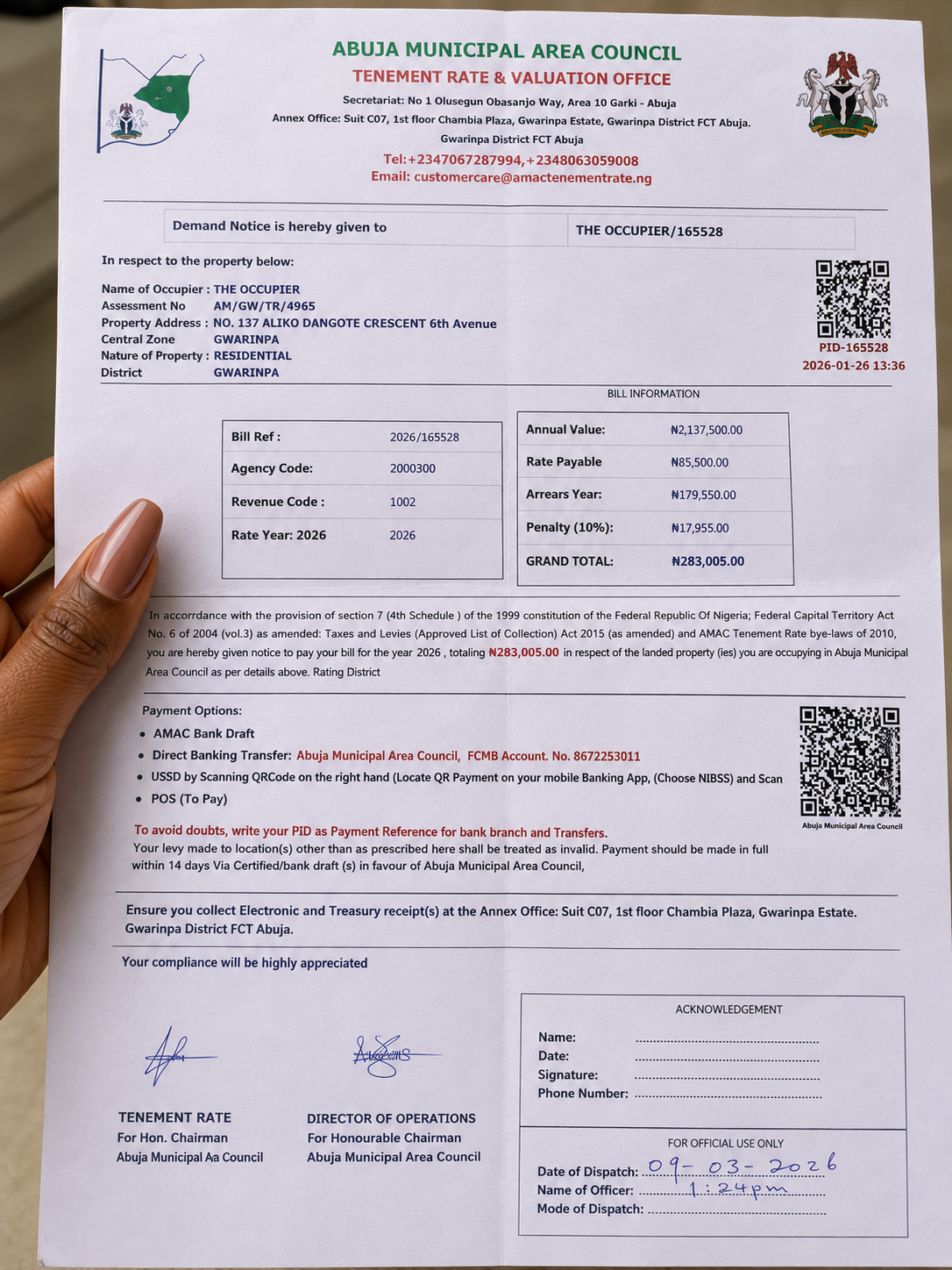
Simbiat Usman displays the Abuja Municipal Area Council (AMAC) tenement rate demand notice issued to her property in Abuja. (Photo: Mirian/AHR)
ABUJA, Nigeria- thousands of Abuja residents, finding a home is only the beginning of an expensive journey. Beyond soaring annual rents come agency fees, legal charges, inspection costs, caution deposits, service and security levies, maintenance bills—and, increasingly, the contentious annual tenement rate demanded by the Abuja Municipal Area Council (AMAC). Intended to fund local infrastructure, the levy has instead ignited a bitter and long-running dispute between landlords and tenants, each insisting the other should bear the cost. In this report, Oluwatobi Adu investigates the legal grey areas, speaks to tenants facing eviction over the tax, examines the positions of property managers, AMAC officials and legal experts, and asks the question at the centre of Abuja’s growing housing controversy: Who is really responsible for paying the tenement rate?
Finding accommodation in Abuja has become one of the biggest financial burdens for residents.
Before collecting the keys to an apartment, prospective tenants often pay annual rent running into millions of naira alongside agency fees, legal fees, inspection charges and caution deposits. After moving in, many face additional costs, including estate maintenance, refuse disposal, security levies and repairs that landlords frequently decline to undertake.
For many, the annual AMAC tenement rate has become yet another unexpected bill.
Although demand notices are commonly addressed to the occupier of a property, many tenants insist the tax should be borne by landlords because they own the buildings and already receive substantial rental income. Property owners, on the other hand, argue that since the notices are issued to occupants, tenants should settle the levy.
The disagreement has sparked countless disputes across the Federal Capital Territory, with some ending in threats of eviction and lengthy disagreements.
“I Was Given Two Weeks to Vacate”
For 27-year-old Kadijat Muhammed, who lived at Gold City Estate along Airport Road, the dispute over tenement rates ultimately cost her her home.
She told Africa Health Report that after refusing to pay a ₦40,000 tenement rate demanded by her landlady in 2023, she received a quit notice.
“My experience was very bad because we the tenants were literally paying everything for the landlady, be it washing of the head tank, repairs of the gate or padlocks, maintenance, security we were paying times two of whatever amount the estate will say each house should pay.”
Despite living in a one-room self-contained apartment, she said she contributed more towards estate expenses than the landlady, who occupied a three-bedroom apartment within the same premises.
“I fixed the metre, painted my apartment, and when my roof was leaking, she refused to repair it, so I fixed it myself.”
Her ordeal did not end there.
“Afterwards she sent me a message that I was to pay a tenement rate fee of ₦40,000 and when I confirmed it from a property lawyer, he told me the tax is not for tenants but the landowners. When I told her, she gave me two weeks to look for another house and leave.”
Kadijat’s experience illustrates how disagreements over a relatively small tax can quickly escalate into housing insecurity.
“I Spent More Than My Annual Rent Repairing the House”
For 32-year-old Simbiat Usman, the issue goes beyond taxation.
Speaking bitterly to the Africa Health Report, she described moving into a property in Gwarinpa under promises that major defects would be repaired before occupation.
Instead, she said the responsibility fell entirely on the tenants.
“When we collected this apartment, we were told they were going to fix all the things we identified that were bad in the facility but to my surprise after payment the administration officer of the property told me his madam said no dime should be used to repair anything. If we don’t like it, we should wait for others to take the apartment while our money is refunded.”
Unable to find another property, the tenants stayed and carried out the repairs themselves.
“We had no choice but to repair the dilapidated house, starting from plumbing works, creating a kitchen which was not there, fixing leakages, repairing broken sewage, painting and everything needed to make the place livable.”
She estimates she spent more than her annual rent making the property habitable.
Then came another surprise.
“Immediately the landlady increased our rent from ₦1.6 million to ₦2.5 million and told us to pay for the tenement rate because it doesn’t concern her.”
Although she reluctantly paid the levy last year, she has refused to do so again.
“I am not paying for this year because I already pay heavily for rent and I maintain the facility by myself. But she said I will not pack out of the compound until we pay the fee.”
Stories like Kadijat’s and Simbiat’s are becoming increasingly common across Abuja, where soaring housing costs are reshaping the relationship between landlords and tenants.
Residents Remain Confused
Mr. Samuel, a resident of Gwarinpa 2nd Avenue, admitted he was uncertain about who should pay the levy.
“I have heard of the tenant rate multiple times, but I am not in charge of paying that, we mostly pay through the caretaker in my house.”
Regarding his business premises, he added:
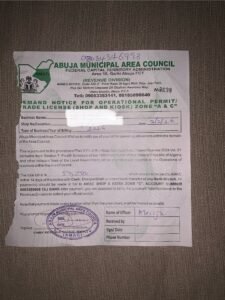
“The one brought to my shop complex is not meant to be paid by us, it is meant to be paid by the landlord of the complex.”
Another resident, Mrs. Chinyere, expressed similar uncertainty.
“I have heard of it multiple times, but I have not been issued one myself at my house. The only one I know about is my shop. I believe the landlord should be in charge because it is a complex and not a roadside kiosk.”
Their comments reflect widespread confusion among Abuja residents over the true legal obligation.
Property Managers Say the Occupier Should Pay
The General Manager of Ajolo’s Property Company Limited, Rasak Adeyemi Alimi, disagrees with many tenants.
“Check the meaning. Tenement means the occupier, and the occupier is the tenant that’s supposed to pay it, not the landlord.”
He argued that those enjoying public services funded through the tax should bear the responsibility.
“People enjoying environmental services are the ones expected to pay for them. The landlord is not the one occupying the place.”
Alimi, however, urged both parties to understand their rights.
“Everybody should know his or her rights. The landlord should know his rights and the tenant should also know their rights.”
He added: “The landlord should collect only rent. Any landlord that collects tenement rate from a tenant is wrong. The tenant is supposed to pay it directly to AMAC.
AMAC Defends Its Practice
Esuu Samuel of AMAC’s Department of Works, Housing and Lands said the council issues demand notices to occupiers.
“The occupiers are the ones that are to pay the tenement rate. If it is the landlord that is occupying that space, he will be the one to pay.”
“The landlord pays the ground rent for that property. Ground rent is attached to the right of ownership and the Certificate of Ownership.”
Lawyers Offer a Different Interpretation
Barrister Rukayat Mustapha, Chief Executive Officer of R.I Mustapha & Associates, said the issue is more legally complex.
“Under the law, the tenement rate is meant to be paid by the landowner or property owner. It is not the tenant.”
She explained that tenancy agreements can legally transfer the obligation to tenants only where expressly stated.
“If it is expressly stated in the tenancy agreement that the tenant will pay the tenement rate and the tenant signs it, then the tenant is bound by that agreement. But if it is not in the tenancy agreement, the landlord has to pay.”
She added: “There has been a lot of debate over the years. Honestly, in Abuja, it is the landlord or the property owner that pays unless there is an agreement.”
A Tax That Has Outgrown Its Purpose?
What emerges from this investigation is not simply a disagreement over taxation but a reflection of Abuja’s worsening housing affordability crisis.
Many tenants say they are paying rising rents while simultaneously funding repairs, maintenance and estate services that traditionally fall within landlords’ responsibilities. Landlords, meanwhile, argue that increasing operational costs and local government levies must be shared by occupants.
The result is a legal grey area where administrative practice, contractual agreements and differing interpretations of the law collide.
Without clear public guidance, many residents continue to rely on hearsay rather than authoritative information.
The Verdict Abuja Needs
The controversy surrounding AMAC’s tenement rate is no longer just about who pays an annual tax. It has become a symbol of the growing strain within Abuja’s housing market, where tenants increasingly feel overwhelmed by hidden costs while landlords insist they are merely complying with existing regulations.
The solution lies not in leaving both sides to interpret the law differently, but in decisive action.
AMAC must publish clear, accessible guidelines explaining who bears legal responsibility for the levy, establish an effective dispute resolution mechanism and embark on sustained public awareness campaigns. Equally, tenancy agreements should explicitly state who is responsible for the payment before a tenant signs.
Until that happens, demand notices will continue to arrive with confusion instead of certainty, and a tax intended to fund community development will keep driving conflict behind the doors of homes and businesses across Nigeria’s capital.
About the Author


 Mirian Gom