
 Oluwafunbi Bello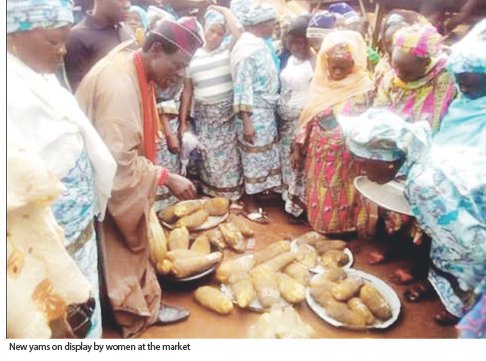
New Yam on display by women at the market
KWARA, Nigeria- The talking drums still echoed through Oja Obada as dancers celebrated, hunters fired ceremonial gunshots into the air and traders displayed freshly harvested yams. On the surface, Kwara State’s annual New Yam Festival appeared to have survived another year. But beyond the colour and celebration lay a quieter story of abandoned farmlands, frightened farmers and shrinking harvests. Insecurity has not stopped the festival—but it is steadily eroding the farming tradition that gives it meaning. In this report, Oluwafunbi Bello travels to farming communities in Oke Ero Local Government Area to reveal how bandit violence is threatening livelihoods, driving up food prices and putting one of the region’s oldest cultural celebrations at risk.
A Festival Built on Harvest
For generations, the last market day of June has carried special significance in Odo-Owa and Iloffa.
Separated only by a boundary, the two communities have traditionally converged at Oja Obada, a bustling market that transforms into the centrepiece of the annual New Yam Festival.
The celebration is more than a cultural event.
It is a thanksgiving for successful harvests, an opportunity for farmers to sell fresh produce, traders to buy yams in bulk and families to stock their homes before prices rise later in the year.
Until recently, buyers could purchase as many as eight medium-sized yam tubers for about ₦4,000, making the festival one of the cheapest periods to buy the staple crop.
Motorcycles, wheelbarrows and cars left the market piled high with yams as visitors celebrated another successful farming season.
This year was different.
When Fear Replaces Celebration
While drums still beat and dancers entertained the crowds, anxiety overshadowed the festivities.
For the first time in years, Odo-Owa and Iloffa celebrated separately after disagreements over the festival date, ending a long-standing tradition of a joint celebration at Oja Obada.
But residents say an even deeper crisis lies beyond the split.
Many farmers can no longer cultivate their land freely because of persistent attacks by armed bandits.
Large stretches of fertile farmland now remain uncultivated as farmers avoid venturing deep into the bush.
Those who still farm often leave at dawn and rush home before midday.
Remaining on the farm beyond 11 a.m., they say, could cost them their lives.
The result is visible in the market itself.
Fewer yams.
Higher prices.
Smaller harvests.
“We Harvested Less, But We Thank God We Are Alive”
Chief Agbana of Iloffa, Chief Oladapo Joseph, said insecurity has transformed farming into a dangerous occupation.
“We thank God we could still have some harvest this year, but it is nothing compared to what we had last year.”
He credited local hunters for helping farmers access parts of their land.
“Our farmers were only able to cultivate because hunters in the town secured some of the farming areas. Even with that, not all the farms are safe.”
Despite the hardship, he said the community chose to celebrate.
“The festival must still hold because, despite everything, we did not lose any of our people. The town remains safe because our hunters and youths are vigilant.”
A Farmer’s Harvest Shrinks—So Does His Family’s Future
For Raphael Fakayode, farming is not simply an occupation.
It feeds his family of six and pays his children’s school fees.
Standing beside the little produce he managed to harvest, he described how insecurity has steadily dismantled his livelihood.
“Not being able to farm when it is my means of feeding my family of six and sending my children to school is heartbreaking.”
His wife sells farm produce.
Now there is barely enough to sell.
“Buying produce has become much more expensive because of the risks farmers face and because the country’s economy has made everything costlier.”
For households like his, insecurity has become both a security crisis and an economic one.
When Traders Can No Longer Buy
The impact extends well beyond the farms.
Produce trader Christianah Afolayan has relied on the New Yam Festival for years to buy large quantities of yam that she resells during the final months of the year.
This year, her business plans collapsed.
“This festival is usually when yam is cheapest.”
Instead, she found rising prices and shrinking supplies.
“I couldn’t buy the quantity I usually buy because many people were competing for the little available, and the money I brought could no longer buy what it used to.”
Her experience mirrors that of many traders whose reduced purchases today could mean tighter food supplies and higher prices months from now.
The Ghost Town That Fed a Region
Several kilometres away lies Idofin-Aiyekale.
Once famous for its rice and beans, the community attracted buyers from across Kwara because of its modern rice processing facility.
Today, many residents have fled following repeated attacks by armed groups.
The roads that once bustled with commercial activity now lie largely deserted.
For nurse Sarah Olaoye, the loss is personal.
“I miss going to that factory because rice and beans were really affordable there.”
She now pays significantly more for food.
“Nobody wants to go near the town.”
When Farmers Become Refugees
The insecurity has also spread into neighbouring Ifelodun Local Government Area.
In Oro-Ago, farmer Femi Bamigbola said fear has emptied the town.
“Everybody has relocated to either Omu-Aran or other towns. Even the king relocated to Ilorin.”
His own decision to leave followed a brutal attack on his son.
“My second son, Ayobami Isaac, was attacked while working on the farm. He was cut on the leg with a cutlass. God saved him.”
Today, Bamigbola survives by working on other people’s farms.
“Farming is my only source of income.”

When Insecurity Fuels Food Inflation
Every abandoned farm means fewer crops reaching the market.
Every displaced farmer reduces local food production.
Every shrinking harvest push prices higher.
Communities such as Odo-Owa, Iloffa and Idofin-Aiyekale have depended on agriculture for generations.
But as insecurity spreads, farming is becoming increasingly risky, weakening rural economies while worsening Nigeria’s food inflation.
What begins as violence in remote communities eventually reaches dining tables hundreds of kilometres away.
Saving Farms Means Saving Food Security
Residents insist that emergency food interventions alone cannot solve the crisis.
What farmers need most is the confidence that they can cultivate their land without fear of being attacked, kidnapped or killed.
Protecting farming communities, strengthening local security, supporting rural livelihoods and restoring access to farmland will be critical not only to preserving cultural traditions such as the New Yam Festival but also to safeguarding Nigeria’s food supply.
Because when fear replaces farming, hunger is never far behind.
The drums may still beat each June, and dancers may still celebrate beneath colourful canopies, but unless peace returns to Kwara’s farmlands, future generations may inherit only the memory of harvests their parents once enjoyed.
About the Author


 Mirian Gom
 Korede Abdullah

 Oluwatobi Adu