 Mirian Gom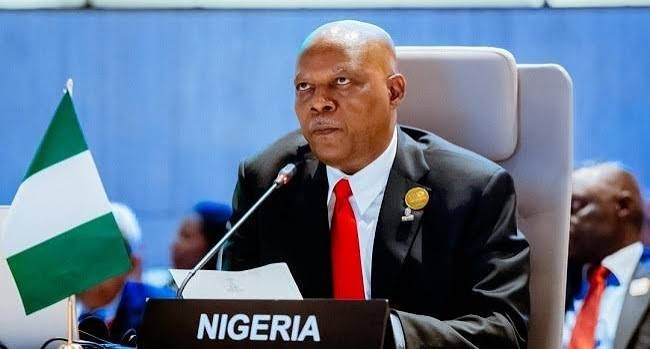
Nigeria Vice President, Kashim Shettima speaks at the Africa Minerals Strategy Group roundtable in New York
ABUJA, Nigeria – Vice President Kashim Shettima has urged African countries to move beyond exporting raw minerals and increase local processing, manufacturing and value addition to ensure mineral wealth generates broader economic benefits.
Shettima made the call while representing President Bola Tinubu at the Third Africa Minerals Strategy Group (AMSG) High-Level Roundtable in New York.
He said Africa could not consider itself wealthy while communities located around major mineral deposits remained poor.
The Vice President called for greater continental coordination, warning against African countries competing for mining investment by offering lower royalties, weaker local-content requirements and excessive concessions. Instead, he advocated integrated markets, regional processing hubs and cross-border mineral corridors to give African countries greater scale and strengthen their position in global mineral supply chains.
Shettima highlighted Nigeria’s mining reforms, including efforts to improve geological information, formalise artisanal mining, increase local value addition and tackle illegal mining.
The Vice President backed the AMSG’s Mutual Assured Development (MADE) Framework, which calls for predictable government policies and credible institutions alongside responsible investment, technology transfer and local value creation.
He also urged African countries to move the Continental Integration and Economic Assurance Declaration beyond its signing into an implementation programme with clear timelines, financing and accountability.
Shettima said the success of Africa’s mineral strategy should ultimately be reflected in infrastructure, factories, competitive African businesses, skilled employment and improved conditions in mining communities.
Minister of Solid Minerals Development and AMSG Chairman, Dele Alake, proposed an African Artisanal Mining Formalisation and Safety Facility. Alake said the proposed mechanism could help African countries formalise artisanal mining through cooperative formation and licensing, geological support, safer equipment, occupational health and safety training, environmental rehabilitation and emergency preparedness.
He cited recent mine-site deaths in the Democratic Republic of Congo, the Central African Republic and Sudan as evidence of the safety risks facing informal mining operations.
Representatives of the United States Government also attended, with US State Department Special Adviser for the Bureau of African Affairs Chris Kulukundis expressing readiness to work with African countries on mineral development.
About the Author


 Hope Ajayi
 Korede Abdullah
 Oluwatobi Adu