
Breathing the Butcher’s Air: Inside Karu’s Growing Battle Between Survival, Stench and Public Health
 Otamere Gladness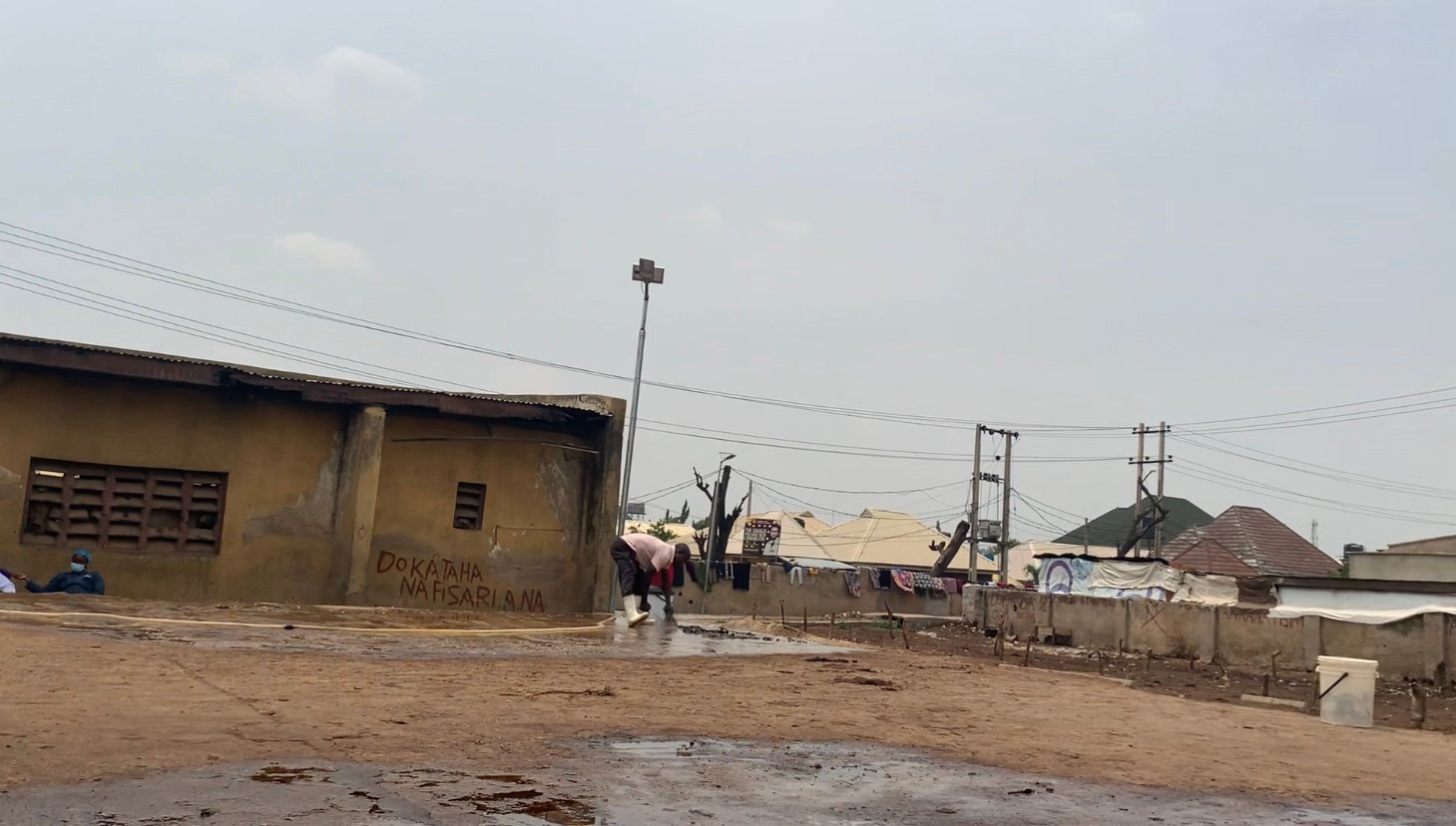
Cleaning activities continue at the Karu abattoir amid concerns over sanitation and environmental safety
KARU, Nigeria – At dawn in Karu, on the outskirts of Nigeria’s capital, the neighbourhood wakes not to birdsong or the bustle of school runs, but to the heavy smell of blood, smoke and animal waste drifting through narrow streets lined with homes and roadside shops. Children walk past heaps of animal remnants on their way to school. Traders’ open stalls beside drainage channels carrying wastewater from slaughter slabs. For years, residents have lived shoulder-to-shoulder with the Karu urban abattoir — a facility originally built outside residential settlements but now swallowed by unchecked urban expansion. In this report, Otamere Gladness, reports that What was once considered a functional public utility has become the centre of a growing public health concern, exposing the collision between poor urban planning, weak environmental enforcement and the daily struggle for survival in Nigeria’s rapidly expanding cities.
Where Homes and Slaughterhouses Collide
A standard abattoir, by global public health standards, is expected to operate as a controlled and isolated facility equipped with proper sewage systems, waste recycling mechanisms, cold storage units and pollution control infrastructure. Such facilities are typically located far from densely populated residential areas to reduce the risks of contamination, airborne diseases and environmental pollution.
But in Karu, reality tells a different story.
The abattoir now sits at the heart of a crowded neighbourhood where homes, kiosks and businesses have emerged around it over the years. The result is an uneasy coexistence between residents and slaughterhouse operators, with many inhabitants complaining that they are forced to inhale polluted air and live amid poor sanitary conditions.
For residents, the concern is not merely about unpleasant smells. It is about what prolonged exposure could mean for their health, environment and quality of life.
“This Place Was Originally Meant for the Abattoir”
Dr Yusuf, manager of the Karu abattoir, insists the facility is not the intruder many residents portray it to be.
According to him, the abattoir existed long before most of the surrounding residential buildings appeared.
“Ideally, an abattoir is set out of residential areas, far from the people,” he explained.
“This place was originally meant for the abattoir, but people started coming here to build houses. Most of the buildings here are illegal. Now they want the abattoir to be moved from a place that was meant for them.”
His argument reflects a recurring urban development crisis across Nigeria, where poor enforcement of zoning regulations allows residential settlements to spring up around industrial and public utility sites.
Yet for many residents now living in Karu, legality matters less than daily survival.
Living With the Smell
Around the community, opinions differ on the extent of the environmental problem.
Some residents describe the atmosphere as unbearable, especially during peak slaughter periods when smoke and odours intensify.
They worry about contaminated water sources, blocked drainage systems and exposure to diseases linked to poor waste disposal practices.
Environmental health experts have long warned that poorly managed abattoirs can expose nearby communities to harmful bacteria, airborne pollutants and contaminated runoff capable of spreading infections and polluting groundwater.
But not everyone shares the same level of concern.
Mrs Faith, a trader and resident living close to the facility, said she has learned to adapt to the environment.
“Shey I’m close to the place?” she said.
“It was that smoke that was disturbing which they have stopped. Outside that, nothing else. I don’t have any problem with the abattoir being here.”
Her response reveals another layer of the issue: in many low-income urban communities, environmental discomfort often becomes normalised when livelihoods depend on proximity to commercial activity.
The Smoke That Choked a community
For years, one of the most controversial practices at the abattoir involved the use of burning tyres to roast animal skin — a method commonly employed in several slaughterhouses across Nigeria because it provides quick and intense heat.
Residents say the thick black smoke regularly covered nearby homes and markets, leaving many coughing and struggling to breathe.
Medical experts have repeatedly linked tyre combustion to the release of toxic chemicals capable of causing respiratory illnesses, chest complications and long-term health problems.
Dr Yusuf acknowledged the dangers and said authorities eventually intervened.
“The only issue the residents were complaining about was the smoke from the tyres that the slaughterers were using because they needed quick flame to roast the animals, but it was stopped because of its dangers to residents and it has reduced air pollution for them,” he said.
“Even the slaughtermen have also come to thank them that since they stopped using tyres their system has been fine; they no longer experience chest pains.”
The decision to stop tyre burning marked a significant shift for the community, but many residents insist the environmental concerns extend beyond smoke alone.
Wastewater disposal, drainage contamination and inadequate sanitation remain unresolved worries.
The Bigger Crisis Beneath the Surface
What is happening in Karu reflects a deeper national problem.
Across Nigeria, rapid urban growth is reshaping cities faster than infrastructure and regulation can keep pace. Facilities once deliberately placed outside urban settlements are now trapped within expanding residential zones.
From dumpsites to factories and abattoirs, communities are increasingly forced into dangerous proximity with industrial activities.
Urban development experts say the problem is worsened by weak enforcement, corruption in land administration and poor city planning.
In many cases, government agencies fail to enforce environmental compliance standards, while residents desperate for affordable housing settle wherever land is available.
The result is a dangerous overlap between residential life and environmental hazards.
For communities like Karu, this means residents may unknowingly face long-term exposure to pollution risks while authorities struggle to determine whether relocation, compensation or rehabilitation is the best solution.
Livelihood Versus Public Health
Beyond environmental concerns lies another difficult reality: the abattoir supports livelihoods.
Hundreds of butchers, meat vendors, transporters and food sellers depend on its daily operations for survival. Relocating the facility without providing viable alternatives could disrupt incomes and deepen economic hardship.
This tension between economic survival and public health protection complicates the debate.
Dr Yusuf admits the facility requires major upgrades but says financial limitations remain a major obstacle.
“But with limited resources needed we can barely do anything, which will also affect the effectiveness of delivering our work in ensuring health safety for residents,” he said.
His comments highlight the chronic underfunding affecting many public facilities across Nigeria, where operators are often left managing growing urban pressures with inadequate infrastructure.
A Community Waiting for Action
For residents, however, patience is wearing thin.
Many insist that relocation is the only sustainable solution. Others argue that if relocation is impossible, authorities must invest in modern waste treatment systems, drainage infrastructure and stricter environmental controls.
Public health advocates warn that delaying action could expose the community to larger outbreaks of disease and worsening environmental degradation in the future.
Yet despite the complaints, daily life around the abattoir continues almost uninterrupted.
Cattle arrive at dawn. Knives sharpen against concrete slabs. Water mixed with blood flows into drainage channels. Smoke rises into the morning air. Nearby, children play and traders bargain over vegetables and household goods.
Life in Karu moves on — even as residents continue breathing the butcher’s air.
About the Author


 Hope Ajayi

 Mirian Gom
 Korede Abdullah