
Oil Wars, Empty Wallets: How Distant Conflict is Rewriting the Cost of Living in Nigeria
 Oluwatobi Adu
ABUJA, Nigeria – On the streets of Abuja, the price of petrol is no longer just a number on a pump—it is a daily verdict on survival.
From the tense waters of the Strait of Hormuz to the bustling markets of Wuse and Banex, the geopolitical standoff between the United States- Israel and Iran is unfolding not only in diplomatic circles, but in the strained pockets of ordinary Nigerians. As crude oil prices surge past global expectations, the consequences are being felt thousands of kilometres away—where transport fares spike by the hour, food prices double overnight, and livelihoods hang in the balance.
In this deeply interconnected world, Nigeria’s paradox is stark: a leading oil producer that remains acutely vulnerable to global disruptions due to its dependence on imported refined fuel. In this report, Oluwatobi Adu traces the human cost of this imbalance—through the voices of traders, commuters, and experts—and exposes the systemic fragility that leaves millions at the mercy of distant wars.
When the Pump Becomes a Battlefield
At Wuse Park, beneath the hum of engines and the restless shuffle of commuters, Mr. Testimony—both trader and cab driver—describes a reality where fuel prices change faster than he can earn.

His words come in quick bursts, mirroring the volatility he faces daily.
“As of yesterday, in the morning we bought fuel at ₦1,018… before 12 it climbed to ₦1,125… in the afternoon it went to ₦1,250… and this morning it was about ₦1,350.”
For him, the arithmetic of survival no longer adds up.
“It’s affecting us seriously. When you work, finish, you pack all the money and go and buy fuel. You go home with nothing.”
Across Nigeria’s urban centres, petrol is not just an expense—it is the engine of economic life. When its price rises, everything else follows. Transporters hesitate to increase fares, fearing to lose passengers already stretched thin, yet absorbing the cost is equally unsustainable.
“Everybody’s feeling the heat. My passenger is feeling the heat. I myself am feeling the heat.”
Markets on Edge: The Domino Effect
At Banex Plaza, a hub of electronics and commerce, Mr. Isaiah sees the crisis through a broader, almost philosophical lens.

“You see this game called war… I see war as a business game, not fighting each other.”
His observation reflects a growing scepticism among Nigerians who feel disconnected from global conflicts yet deeply affected by their consequences.
“What concerns Nigeria with the U.S., Iran or Israel war? We have our own refinery. We can refine our own fuel here in Nigeria.”
Yet reality tells a different story. Goods transported from Lagos to Abuja now arrive with inflated costs embedded in every kilometre travelled.
“Once transportation increases in price, everything increases in price.”
Customers, he says, are caught in a quiet struggle.
“If they can afford it, they buy; if not, they go back.”
This silent retreat of consumers signals a deeper economic contraction—one where purchasing power erodes, and small businesses teeter on the edge.
The Commuter’s Burden
At a Nipco filling station, the impact is immediate and personal.
Mr. Maxwell Ukeme does not speak in abstractions. His reality is measured in meals.
“Not only transportation, generally… feeding, transportation and other sectors too. This thing is telling us negatively.”
He recounts a simple but telling shift:
“I used to eat food for ₦800 before, but this morning I ate ₦1,500, and that is not good on my pocket.”
For millions of Nigerians, inflation is no longer an economic term—it is a lived experience, one that reshapes daily decisions about food, movement, and survival.
“The government should do something about it… I don’t see any reason why they should increase the price of petroleum products for citizens.”
At the Pump: Acceptance Without Choice
For those on the frontlines of fuel distribution, the story is one of reluctant adaptation.
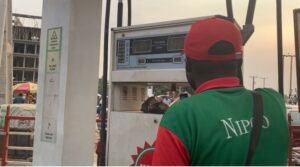
Mr. Matthew Sunday, a fuel attendant, observes the quiet resignation of customers.
“The customers are not complaining… for now they are keeping up with it because they don’t have any option.”
Prices continue to climb—diesel nearing ₦1,690 and petrol around ₦1,205—yet demand persists, driven by necessity rather than choice.
“Everybody is trying to bring down the price so that everything will work well for the country.”
A Fragile System: Expert Diagnosis
Public affairs analyst Dr Jide Ojo offers a sobering assessment of Nigeria’s vulnerability.
“Nigeria should ordinarily not have been negatively affected, but we are import dependent and we are not producing enough locally.”
Despite being an oil-rich nation, Nigeria imports a significant portion of its refined petroleum—exposing it to global shocks.
“Even the price of crude oil affects virtually everything… the price of foodstuff will increase, the price of transportation will increase, and other essential commodities will increase.”
He points to the Dangote Refinery as a critical buffer:
“We should thank our star that we even have a Dangote refinery because if we don’t have it, it would have been worse.”
Yet, he argues, more deliberate policy action is needed. Among his recommendations:
Stable crude supply to local refineries
Expansion of compressed natural gas (CNG) transport systems
Investment in rail networks such as Abuja–Kaduna, Itakpe–Warri, and Lagos–Ibadan
Reduced reliance on imports from global markets
“The way to protect us from shockwaves in the international market is to increase our production base so that we are self-sufficient.”
The Paradox of Plenty
Nigeria’s current reality presents a troubling contradiction. As global oil prices rise, government revenues may improve—but the benefits rarely trickle down fast enough to offset the immediate burden on citizens.
Instead, higher crude prices translate into more expensive refined fuel imports, amplifying inflation across sectors. The result is a cycle where the nation gains on paper but loses in practice—especially for its most vulnerable populations.
Breaking the Cycle: A Call for Reform
From Wuse to Banex, from fuel pumps to dining tables, a consistent message emerges: Nigerians are tired of being collateral damage in global conflicts.
The solutions, while complex, are not elusive:
Accelerate domestic refining capacity
Prioritise local supply chains
Expand affordable public transport
Implement targeted economic protections for citizens
Without these reforms, the country risks remaining trapped in a cycle where external shocks dictate internal realities.
Beyond Survival
In Nigeria today, the price of fuel is more than an economic indicator—it is a measure of national resilience.
As distant tensions continue to ripple across global markets, the question is no longer whether Nigeria will feel the impact, but how prepared it is to withstand it.
For Mr. Testimony, Mr. Isaiah, Mr. Ukeme, and millions like them, the stakes are immediate and deeply personal. Their stories are not just accounts of hardship—they are urgent calls for a system that works, a government that responds, and a future where survival is no longer dictated by events beyond their shores.
About the Author

 Mirian Gom
 Korede Abdullah
The wonderful thing about everything happening in our world today is that “we Nigerians must surely survive”