Nigeria Hired 37,000 Health Workers. Why Are Doctors, Nurses Still Leaving?
 Korede Abdullah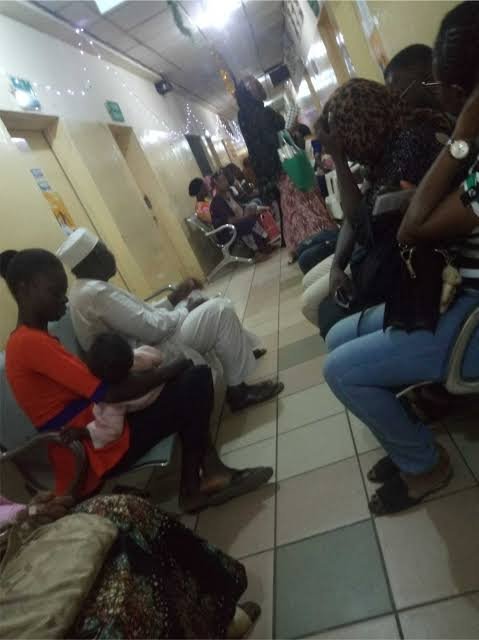
A crowded public hospital waiting area An image showing patients waiting in long queues at a government hospital visually illustrates the consequences of staff shortages.
LAGOS, Nigeria – Every day, Nigeria loses some of its most experienced doctors and nurses to hospitals overseas. Even as the federal government recruits thousands of new health workers, another wave is quietly packing its bags. Can recruitment ever outrun migration? In this report, Korede Abdullah examines whether the government’s hiring drive is enough to reverse the brain drain threatening the nation’s healthcare system.
A Welcome Recruitment Amid a Growing Crisis
The Federal Government says it has employed more than 37,000 health workers since 2023 in a bid to strengthen healthcare delivery and reduce the migration of skilled professionals.
According to the Coordinating Minister of Health and Social Welfare, Prof. Muhammad Pate, over 20,000 doctors, nurses, pharmacists, laboratory scientists and other healthcare professionals were recruited into 58 federal tertiary hospitals through special waivers approved by President Bola Tinubu. Nurses accounted for about 60 per cent of the new appointments.
Nigeria Still Faces a Severe Workforce Shortage
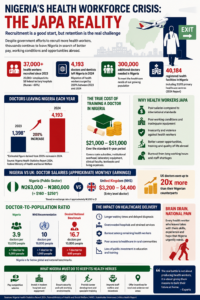
Despite the recent recruitment exercise, Nigeria remains one of the world’s most underserved countries in terms of healthcare personnel. The challenge is compounded by the accelerating exodus of skilled professionals. According to the Nigeria Health Statistics Report released by the Federal Ministry of Health and Social Welfare, 4,193 doctors and dentists left Nigeria in 2024 alone, while the migration of health workers across all professional cadres surged by 200 per cent between 2023 and 2024. The figures underscore the scale of the workforce crisis confronting the country’s health sector.
The country has an estimated 3.9 doctors for every 10,000 people, far below international recommendations. In practical terms, there is approximately one doctor for every 5,000 Nigerians, compared with the commonly cited benchmark of one doctor for about 600 patients.
The shortages are particularly acute in densely populated states. Lagos alone is estimated to require about 33,000 additional doctors, while health experts estimate Nigeria needs around 300,000 more doctors to adequately meet the needs of its growing population.
Against that backdrop, many stakeholders describe the recruitment of 37,000 health workers as an important beginning rather than a lasting solution.
The Salary Gap Fueling the ‘Japa’ Wave
For many healthcare professionals, the decision to leave Nigeria is driven by simple economics.
A newly employed doctor in Nigeria typically earns between ₦263,000 and ₦380,000 monthly. Following the depreciation of the naira, that is equivalent to roughly 160 to 250 US dollars.
The economic impact of the migration extends beyond workforce shortages. Training a medical doctor in Nigeria requires significant public and private investment. Estimates show that the true cost of producing a doctor range between 21,000 and 51,000 US dollars over the standard six-year medical programme, taking into account government subsidies, teaching hospitals, laboratory equipment, academic staff, textbooks and students’ living expenses. When newly qualified doctors emigrate soon after graduation, Nigeria effectively loses both critical human capital and a substantial investment in healthcare education.
In comparison, entry-level doctors in the United Kingdom can earn between 3,200 and 4,400 US dollars each month, while salaries in Canada, Saudi Arabia and the United States are often significantly higher.
The disparity has made migration increasingly attractive, particularly for young professionals seeking financial stability.
Health stakeholders note that some Nigerian doctors can earn abroad in less than two days what they currently receive in an entire month at home.
Hospitals That Struggle to Support Those Who Stay
Salary is only one part of the problem.
Across many public hospitals, health workers continue to contend with inadequate medical equipment, shortages of consumables and deteriorating infrastructure.
Essential supplies such as gloves, syringes and laboratory reagents are frequently unavailable. Advanced diagnostic equipment, including CT scanners, MRI machines and cancer treatment facilities, remains scarce in many institutions.
Some hospitals have reportedly performed emergency procedures using torchlights or mobile phone flashlights during power outages.
Meanwhile, chronic staff shortages have increased workloads, contributing to burnout among doctors and nurses. Insecurity, including kidnappings and assaults on health workers, has further weakened morale.
Laboratory Services Are Also Under Pressure
Medical Laboratory Scientist Femi Afolabi believes the government’s recruitment exercise is a positive step but says laboratory services remain critically understaffed.
“The recruitment is encouraging, but laboratory services still require many more professionals. Considering the number of hospitals and laboratories across the country, the recruitment only addresses a fraction of the existing shortage. There should be continuous recruitment to meet growing healthcare demands.”
According to him, many experienced laboratory scientists have already emigrated, leaving significant manpower gaps across public hospitals.
He said outdated equipment, shortages of reagents, unstable electricity and poorly maintained diagnostic machines continue to undermine laboratory services.
Delayed laboratory results, he warned, often slow diagnosis and treatment, particularly during medical emergencies.
Afolabi called for stronger investment in laboratory infrastructure, improved salaries, sustainable funding and greater recognition of laboratory medicine as a vital component of healthcare delivery.
Retention, Not Recruitment, Is the Bigger Challenge
Former Ekiti State Chairman of the National Association of Nigerian Nurses and Midwives, Ademola Alabi, believes retaining experienced professionals should become the government’s primary focus.
“Many of those being employed today may still leave tomorrow if the issues that push them out of Nigeria are not addressed.”
He said poor remuneration, inadequate equipment, staff shortages, insecurity and weak welfare continue to drive nurses abroad despite ongoing recruitment.
The consequence, he warned, is increased burnout among those who remain, longer waiting times for patients and a higher risk of medical errors.
Young medical doctor Dr Toyin Quadri expressed similar concerns.
“Recruitment is a good first step, but retention is the real challenge. The government must invest in health infrastructure, improve staff welfare and make healthcare a national priority.”
According to him, many young doctors continue to leave in search of specialist training opportunities, safer working environments, better remuneration and improved quality of life.
Rural Communities Bear the Greatest Burden
The effects of Nigeria’s healthcare brain drain are most visible in rural communities.
According to the Federal Ministry of Health and Social Welfare’s 2024 State of the Health of the Nation Report, Nigeria has 40,184 registered health facilities, including 31,815 primary healthcare centres.
Many of these facilities, however, operate with inadequate infrastructure, unreliable electricity and water supply, shortages of medicines, weak laboratory services and insufficient skilled personnel.
Unable to obtain quality care at the primary level, many patients bypass local health centres altogether, placing additional pressure on already overcrowded secondary and tertiary hospitals.
Building a Health System Worth Staying For
Every doctor, nurse or laboratory scientist who leaves Nigeria represents more than an empty position in a hospital. They take with them years of publicly supported education, clinical training and scarce expertise. With 4,193 doctors and dentists leaving the country in 2024 alone, and health worker migration rising by 200 per cent in just one year, the challenge has become as much an economic issue as a healthcare one.
But beyond the statistics are the patients left waiting in overcrowded clinics, the longer queues in hospitals and the communities struggling to access skilled care. Unless Nigeria makes staying as rewarding as leaving, recruitment drives will continue to refill vacancies only for them to reopen months later. The real battle is no longer about producing health workers—it is about giving them a reason to build their future at home.
About the Author


 Oluwatobi Adu
 Hope Ajayi
 Mirian Gom