 Mirian Gom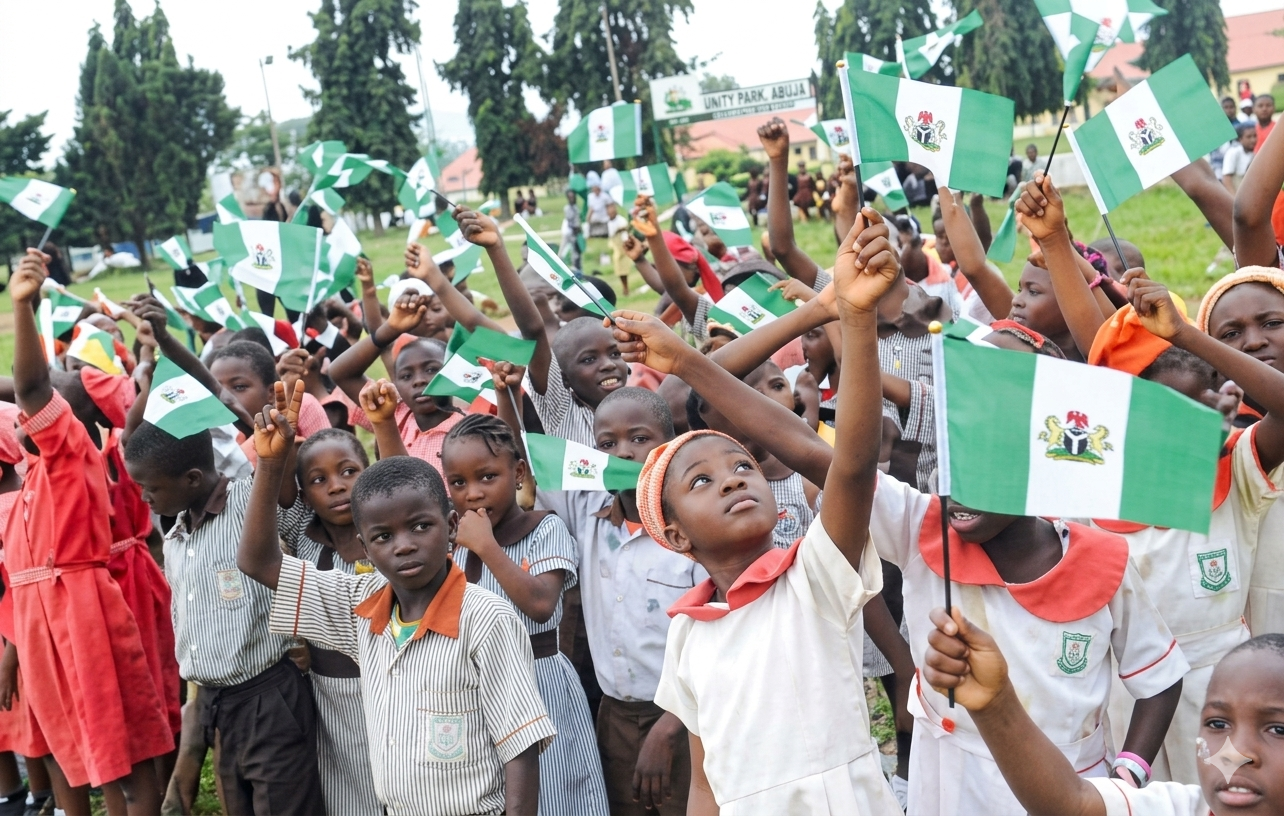
(By Otamere Gladness, Oluwatobi Adu, and Oluwafunbi Bello)
ABUJA, Nigeria – Every May 27, Nigeria celebrates Children’s Day with colourful parades, speeches, music, and festivities across schools and public institutions. Politicians make promises, pupils wear bright uniforms, and social media is filled with messages about the future of the nation.
Yet beyond the celebration lies a difficult truth — the state of Nigerian children remains deeply troubling.
For millions of children across the country, childhood is defined not by safety, learning, and opportunity, but by hunger, poverty, violence, poor healthcare, exploitation, and uncertainty about tomorrow.
As Nigeria marks Children’s Day 2026, the occasion must become more than a ceremonial event. It should serve as a national reflection on how the country is failing many of its youngest citizens and what urgent actions are needed to protect them.
The State of Nigerian Children Reflects a National Emergency
Recent UNICEF 2025 reports paint a disturbing picture of child welfare in Nigeria.
From education and healthcare to nutrition, child protection, and early marriage, millions of Nigerian children continue to face severe hardship despite government policies and international interventions.
The figures reveal not just isolated challenges, but a widening national crisis affecting the future of an entire generation.
Education Crisis: Millions Still Locked Out of Learning
Education remains one of the clearest indicators of inequality among Nigerian children.
According to UNICEF, about 10.2 million Nigerian children are currently out of school, placing Nigeria among the countries with the highest number of out-of-school children globally.
Even among children enrolled in school, learning outcomes remain poor. Only 27 percent of children between ages 7 and 14 possess basic reading skills, while just 25 percent have foundational numeracy skills.
The transition rate to upper secondary education also remains low. UNICEF reports that only 51 percent of adolescents move to upper secondary school on time, while just 38 per cent of rural children successfully make that transition.
The situation worsens at senior secondary level, where dropout rates peak at 27 per cent.
Behind these numbers are deeper social realities — poverty, insecurity, child labour, weak infrastructure, shortage of teachers, and economic hardship.
In many communities, children still study in overcrowded classrooms with poor facilities, while others are forced to abandon education entirely to support family income through street hawking and informal labour.
Government interventions such as the National Home-Grown School Feeding Programme have helped increase enrolment in some states. However, inflation and rising living costs continue to push vulnerable children away from classrooms and into survival labour.
Without urgent investment in quality education, Nigeria risks producing a generation trapped in poverty and limited opportunities.
Child Health and Nutrition: A Crisis of Survival
The healthcare situation facing Nigerian children remains equally alarming.
According to UNICEF, one in every nine Nigerian children dies before reaching the age of five. Nigeria also ranks first in Africa and second globally for the highest number of malnourished children.
Nearly two in five children under five years — about 40 percent — are stunted due to chronic malnutrition, while one in twelve children under five suffers from wasting, a severe form of undernutrition linked to increased risk of death.
The crisis is particularly severe in rural communities where access to healthcare services remains limited.
Only 34 percent of rural children aged 12 to 23 months are fully vaccinated, compared to 48 percent in urban areas, highlighting the deep inequality in healthcare access across the country.
Rising food prices, poverty, poor maternal healthcare, and weak healthcare infrastructure continue to worsen child nutrition and survival outcomes.
UNICEF further reports that about 17.4 million Nigerian children have lost one or both parents, including approximately 2.2 million orphaned by AIDS.
While vaccination campaigns, nutrition programmes, and primary healthcare interventions supported by government agencies, UNICEF, and other humanitarian organisations have helped improve healthcare access in some communities, the overall gaps remain enormous.
Mental and emotional wellbeing among children also receives little national attention despite growing trauma linked to insecurity, displacement, violence, and poverty.
Child Rights Violations Continue Despite Existing Laws
Nigeria has legal frameworks designed to protect children, including the Child Rights Act. However, implementation remains inconsistent and weak across several states.
Children continue to face abuse, exploitation, trafficking, neglect, and violence both within homes and in public spaces.
According to UNICEF data, 90 percent of Nigerian children under the age of five experience some form of violence, with girls facing greater vulnerability in many cases.
Additionally, Nigeria recorded 2,436 grave violations against children in 2024, placing the country among those with some of the highest rates of child-related violations globally.
Despite growing awareness campaigns by NGOs, civil society organisations, and government agencies, enforcement remains inadequate while many child abuse cases go unreported due to stigma, fear, and weak access to justice.
Protecting children requires more than legislation. It demands stronger institutions, community awareness, and consistent accountability for offenders.
Child Labour Continues to Rob Children of Their Future
Child labour remains one of the most visible signs of hardship in Nigeria.
Across cities, highways, markets, and rural communities, millions of children continue to engage in street hawking, domestic labour, farming, mining, and other hazardous activities.
UNICEF reports that 31 percent of Nigerian children between ages 5 and 17 are engaged in child labour.
For many struggling families, children have become contributors to household survival due to worsening poverty and unemployment.
The burden falls heaviest on vulnerable households. UNICEF data shows that 81 percent of children in the poorest homes are multidimensionally poor, compared to 30 percent among children from the richest households.
Child labour not only exposes children to exploitation and danger but also destroys educational opportunities and reinforces generational poverty.
Several NGOs and child welfare organisations continue advocating stronger social protection systems, economic support for low-income families, and policies aimed at reducing poverty-driven child labour.
Child Marriage Still Threatens Millions of Girls
Nigeria continues to lead Africa in child marriage, with more than 23 million girls married before adulthood.
According to UNICEF, two in five young women between ages 20 and 24 were married before the age of 18. In rural communities, child marriage affects one in every two girls — more than double the rate recorded in urban centres.
Poverty remains one of the strongest drivers of early marriage, as many struggling families see marriage as a survival strategy.
Traditional beliefs, gender inequality, and limited access to education also continue to sustain the practice.
UNICEF further reports that 79 percent of married girls between ages 15 and 17 are multidimensionally poor.
The consequences are devastating. Child marriage increases the risk of maternal mortality, school dropout, domestic violence, and long-term poverty among girls.
Although advocacy campaigns by government institutions, religious leaders, and humanitarian organisations have increased public awareness, implementation gaps and cultural resistance continue to slow progress.
Girls who should be building their future in classrooms are instead forced into adulthood far too early.
Beyond Celebration, Nigeria Must Protect Its Children
Children’s Day should not merely be a yearly celebration filled with speeches and entertainment while millions of children continue to suffer silently.
The future of Nigeria is already visible in overcrowded classrooms, underfunded hospitals, displaced communities, markets, and rural villages where children struggle daily against poverty and neglect.
Every child deserves access to quality education. Every child deserves healthcare and proper nutrition. Every child deserves protection from violence, exploitation, labour, and early marriage.
Children are not simply symbols of national hope; they are the foundation upon which Nigeria’s future depends.
Protecting them is not charity. It is a national responsibility.
About the Author


 Hope Ajayi
 Korede Abdullah