
 Mirian Gom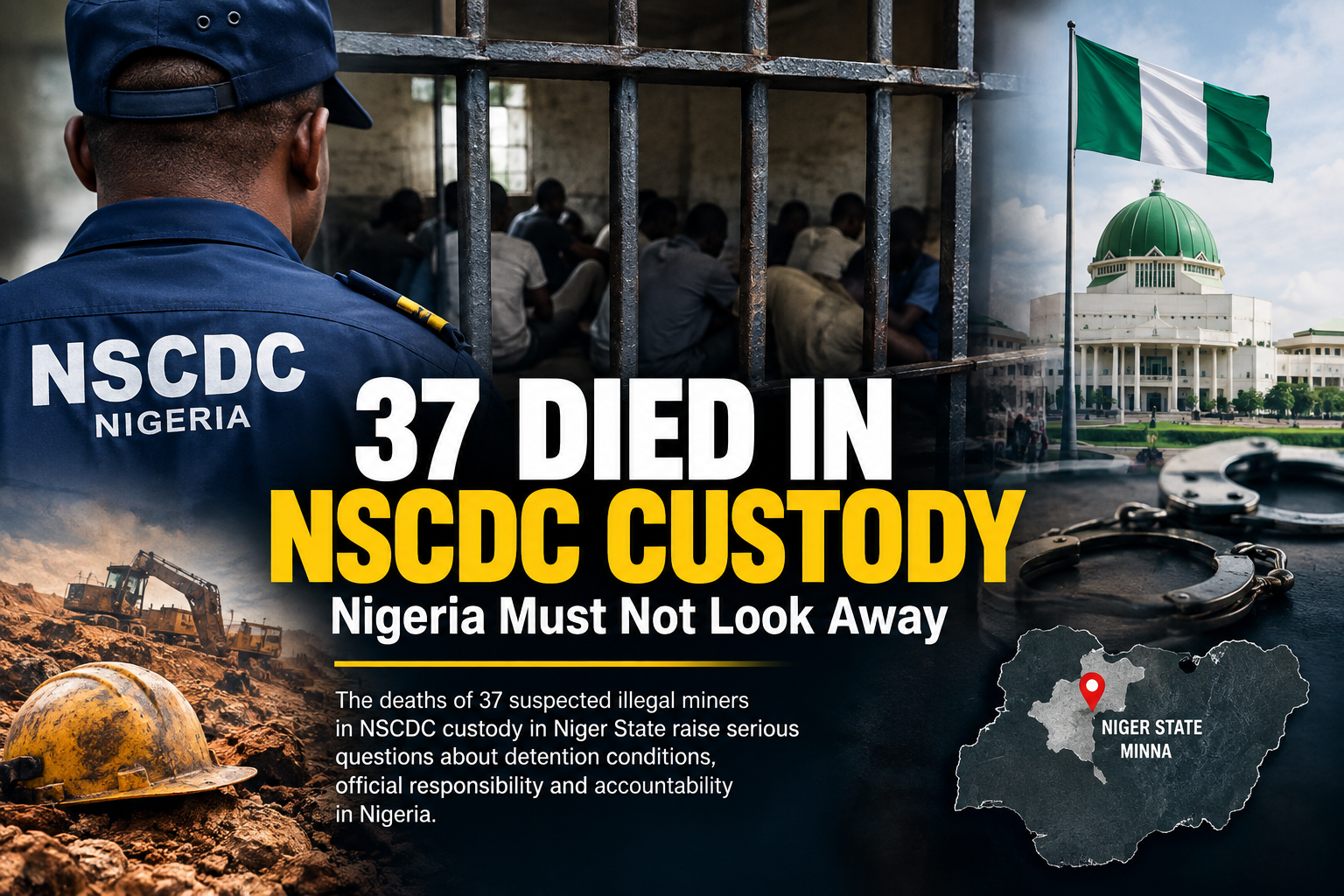
Thirty-seven suspected illegal miners are dead after being detained by the Nigeria Security and Civil Defence Corps (NSCDC) in Minna, Niger State.
They entered government custody alive.
They did not leave it alive.
That fact alone demands a full explanation.
The deaths have raised serious questions about detention conditions, medical care, official responsibility and the events that unfolded inside the NSCDC facility.
The exact cause of death has not yet been established. Authorities are conducting medical examinations, forensic investigations and autopsies, while the police and other agencies are also investigating the incident.
President Bola Ahmed Tinubu has ordered a full and transparent investigation. He directed investigators to examine the circumstances of the arrests, the condition of the detainees, the number of people held in the facility, the detention conditions, the medical attention provided and the events leading to the deaths.
That investigation must now deliver more than assurances.
It must establish what happened.
Suspects are not convicts
The detainees were suspected of illegal mining.
Those allegations may justify investigation and, where evidence supports it, prosecution. Nigeria has a legitimate duty to enforce its mining laws and tackle unlawful mining activities.
However, suspicion is not conviction.
Once the state takes away a person’s liberty, it assumes responsibility for that person’s safety and welfare.
A person does not lose the right to life, dignity or humane treatment because he or she has been accused of an offence.
That principle applies inside every detention facility in Nigeria.
It must also apply when the allegations involve illegal mining.
What Happened Inside the Cell?
Accounts from survivors have raised disturbing questions about the conditions in which the detainees were held.
One survivor said a large number of detainees were packed into a poorly ventilated cell and later described struggling to breathe. Other accounts have alleged that an unidentified substance was sprayed inside the facility and that detainees pleaded for water and for the door to be opened.
These accounts remain allegations.
They must not be treated as proven facts before investigators establish what happened.
But neither should they be ignored.
Investigators must establish how many people were held in the facility, the capacity of the cell, the ventilation available and the level of medical supervision.
They must determine whether detainees reported health problems before the deaths.
They must also establish when officers became aware that people were in distress and what action was taken.
Most importantly, investigators must determine what happened inside that facility and whether the deaths could have been prevented.
The answers should come from evidence, medical findings and credible testimony.
The Cause of Death Must be Established
The initial NSCDC account linked the deaths to a suspected disease outbreak. However, the corps later stressed that the actual cause had not been established, and that medical and laboratory examinations were required.
Niger State Governor Mohammed Umaru Bago has also said investigators are examining possible factors including overcrowding, suffocation and exposure to hazardous substances associated with mining activities. He stressed that the official cause had not been established.
That distinction matters.
Nigeria must resist the temptation to reach conclusions before the evidence is available.
If the deaths resulted from disease, the investigation should establish the disease and explain how it spread among people in custody.
If overcrowding or inadequate ventilation contributed to the deaths, that must be established.
If exposure to a hazardous substance played a role, investigators must identify the substance and determine how the detainees came into contact with it.
If negligence or misconduct contributed to the deaths, those responsible must face the consequences provided by law.
And if the evidence points elsewhere, that finding must also be made public.
Accountability Must goes Beyond Suspension
The suspension of the Niger State NSCDC commandant and his team is an administrative measure. It does not, by itself, establish criminal responsibility.
President Tinubu has made the same point, saying that suspension must not substitute for determining criminal responsibility where the evidence warrants prosecution.
That is the standard the investigation must meet.
Investigators should preserve detention records, medical records, operational reports and any available CCTV footage.
Survivors should be interviewed and protected from intimidation.
Families of the deceased should receive timely information about the investigation and the findings concerning their relatives.
The investigation should also examine the entire chain of events — from the arrests and transportation of the suspects to their detention, medical care, supervision and the emergency response.
The objective should not be to find a convenient scapegoat.
It should be to establish responsibility based on evidence.
Public Anger Cannot Replace Due Process
The deaths have already triggered protests and unrest in Minna.
The Niger State Government imposed a 24-hour curfew and suspended mining activities in the state while investigations continue. It has also established a committee of inquiry.
Maintaining public order is necessary.
However, public anger cannot replace due process.
Neither can official statements.
Nor can condolences alone.
The families deserve answers about what happened to their relatives. The wider public also deserves confidence that people held in government custody are protected by the same laws the government expects citizens to obey.
Fighting Illegal Mining Must Remain Lawful
Nigeria must continue to confront illegal mining.
Unlawful mining can damage the environment, undermine legitimate economic activity and create wider security and public-safety concerns.
Those who violate the law should be investigated and prosecuted where the evidence supports criminal charges.
But enforcement must itself remain within the law.
The fight against illegal mining cannot justify overcrowded detention facilities, inadequate medical care, unlawful treatment or any other violation of the rights of people in custody.
The state cannot demand respect for the law while failing to uphold its own obligations.
What Happens After the Headlines?
The immediate response to the tragedy is important.
The more difficult task is what comes next.
If overcrowding contributed to the deaths, detention procedures must change.
If medical screening was inadequate, that system must be strengthened.
If officers failed to respond to an emergency, the reasons must be established and appropriate action taken.
If detention facilities are being used beyond their safe capacity, authorities must address that problem before another tragedy occurs.
The investigation should therefore produce more than a report.
It should lead to practical reforms.
There should be clear standards for detention capacity, ventilation, medical screening, emergency response and the monitoring of detainees.
There should also be consequences for officials whose unlawful actions or negligence are proven to have contributed to deaths.
Thirty-seven Lives Must not Become Another Statistic
Thirty-seven people died while in government custody.
Behind that number were families, parents, children, siblings and friends.
Each family deserves to know what happened.
The allegations against the detainees may ultimately be proved or disproved through due process. But their legal status did not remove the state’s responsibility to protect them while they were detained.
The government took away their liberty.
It therefore assumed a duty to protect their lives.
Now, Nigeria must ensure that the investigation into the 37 deaths in NSCDC custody is comprehensive, transparent and evidence led.
Let survivors be heard.
Let the evidence speak.
Let officials answer difficult questions.
Let wrongdoing be prosecuted where it is established.
And let every institutional failure identified by the investigation be corrected.
The country cannot allow a tragedy of this scale to fade when the headlines do.
Thirty-seven people died in custody. Their families deserve answers, and Nigeria deserves accountability.
About the Author



 Korede Abdullah
 Oluwatobi Adu
 Hope Ajayi