WHEN WORK DISAPPEARS: The Nigerians Building Survival Businesses to Stay Afloat
 Korede Abdullah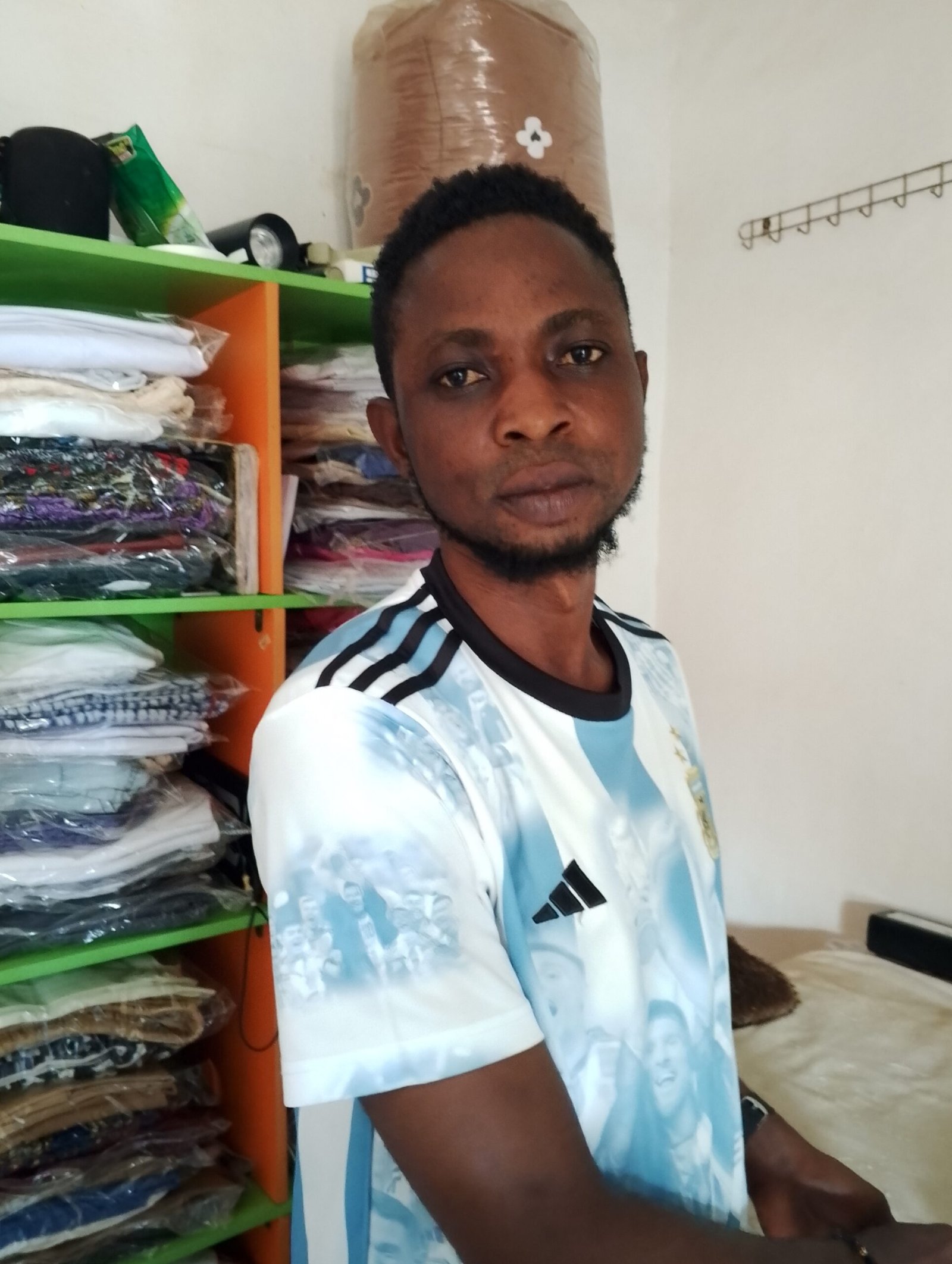
Olanrewaju Bakare
LAGOS, Nigeria – For Olanrewaju Bakare, the loss of his private-sector job in August 2024 did not leave him time to search for the perfect next opportunity. It pushed him into survival. He opened a laundry shop in Lagos, only to discover that escaping unemployment meant entering another struggle—one where the cost of electricity, fuel, water, detergents and transport keeps rising while customers have less money to spend. His story is one of many unfolding across Nigeria, where economic reforms, rising living costs, and shrinking purchasing power are forcing workers into businesses they never planned to start. In this report, Korede Abdullah examines what happens when a job disappears, self-employment becomes the only option, and even survival businesses struggle to survive.
When a Salary Disappears
Bakare did not set out to become a laundry operator. Before August 2024, he worked in the private sector and depended on his salary. When he was laid off, however, finding another source of income became an immediate necessity.
“Losing my job in August 2024 was not something I planned for. I had been working in the private sector, but after I was laid off, I had to think about how to survive and support myself,” he said.
His response reflects a wider shift in an economy where losing formal employment can quickly push workers towards self-employment, regardless of whether they have sufficient capital, experience or a safety net.
But starting a business does not necessarily mean escaping economic hardship. Bakare said the cost of running his laundry business has risen sharply, from electricity and fuel to water, detergents, transport and maintenance.
“Starting the laundry business gave me something to depend on, but it has not been easy because the cost of almost everything has increased,” he said.
The problem is not only what businesses pay. It is also what their customers can afford.
The Customer Cannot Pay More
For Bakare, raising prices is not a straightforward solution. If he charges more, customers complain. If he keeps his prices unchanged, his own expenses can consume whatever profit remains.
“Customers are also facing hardship, so when you increase your price, they complain because their own income has not increased. But if you don’t increase your price, you may not be able to cover your expenses,” he said.
For operators such as Bakare, economic pressure therefore comes from both directions.
The Artisan Who Cannot Afford to Wait
In Ikotun, Lagos, Gbenga Kareem is facing a similar squeeze from another part of the informal economy.
As an iron fabricator, he depends on materials, electricity and fuel to complete jobs. But as the cost of those inputs rises, customers are increasingly postponing projects.
“The materials we use are becoming more expensive, and customers are also struggling. Some people come to ask for the cost of a job and when they hear the price, they say they will come back later,” Kareem said.
For a small fabricator, a delayed job can mean more than lost revenue. Materials often have to be purchased before production can begin, tying up scarce capital in an environment where prices can change quickly.
And the pressure does not stop at raw materials. “When electricity is not available, you have to find another source of power. That means spending more money on fuel. All these costs eventually enter into the price of the job,” he said.
Bakare has also felt the impact of higher fuel costs, which he said reach far beyond the price displayed at a petrol station. “Fuel is not only about the money you spend to buy petrol. It affects transportation, the movement of goods and the cost of running machines,” he said.
A Job Is Not Enough
For Dr Mojeed Saliu, Head of the Department of Economics at Ekiti State University, Ado-Ekiti, Nigeria’s employment crisis cannot be understood simply by counting how many people have jobs.
The more important question, he said, is whether those jobs provide enough income for people to live on.
“Employment is not only about whether someone has a job or not. We must also consider the quality of the job, income, purchasing power and whether that income can sustain a household,” Saliu said.
That distinction is crucial in an economy where a person can be technically employed while still struggling to pay for food, transport, housing and other necessities.
A growing number of people moving into self-employment may therefore represent economic adaptation rather than economic security.
When Growth Does Not Reach the Household
Nigeria’s economic reforms, including the removal of fuel subsidies and exchange-rate liberalisation, have altered the cost of doing business.
Saliu said the reforms have had both positive and negative effects, but businesses remain exposed to higher costs across fuel, electricity, transportation, machinery and raw materials.
“When production becomes more expensive and consumers have less purchasing power, businesses are forced to make difficult decisions. Some reduce their workforce, others reduce production, while some businesses close completely,” he said.
The result is a difficult contradiction: businesses need to charge more to cover their costs, but customers have less purchasing power to absorb those increases.
Saliu also cautioned against treating GDP growth as a complete measure of economic wellbeing.
“GDP growth does not automatically translate into employment growth. What matters is the nature of the growth,” he said.
For workers and small business owners, the distinction is tangible. A positive economic indicator does not necessarily mean a fuller wallet at the end of the month.
Six Zones, One Economic Shock
The SBM Intelligence survey shows that economic disruption is not being experienced uniformly across Nigeria.
The Southeast recorded the highest proportion of respondents reporting major economic shocks at 66.5 per cent, followed by the North-Central at 61.3 per cent, South-South at 50.3 per cent, Northeast at 40.4 per cent, Southwest at 32.7 per cent and Northwest at 21.5 per cent.
Saliu said the differences partly reflect the economic structure of each region.
The Southeast, for example, has a large concentration of small businesses, traders and manufacturers who may be particularly exposed to changes in energy, transport and foreign-exchange costs.
But he cautioned against viewing the figures as a contest between regions.
Instead, they show how the same national economic pressures can produce different consequences depending on the businesses, industries and livelihoods that dominate a particular community.
The Decision to Leave
Perhaps the most striking finding from the survey is not only that people are struggling to find work, but that many are considering leaving their communities altogether.
With 79.1 per cent of respondents saying they had considered relocating in search of employment, migration is becoming part of the conversation about economic survival.
Saliu said the decision is understandable when people cannot find sustainable opportunities where they live.
“When people cannot find decent employment where they reside, they naturally begin to consider moving to another city, another region or another country,” he said.
Migration itself, he noted, is not necessarily negative. People may acquire new skills, earn more and send money home.
“The ideal situation is for people to have opportunities at home and decide to travel because they want to, not because they have no other option,” Kareem said.
The Business That Replaced the Job
For people like Bakare, the distinction between employment and entrepreneurship has become increasingly blurred.
He now owns a business, but he does not describe that transition as an easy success story.
“People think that once you start a business, you have solved your problem. But you still have to pay rent, buy equipment, pay for electricity and get customers. It is another struggle,” he said.
That struggle is replicated across the informal economy, where small businesses and artisans provide income for millions but often operate with limited access to affordable finance, reliable electricity, infrastructure and formal support.
Kareem said government support for small operators could help businesses survive and eventually employ others.
The implication is significant: when a small business collapses, the impact may extend beyond its owner to apprentices, employees, suppliers and households that depend on the income it generates.
Reform Without Abandonment
Saliu said economic reforms may be necessary to address structural weaknesses in Nigeria’s economy, but adjustment costs should not be borne entirely by households already under pressure.
“Economic reforms can be necessary, but the people affected by those reforms must not be abandoned during the adjustment period,” he said.
He called for stronger social protection, affordable credit for micro, small and medium-sized businesses, improved electricity, better roads and transport systems, and vocational and technical training linked to actual employment opportunities.
He also highlighted agriculture and agro-processing as sectors with potential to generate employment on a larger scale.
The challenge, however, is ensuring that support reaches the people who are already struggling to keep their businesses and households afloat.
What Does Recovery Look Like?
For Bakare, recovery is not an abstract economic target.
It is whether his laundry business can meet its running costs and still leave enough income for him to live.
For Kareem, it is whether a customer can hear the price of a fabrication job without immediately deciding to postpone it.
For millions of other Nigerians, it is whether a salary, business or trade can once again provide enough purchasing power to cover the basics.
Bakare believes policymakers need to look beyond headline economic indicators.
“If GDP is growing but people are losing their jobs and small businesses are struggling to survive, the government needs to look closely at what is happening at the household level,” he said.
Kareem’s argument is equally grounded in the everyday economy: a business that survives can support another worker, pay a supplier and keep money circulating within the community.
Beyond the Numbers
Nigeria’s economic debate is often framed through inflation, GDP, exchange rates, investment and government reforms.
But for Bakare, the starting point was a letter—or conversation—that told him his job was gone.
For Kareem, it is the rising price of the materials he needs before he can begin a job.
And for the customers they depend on, it is the growing calculation of what they can afford to buy, postpone or abandon.
Their experiences reveal the human dimension behind the economic figures: when formal employment disappears, people create alternatives; when those alternatives become too expensive to sustain, the pressure moves deeper into households and communities.
The question, then, is not simply whether Nigeria’s economy is growing.
It is whether that growth is creating jobs people can live on, businesses that can survive and incomes that can still buy the necessities of life.
As Saliu put it: “The real test of economic recovery should therefore not only be whether inflation falls or GDP rises. We should also ask whether ordinary Nigerians can find decent work, earn sustainable incomes and afford a reasonable standard of living,” he said.
About the Author

 Mirian Gom
 Oluwatobi Adu