
Fuel at a Breaking Point: Nigeria’s High-Stakes Gamble on CNG Amid Soaring Petrol Pain
 Chukwu Obinna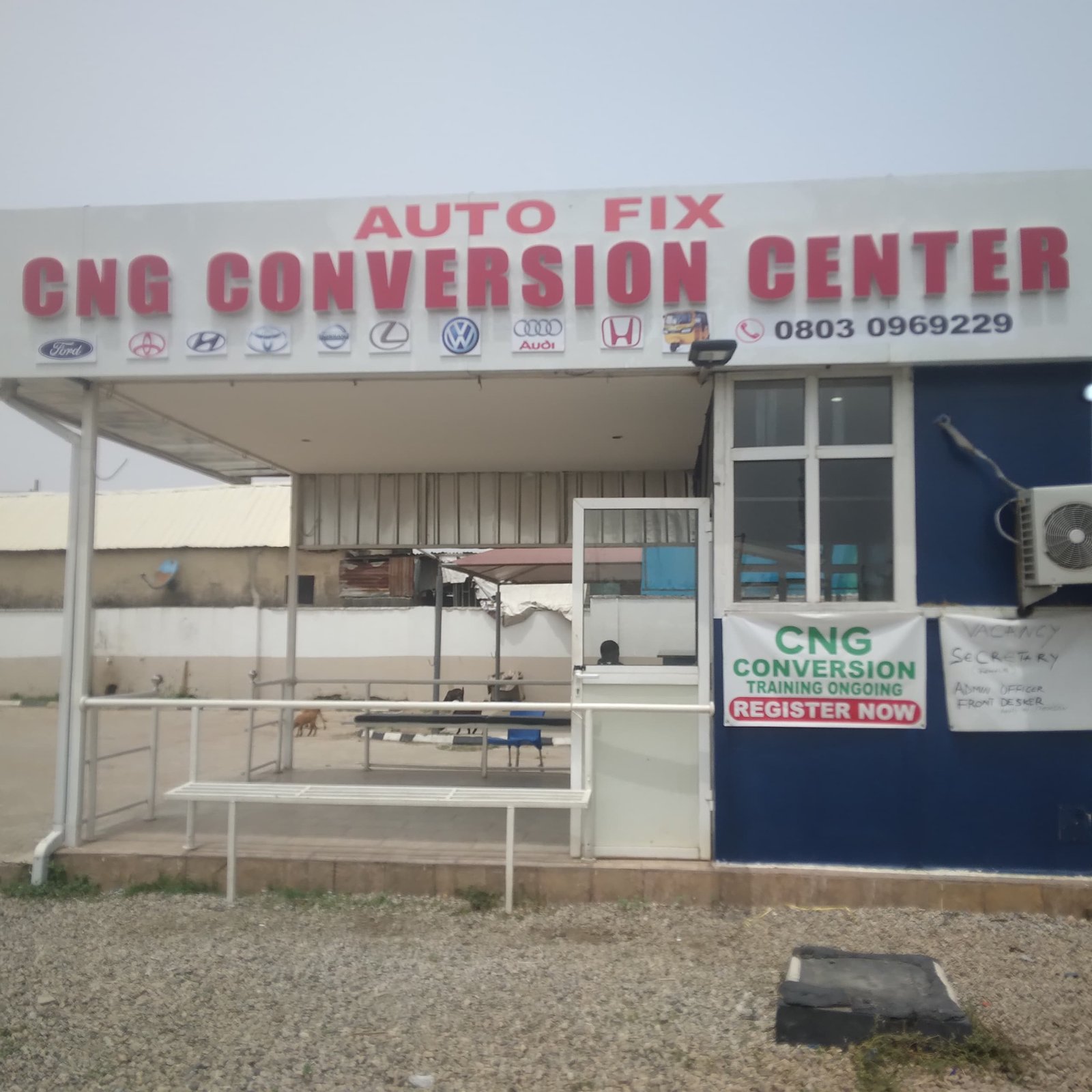
Auto Fix CNG Conversion Centre, Kubwa District, Abuja. (Photo Credit: Chukwu Obinna/AHR, 2026)
ABUJA, Nigeria – At dawn in Abuja’s Kubwa district, a queue of vehicles snakes quietly toward a modest conversion centre, engines idling, drivers watching, waiting. For many, this is no longer a choice—it is survival.
When Casmir Ebelechi established what he calls Abuja’s first compressed natural gas (CNG) conversion facility, few Nigerians were willing to take the risk. Today, with petrol prices surging between ₦1,295 and ₦1,500 per litre, his gamble has turned into a frontline of Nigeria’s energy transition.
Yet beyond the growing lines lies a more complex story—one of ambition colliding with structural gaps, and a nation attempting to recalibrate its economic future in real time. Chukwu Obinna, writes.
A Nation at An Energy Crossroads
Nigeria’s push toward CNG is not merely environmental—it is economic triage.
Following the removal of fuel subsidies, the federal government has accelerated its Presidential Initiative on Compressed Natural Gas and Electric Vehicles (Pi-CNG & EV), positioning gas as a cheaper, cleaner alternative. On paper, the country is well suited: Nigeria holds over 208 trillion cubic feet of proven natural gas reserves—among the largest globally.
But abundance has never guaranteed accessibility.
For decades, gas flaring in the Niger Delta has symbolised waste—burning away potential wealth while polluting communities. Now, policymakers see CNG adoption as a way to reverse that narrative, cutting emissions while easing transport costs.
Transport alone accounts for roughly 24 per cent of Nigeria’s greenhouse gas emissions, making it a critical battleground for both climate action and economic stability.
Yet despite over 100,000 vehicle conversions recorded by early 2025, this represents less than one per cent of Nigeria’s estimated 12 million vehicles—a reminder that transformation at scale remains distant.
The Promise—and Price—of Conversion
At Ebelechi’s facility, the mechanics of conversion reflect both innovation and cost.
Under each vehicle, reinforced pressure pipes connect to an Electronic Control Unit, enabling drivers to switch between petrol and gas. The cylinders, he explained, are built to withstand extreme impact.
“CNG produces zero carbon emissions, helping with sustainable development and preserving the ozone layer,” Ebelechi said.
For drivers, the appeal is immediate. Daily fuel expenses can drop from around ₦20,000 on petrol to roughly ₦5,000 on CNG. At about ₦230 per standard cubic metre, the savings accumulate quickly.
But entry comes at a price.
Conversion costs range from ₦850,000 for smaller engines to nearly ₦1 million for larger vehicles—placing it out of reach for many Nigerians already grappling with inflation. While high-mileage drivers may recover costs within a year, the upfront burden remains a significant barrier.
Globally, Nigeria’s conversion costs are among the highest. In countries such as India, Pakistan and Egypt, similar conversions are considerably cheaper—a disparity that continues to slow adoption.
Still, for those who make the leap, the benefits extend beyond savings. Unlike petrol, CNG burns cleaner, reducing engine residue and potentially improving longevity.
Infrastructure: The Achilles’ Heel
If cost is the first hurdle, infrastructure is the most decisive.
Nigeria’s CNG ecosystem remains thin. As of April 2025, the country had just 27 mother stations, 63 daughter stations and around 242 conversion centres. The shortage is even more pronounced in northern and south-eastern regions, where pipeline limitations and distribution costs restrict expansion.
Equally pressing is the human capital gap: only about 320 certified CNG technicians nationwide, compared to over 5,000 in Argentina.
Conversion centre operator Abilichi described the situation as a work in progress.
“The government has introduced subsidies providing up to 40 per cent discount on kits, and customers are subscribing, but delays in distributing the new ‘2.0’ version have slowed things,” he said.
He also dismissed widespread safety concerns, noting that CNG disperses quickly into the atmosphere and is less combustible than petrol when properly handled.
“Broad access creates healthy competition that drives down transport and goods costs across the board,” he added.
Voices from the Road
For drivers navigating Abuja’s congested roads, the shift to CNG is both a relief and risk.
Taxi operator George Ade described the immediate financial benefit:
“Since I converted, I’m spending less on fuel and making more turnover daily.”
But his experience also reveals lingering doubts:
“My engine doesn’t function as effectively as when running on pure fuel—there are signs it’s degrading faster.”
Such concerns are echoed across the transport sector. While studies confirm gradual adoption, they also highlight persistent barriers: limited refuelling points, high upfront costs, low awareness, and resistance from entrenched industry groups.
Government Ambition vs Ground Reality
Official figures present a narrative of rapid progress.
The Pi-CNG & EV initiative reports over $2 billion in investment, nearly 100,000 jobs created, and a dramatic increase in conversion capacity. From just 11,000 converted vehicles in 2023, the surge to over 100,000 marks a significant leap.
The government’s target is even more ambitious: one million converted vehicles by 2027.
Supporting this is the ₦122 billion allocation under the Midstream and Downstream Gas Infrastructure Fund to expand gas infrastructure nationwide.
Yet the scale of Nigeria’s transport ecosystem dwarfs these gains. With millions of vehicles still dependent on petrol, the transition remains in its infancy.
Electric vehicles, often touted as the future, face even steeper challenges. With a ratio of new to used cars at 1:131 and fewer than 85 public charging stations nationwide, EV adoption remains largely aspirational.
Climate Commitments and Development Goals
Nigeria’s CNG push aligns with multiple global development targets.
Under its Energy Transition Plan, gas is positioned as a “bridge fuel” toward cleaner energy, supporting goals on affordable energy, economic growth, infrastructure development, sustainable cities, and climate action.
The country aims for 25 per cent CNG vehicle adoption by 2030 and up to 80 per cent by 2050.
But current projections suggest emissions could still exceed national targets, underscoring the urgency for faster implementation.
The Economics of Urgency
Behind the policy lies a stark economic reality.
Although inflation eased to 15.06 per cent in February 2026, transport and energy costs remain stubbornly high. For millions of Nigerians, fuel is no longer just a commodity—it is a daily calculation between mobility and survival.
Petrol price volatility has become the single most powerful driver of behavioural change, pushing individuals toward alternatives regardless of policy timelines.
A Transition Still in Motion
Back in Kubwa, the queue at Ebelechi’s centre continues to grow.
Each vehicle represents a decision—an investment in uncertain savings, a bet on infrastructure yet to fully materialise, and a quiet vote of confidence in a system still under construction.
Nigeria’s CNG transition is no longer theoretical. It is unfolding in real time—messy, uneven, and urgent.
Whether it delivers lasting relief or deepens existing inequalities will depend not just on policy ambition, but on execution: the speed of infrastructure rollout, the affordability of conversion, and the trust of everyday Nigerians.
For now, at least, the engines keep running—some on petrol, others on promise.
About the Author


 Oluwatobi Adu


 Hope Ajayi