
 Koko Maxwella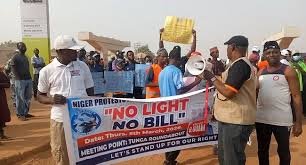
MINNA, Nigeria – Residents of Minna, the Niger State capital, staged a peaceful protest on Thursday over persistent electricity outages and what they describe as exploitative estimated billing by the Abuja Electricity Distribution Company (AEDC).
The protest, organised by human rights activist Lanre Sadiq, Chief Executive Officer of Human Rights Radio, draws residents, youth groups and civil society organisations who march through major streets demanding improved power supply and the immediate installation of prepaid meters.
The demonstrators assemble at Tunga Roundabout near Access Bank before marching to the AEDC regional office on UK Bello Road, where they present their demands.
Speaking during the demonstration, Sadiq condemns the continued use of estimated billing, saying it places unfair financial burdens on residents already struggling with unreliable electricity supply.
“Many households receive inflated electricity bills despite experiencing poor and inconsistent power supply,” Sadiq says.
According to him, some residents living in small apartments pay as much as ₦46,000 monthly under the estimated billing system.
He calls on AEDC to comply with the Federal Government directive on electricity metering, stressing that prepaid meters ensure transparency and allow consumers to pay only for the electricity they actually use.
Sadiq also argues that communities should no longer bear the cost of providing electricity infrastructure such as transformers and cables.
Another activist, Abdullahi Jabi of the Campaign for Democracy, says persistent power outages are damaging local businesses and worsening security challenges in the state.
“The protest aims to highlight how poor electricity supply affects economic activities and community safety,” Jabi says.
Responding to the protesters, Acting Managing Director of Niger State Electricity Distribution Company, Samuel Odekina, acknowledges the complaints and promises improvements.
“Management has taken note of the issues raised and will review the demands presented by the demonstrators,” Odekina says.
He, however, reminds residents that electricity consumed must be paid for while assuring continued engagement with communities to improve service delivery.
About the Author


 Oluwatobi Adu
 Korede Abdullah

 Chukwu Obinna