


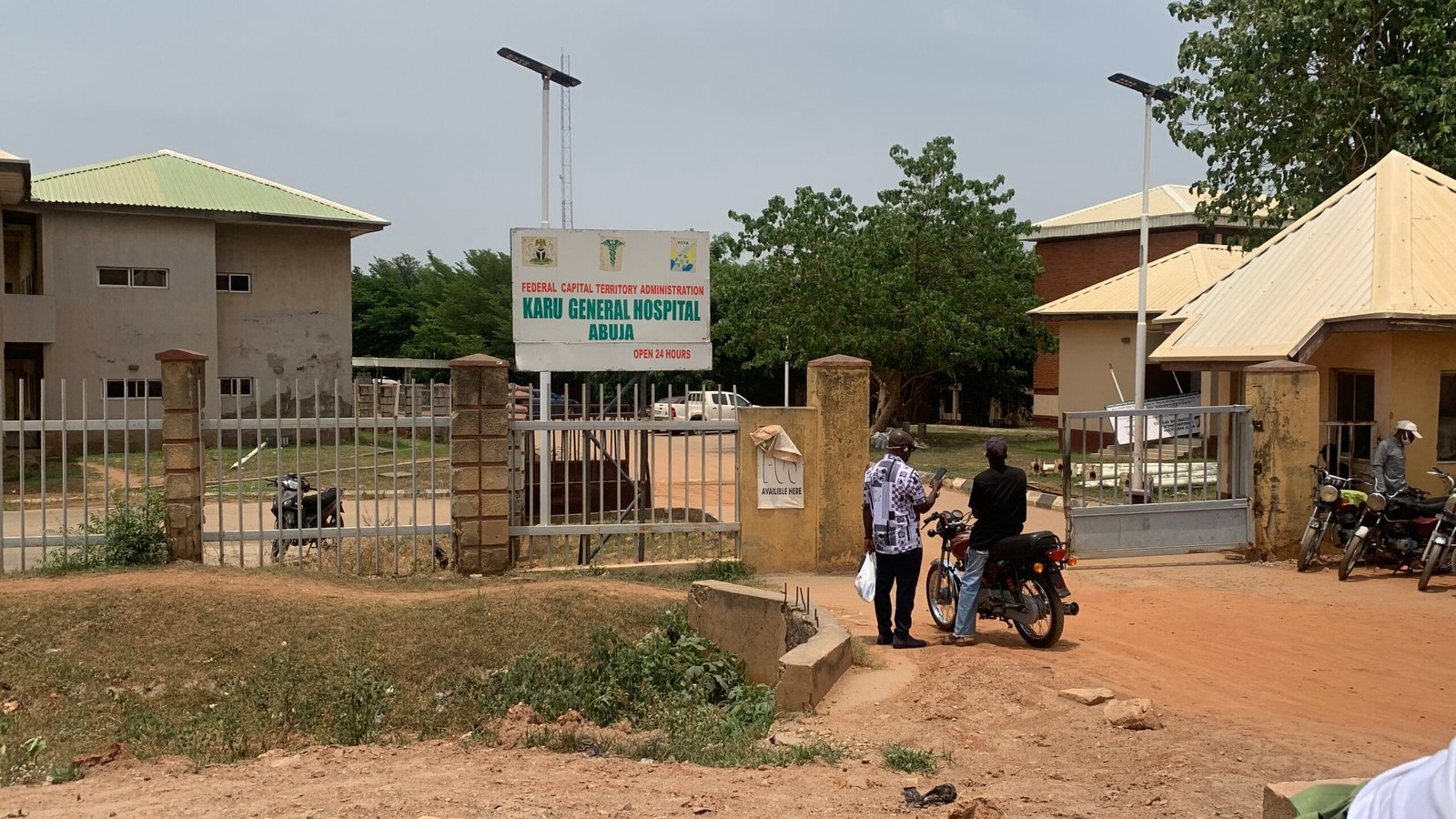
KARU, Nigeria – In the rapidly growing border community between Nigeria’s Federal Capital Territory and Nasarawa State, residents say Karu General Hospital — officially upgraded to serve as a secondary healthcare facility — still functions largely as a psychiatric centre, leaving many without access to essential medical services. Families allege that pregnant women, emergency patients and others requiring routine treatment are often forced to travel long distances to seek care elsewhere, despite promises of expanded healthcare delivery within the community. In this report, Africa Health Report’s Oluwatobi Adu visited the facility to investigate why many residents believe the hospital is yet to fulfil the responsibilities expected of a functional general hospital, raising broader concerns about healthcare access, service delivery and public trust in Nigeria’s health system.
Outside the facility, a food vendor who has worked near the hospital for several years dismissed suggestions that the institution had recently transformed into a fully operational general hospital.
“It has been there since,” she said quietly, watching patients move in and out of the compound.
When asked what services people mostly visit the hospital for, she replied that the facility was still largely known for psychiatric treatment, although “they have extended some of what they do”.
She added: “Some parts were given to Indian people to handle,”
though she admitted she had limited knowledge of the arrangement.
Nearby commercial motorcycle riders offered similar accounts.
To many of them, the hospital’s identity has barely changed.
“It is still a psychiatric hospital people know it for,” one rider said. “If someone has serious sickness or a pregnant woman problem, they go elsewhere.”
That perception reflects a deeper frustration shared by many residents who say the facility has not evolved into the comprehensive public hospital they were promised.
A Growing Community, A Shrinking Sense of Access
Karu has expanded rapidly over the years, fuelled by Abuja’s rising population and the migration of lower- and middle-income earners seeking affordable housing outside the city centre.
The growth has intensified pressure on already fragile infrastructure — especially healthcare.
In communities where traffic congestion can stretch emergency journeys into hours, proximity to functioning hospitals can determine survival.
Yet many residents interviewed by Africa Health Report said they still depend on distant facilities in central Abuja or neighbouring communities for healthcare services that should ordinarily be available locally.
For pregnant women, families with children and elderly residents, the consequences are both financial and physical.
Transport fares, delayed treatment, and overcrowded referral hospitals have become part of daily healthcare realities.
Public health analysts say such gaps often expose systemic weaknesses in Nigeria’s healthcare delivery structure, where official announcements of upgrades sometimes outpace actual implementation on the ground.
Inside the Hospital Compound
During a media visit by Africa Health Report, the hospital premises appeared unusually quiet for a secondary healthcare facility serving such a densely populated area.
A handful of nurses and staff members in scrubs moved through the compound, while waiting areas around the information section remained largely empty.
Hospital information officers challenged claims that the institution was underfunctional.
One official insisted the facility had always carried the identity of Karu General Hospital, even while acknowledging its psychiatric roots.
“This place was just converted to a general hospital,” the officer said.
He further maintained that the expansion was designed to create a facility “that everybody can access”.
Attempts to independently tour additional sections of the hospital required administrative approval, underscoring the sensitivity surrounding public scrutiny of the institution.
Inside the administrative office, another official offered more detailed explanations about the hospital’s operational structure and evolution.
According to her, the facility previously operated with functional units including the General Outpatient Department (GOPD), laboratory services, pharmacy and the Behavioural Medicine Unit (BMA), which catered for psychiatric inpatient and outpatient treatment.
She explained that expansion efforts had recently introduced additional services.
“Following expansion, new services were introduced, including an Anti-natal care clinic (maternity), a labour ward for deliveries, and an eye clinic.”
She added:
“The labour ward has been set up for deliveries and the rest very recently we started.”
According to her, most of the newly introduced services only became operational toward the end of last year.
That timeline may partly explain why many residents say they have yet to experience meaningful changes in healthcare access.
The Insurance Gap
Further inquiries uncovered another challenge potentially affecting accessibility.
An official attached to the hospital’s insurance desk clarified that the facility was not integrated into Nigeria’s National Health Insurance Scheme (NHIS), now managed under the National Health Insurance Authority framework.
“We are not NHIS. We are FHIS – FCT Health Insurance Scheme,” the officer stated.
While the FCT Health Insurance Scheme serves residents within the territory, the distinction may limit flexibility for some patients accustomed to national insurance coverage systems.
For low-income earners already burdened by transportation costs and rising medical expenses, out-of-pocket payments can discourage early treatment and worsen health outcomes.
Healthcare economists have repeatedly warned that weak insurance penetration remains one of Nigeria’s biggest barriers to equitable healthcare access.
Between Government Promises and Public Reality
The story of Karu General Hospital reflects a broader national dilemma.
Across Nigeria, health authorities frequently announce rehabilitation projects, upgrades, and expansions aimed at improving access to care. Yet residents in many communities continue to complain about shortages of personnel, limited diagnostic capacity, underutilised buildings, and slow implementation of promised reforms.
In Karu, the disconnect between official declarations and public perception has become especially visible.
While hospital authorities insist expansion is ongoing, residents measure progress differently — through lived experience.
For them, a “general hospital” is not defined by signage or administrative classification, but by whether a mother can deliver safely there at midnight, whether emergency care is available without referral, or whether families can avoid exhausting journeys to distant hospitals for routine treatment.
The quietness observed during the visit also raised questions residents continue to ask privately: if services have expanded significantly, why does public awareness remain low? And if the hospital is now fully operational as a general hospital, why do so many locals still bypass it?
Health sector observers say rebuilding public confidence after years of limited services often takes time. But they also stress that transparency, staffing, equipment provision, and community engagement are essential if upgraded facilities are to gain public trust.
A Community Waiting for Healthcare That Feels Real
As Karu continues to expand into one of the FCT’s busiest urban corridors, pressure on public healthcare infrastructure is expected to intensify.
Residents say what they seek is not merely another government announcement but visible, reliable, and accessible healthcare services capable of meeting the demands of a growing population.
For now, many still see Karu General Hospital as a place where psychiatric services appear most established, while broader medical care remains in transition.
Whether the facility eventually grows into the fully functional general hospital authorities, envision may depend not on future promises but on how quickly ordinary residents begin to experience meaningful change.
Until then, for many in Karu, the hospital remains a symbol of Nigeria’s wider healthcare paradox — where infrastructure may exist on paper – but access often still feels far away.






Join the conversation