 Oluwafunbi Bello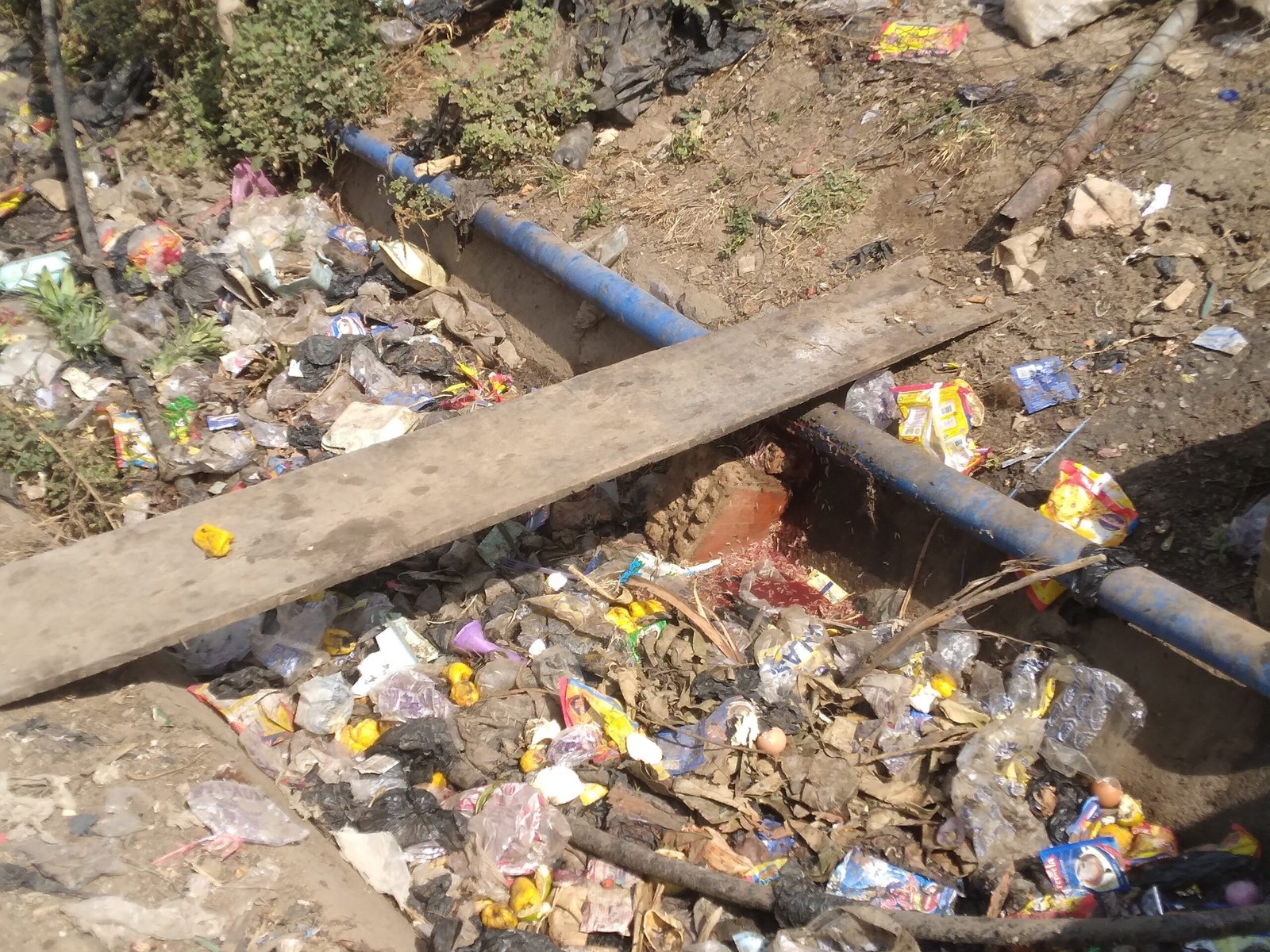
Stagnant drainage filled with animal waste beside Kubwa Market in Abuja
ABUJA, Nigeria – By the time you reach the gutter at Kubwa Market, your body reacts before your mind does. The smell is thick, sour and unmistakable. It clings to the air, forcing pedestrians to turn their faces away even before they see what lies below: stagnant wastewater mixed with blood, feathers and decomposing scraps from a nearby chicken stall. Maggots writhe through the sludge, undisturbed, as commerce carries on around them.
This is Nigeria’s capital city — planned, powerful and political. Yet on its streets, neglect festers quietly. Oluwafubi Bello, writes.
Standing just steps from the gutter, Abubakar Haruna arranges cow intestines on a metal tray. Flies swarm, and he waves them away with a torn piece of cardboard, his movements practised and resigned.
“When you don’t have money, you don’t have a choice,” he said, his voice low. “I don’t have money to get space inside the market, so I just dey around outside.”
Haruna recalled a visit from environmental officers last year.
“Yes, they come. I think they say they go do something. But till today, nothing,” he said, pausing before adding in a whisper, “Abeg madam, I go carry my meat comot for here. Please do not report me.”
His plea captures a familiar story across Abuja: inspections without enforcement, visits without consequences, promises without follow-up.
A Business Beside Black Water
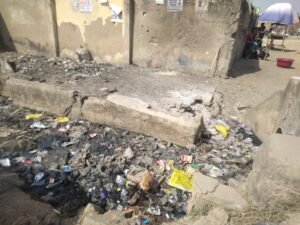
In Kubwa, at White Safari, a drainage channel of black, foul-smelling water cuts through the neighbourhood. Waste floats lazily on the surface. Passers-by cover their noses. Some cross the road entirely to avoid it.
Just metres away, Aishat Bala runs a small salon under a faded umbrella. Her table is neatly arranged with hair extensions, nail polish and combs — an effort to impose order on chaos.
“This place is always like that,” she said, gesturing toward the drainage. “People dump waste there.”
Bala said she recently paid local waste collectors, known as sa bolar, to clear the gutter after customers complained.
“I’m losing customers,” she explained. “That’s why it is even this bearable to look at now.”
Environmental officials, she said, had visited during last year’s rainy season.
“The flood swept away the dirt that time,” Bala recalled. “I told them to do something or put a penalty for dumping refuse. The water is coming from the bathroom of tenants in that compound.”
She pointed towards a nearby residential block.
“But they just came, took note and left. Since then, nothing.”
For Bala, the issue is not ignorance. It is inaction.
Overflow in Jabi
The complaints echo in Jabi, near the VIO office towards Lifecamp. There, an overflowing drainage spills onto the road, splashing pedestrians and slowing traffic during peak hours.
Zubairu Ibrahim, who operates a car wash nearby, said he has been wrongly blamed.
“When they came, I told them to remove the big stone blocking the drainage and I will do the remaining work myself,” he said. “They never came back.”
During a later inspection, officials identified that the waste was partly coming from an illegal settlement and runoff from Jabi Lake — a problem bigger than any single operator.
Still, weeks after the visit, the water remained.
For residents and business owners, the pattern is predictable: officials arrive, identify the problem, and disappear.
What the Authorities Say
At the Abuja Environmental Protection Board (AEPB), officials acknowledge that earlier efforts may not have been sufficient.
“Maybe what we’ve done there was not enough,” said Mrs Naomi Davids, an administrative officer in the Solid Waste Department, after reviewing photographs from Kubwa and Jabi. “We will do more to ensure that drainages are not treated as dumping sites.”
Engineer Cyrus Chike Nnaji, District Supervisor at the Liquid Waste Department, said his team planned a patrol of Jabi on Tuesday, February 17, 2026.
“If it’s something we can do immediately, we will do it,” he said. “If it requires funding, we will write to the Director of the agency to request funds.”
After inspecting the area, Nnaji confirmed that an illegal settlement appeared to be contributing significantly to the problem.
“We are going to report to our director and wait for further instructions,” he said.
For residents, those words sound familiar.
Inspection Without Enforcement?
Across Kubwa and Jabi, the evidence points to a system heavy on observation and light on action.
Drainages are inspected but not cleared. Illegal dumping is identified but rarely punished. Informal operators continue to set up beside waste channels because monitoring is inconsistent. Residents and small business owners, desperate to protect their livelihoods, end up paying out of pocket to fix public infrastructure.
Environmental health experts warn that stagnant wastewater mixed with animal waste creates breeding grounds for mosquitoes, flies and bacteria. Prolonged exposure increases the risk of cholera, typhoid and respiratory infections — especially in densely populated urban areas.
Yet beyond public health, many residents say the deeper issue is accountability.
When environmental officers arrive, communities expect more than clipboards and photographs. They expect enforcement: sanctions for illegal dumping, sustained drainage clearing, monitoring of informal settlements and consistent follow-up.
Until inspections are matched with action, Abuja’s sanitation crisis will continue to unfold quietly — in gutters, beside salons, under umbrellas and next to meat trays.
Officials will come.
Notes will be taken.
Promises will be made.
And on Abuja’s streets, the smell will remain.
About the Author

 Edino Chubiyo Cornelius
 Hussaini Ibrahim
 Koko Maxwella