 Mirian Gom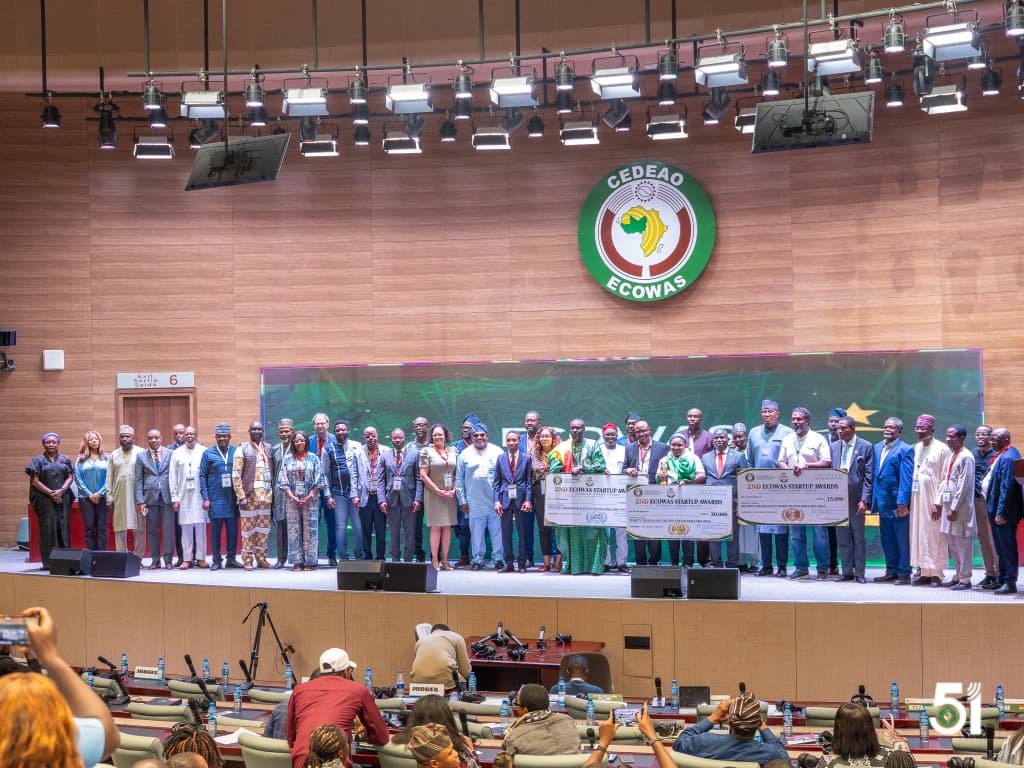
Young entrepreneurs at the ECOWAS Startup Awards in Abuja, Nigeria
ABUJA, Nigeria – Sixty young entrepreneurs arrived in Abuja with ideas, pitches and ambitions; by the time they left, three had won a combined $65,000, while the other 57 gained something potentially more consequential—a regional network of investors, mentors and markets. For Gom Mirian, the bigger question is whether the momentum created by the ECOWAS Startup Awards can help turn promising businesses into companies that create jobs and expand across West Africa.
At the new ECOWAS Commission headquarters in Abuja, Nigeria’s Hubpharm Africa and Services won the second edition of the ECOWAS Startup Awards. The company, led by co-founder and Chief Executive Officer Tope Kareem, received the $30,000 first prize.
Senegal’s Gaynako, led by Pape Natango Mbaye, finished first runner-up and won $20,000. Côte d’Ivoire’s myOpinion, founded and led by Steve Bah Blesson, took second runner-up with $15,000.
The prize money was the most visible reward. However, the broader ambition is to help young entrepreneurs build businesses that create jobs, attract investment and expand beyond national borders.
ECOWAS Startup Awards: Beyond the Prize Money
Dehpue Yenpea Zuo, ECOWAS Commissioner for Economic Affairs and Agriculture, said the Startup Awards was designed to support regional economic transformation rather than serve as another business competition. “The ECOWAS Startup Awards is an instrument of regional economic transformation,” Zuo said at the opening of the programme.
He linked entrepreneurship directly to employment, describing it as a way to address youth unemployment by creating business owners who can employ others.
As more young people enter West Africa’s labour market, governments and established companies cannot absorb every job seeker. Supporting businesses with the potential to grow and recruit workers is one possible response.
However, creating entrepreneurs is easier than building sustainable companies.
The scale of interest in the ECOWAS Startup Awards was evident in the application figures. The organisers received 8,679 registrations from all 12 ECOWAS member states. Of these, 1,499 applications qualified before the selection process produced 60 finalists.
The finalists represented six sectors: education technology and skills development, financial technology, health technology, agricultural technology and food systems, clean technology and green innovation, and tourism, hospitality and travel technology.
A significant proportion of the finalists also represented women-led enterprises.
These figures demonstrate the interest in entrepreneurship across the region. The bigger challenge is ensuring that promising businesses receive the support they need to survive, grow and create jobs.
Startups Need Capital and Market Access
Peter Oluonye, Acting Director of the Directorate of Private Sector and Industry at the ECOWAS Commission, said the response to the awards confirmed the depth of entrepreneurial talent in West Africa.
Reflecting on the inaugural edition in 2021, he said it “demonstrated that our region had no shortage of innovative talent.”
However, the competition also revealed the need for platforms that connect entrepreneurs with funding and markets.
It showed, he said, “that there was a genuine appetite for a platform that would connect them to capital, markets, and each other.”
The five-day Abuja programme sought to meet some of these needs through masterclasses on business validation, market access, regional expansion, investment readiness, fundraising and technology. Sessions also covered environmental, social and governance issues, impact, return on investment and business pitching.
Participants took part in policy discussions, sector clinics, investor engagements, business-to-business meetings and investor deal rooms.
Oluonye urged the founders to use the programme to build lasting relationships with potential partners. “Build relationships. Ask difficult questions. Engage with the investors and mentors who are here to support you,” he told them.
For the startups, these connections could prove valuable long after the competition. Access to investors, customers and experienced mentors can help businesses address challenges that prize money alone cannot solve.
Can West African Startups Cross Borders?
For Natasha Akioye, National Coordinator of the International Trade Centre in Nigeria, supporting entrepreneurs requires more than helping individual businesses grow.
The goal, she said, is to provide enterprises with “the skills, capabilities, finance, networks and market opportunities required to become competitive, scale across borders and contribute to stronger regional economies.”
This ambition aligns with the ECOWAS regional integration agenda.
A business that succeeds in one country but struggles to reach customers elsewhere remains limited by its domestic market. Expanding across West Africa could give startups access to more customers and opportunities to join regional supply chains.
However, regional expansion requires more than an innovative product. Businesses must also secure investment, build reliable distribution networks and understand the requirements of different markets.
Akioye said the challenge was to match entrepreneurial talent with the resources needed to build sustainable companies. “The challenge — and the opportunity — is to ensure that this talent is matched with the capabilities, investment, technology, networks and market access required to turn promising ideas into sustainable and scalable businesses.”
Whether the ECOWAS Startup Awards can deliver on this ambition will depend partly on how effectively the programme connects its finalists with these resources after the competition.
Why Startups Need More Than Ambition
Martin Boylan, Head of Cooperation at the European Union Delegation to Nigeria and ECOWAS, said entrepreneurs needed a supportive business environment to succeed. “Entrepreneurship does not succeed on its own,” Boylan said. “Startups flourish when there is an enabling ecosystem around them.”
Such an ecosystem includes access to finance, reliable infrastructure, digital connectivity, relevant skills, predictable regulation and intellectual property protection.
For businesses seeking to operate across borders, accessible regional markets are equally important.
Boylan said the European Union viewed the entrepreneurs as partners in West Africa’s economic transformation rather than simply beneficiaries of development programmes.
The Abuja programme reflected this approach by combining the competition with opportunities for mentorship, networking and business development.
Beyond the three-day physical phase, all 60 finalists received access to a six-month acceleration programme, mentorship, investors, regional visibility and post-event support.
ECOWAS also announced the launch of its Private Sector Development Academy. The initiative is intended to provide continuing learning opportunities in enterprise development, digital transformation, export readiness, innovation management and competitiveness.
These measures could extend the benefits of the awards beyond the ceremony. However, their impact will depend on whether participating businesses can turn the support into measurable commercial progress.
What Happens After the ECOWAS Startup Awards?
For the three winners, the immediate benefit is clear. Hubpharm Africa and Services received $30,000, Gaynako won $20,000, and myOpinion secured $15,000.
The remaining 57 finalists received no prize money. Their prospects may therefore depend heavily on whether the programme’s mentorship, investor connections and market opportunities translate into tangible results.
Winning a competition does not automatically make a business sustainable. Startups must still attract paying customers, raise capital, retain skilled workers, navigate regulations and develop products that meet market needs.
The organisers have also signalled plans to strengthen the initiative. Zuo said he intended to seek management approval to increase the first prize from $30,000 to $50,000 in future editions.
He said the proposed increase would make the competition “more attractive and competitive.”
Zuo also disclosed that the awards were intended to become an annual event, following the inaugural edition in 2021.
If sustained, the programme could provide a continuing platform for identifying and supporting entrepreneurial talent across West Africa. An annual competition, however, would need consistent funding and effective follow-up to deliver lasting benefits.
From Startup Ideas to Jobs Across West Africa
Zuo reminded the finalists that the competition was about more than winning prizes. He encouraged them to become business leaders capable of making a difference in their communities and beyond.
He cited Aliko Dangote as an example of how a business can grow from modest beginnings into a company with global reach. The lesson, however, is not that every startup will become a conglomerate, but that a company’s initial size does not necessarily determine its future reach.
Ambition alone cannot guarantee that growth. Capital, infrastructure, technology, skills, regulation and access to customers will help determine whether these young businesses survive and expand.
The real test of the ECOWAS Startup Awards will come after the Abuja ceremony. It will be measured by whether the finalists secure customers, attract investment, create jobs and build businesses capable of competing across borders.
Can a startup in Lagos develop a customer base in Dakar? Can a Senegalese business find opportunities in Abidjan? And can entrepreneurs increasingly treat West Africa as a connected market rather than a collection of separate national economies?
The answers will help show whether the programme can translate entrepreneurial promise into regional economic opportunities.
As Zuo told the participants: “When your business succeeds, West Africa succeeds. When you create jobs, you change lives. When you expand across borders, you strengthen regional integration.”
For the 60 startups that gathered in Abuja, the awards ceremony may be only the beginning. The bigger story is whether they can turn recognition, funding and support into sustainable businesses that create jobs across West Africa.
About the Author


 Korede Abdullah