Ground into Danger: Inside Nigeria’s Hidden Food Contamination Crisis from Market Machines
 Korede Abdullah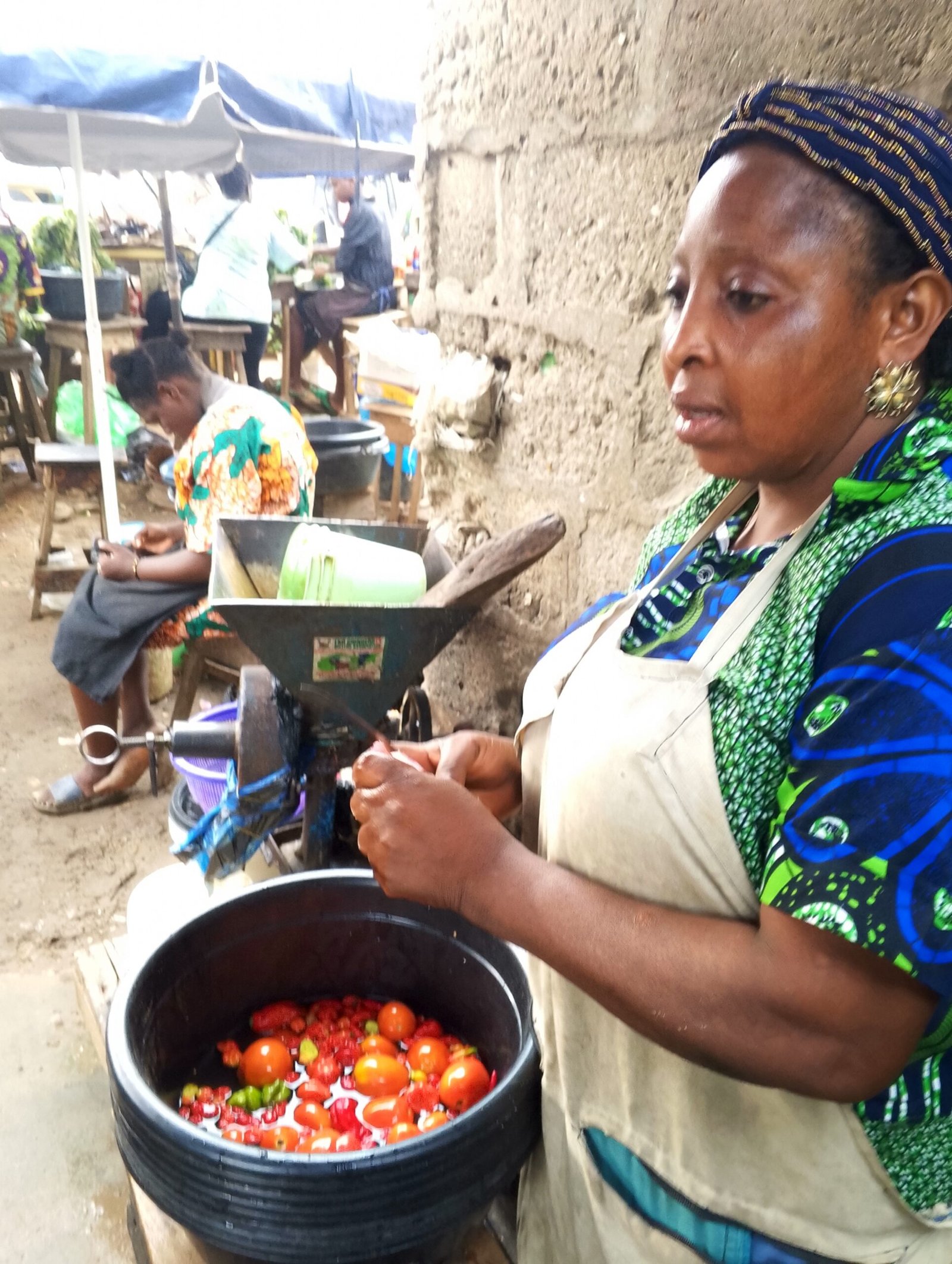
Mrs. Kudirat Salami, grinding machine operator processing pepper at a busy Nigerian Igando market amid rising food safety concerns, highlighted a persistent challenge. (Photo Credit: Korede Abdullah/ AHR, 2026)
LAGOS, Nigeria – In the bustling rhythm of Nigeria’s local markets, the grinding machine is a constant—whirring through peppers, tomatoes, and grains that will end up on millions of plates. It is fast, affordable, and indispensable. But beneath the familiar hum, a quieter concern is growing: could these everyday machines be silently contaminating the nation’s food?
A wave of warnings from scientists, regulators, and lawmakers has ignited fresh scrutiny over locally fabricated grinding machines—raising urgent questions about food safety, public health, and the cost of regulatory neglect. Korede Abdullah, writes.
A Routine Tool Under Suspicion
For decades, grinding machines have been a cornerstone of Nigerian food preparation, especially in urban and peri-urban communities where households depend on shared facilities in markets.
Yet recent findings by the Federal Institute of Industrial Research, Oshodi (FIIRO) suggest that what has long been trusted may now require closer inspection.
The institute has raised concerns that some machines—particularly poorly fabricated or poorly maintained ones—could introduce harmful substances into food.
Among the risks identified are non-food-grade metals, rust particles, lubricant leaks, and bacterial contamination arising from inadequate hygiene practices.
Experts warn that prolonged exposure to such contaminants may contribute to serious health conditions, including organ damage and cardiovascular complications.
However, they are careful to draw a distinction: the issue is not local fabrication itself, but weak standards and inconsistent enforcement.
“We Take Hygiene Seriously”
Faced with growing public concern, operators insist they are not ignoring the risks.
In an exclusive interview with Africa Health Report, Chairman of the Lagos State Grinding Machine Operators, Igando Branch, Mr. Olayiwola Waheed, defended the practices of his members.

“We take hygiene very seriously. As an association, we hold weekly meetings where we discuss cleanliness, environmental sanitation, and proper handling of customers’ food items,” he said.
According to Waheed, these meetings serve not only as reminders, but as accountability platforms where lapses are addressed and standards reinforced.
Policing Cleanliness from Within
Within the association, hygiene is not optional—it is enforced.
“Members who fail to comply with hygiene standards can be sanctioned, ranging from warnings to temporary suspension,” Waheed explained.
Daily cleaning routines are mandatory, including the dismantling and washing of machine components.
“It is mandatory for every operator to remove the stone component of the grinding machine at the end of each day… to remove remnants of pepper or any other items previously ground.”
During operations, operators are expected to use clean water and dispose of waste properly—measures aimed at reducing contamination risks in real time.
Between Assurance and Anxiety
Despite these assurances, Waheed acknowledged that risks remain—particularly where standards are not upheld.
“We understand those concerns, and they are valid to an extent,” he said, referring to FIIRO’s warnings.
He pointed to rust, substandard metals, and lubricant contamination as potential hazards—while maintaining that stronger regulatory enforcement, not the abandonment of local fabrication, is the solution.
“Contamination could lead to serious health consequences, including organ damage and cardiovascular problems.”
Voices from the Market Floor
At Igando Market, where grinding machines operate daily under intense demand, operators describe a balancing act between maintaining hygiene and navigating infrastructural limitations.
Mrs. Bose Akinwale emphasised routine cleaning:
“We clean our machines every day after work… so no pepper or dirt will remain inside.”
Customers, she noted, often insist on observing the cleaning process—an indication of rising awareness.
“Water supply can be limited, but we still try our best to keep everything clean.”
Janet Oladele echoed these concerns, calling for government support.
Operators say they understand the risks—but stress that better infrastructure, particularly water access and waste systems, is essential for consistent compliance.
Lawmakers Step In
The growing alarm has reached Nigeria’s legislative chambers.
In March, the House of Representatives called for an urgent investigation into the safety of locally fabricated grinding machines.
Lawmaker Wale Raji warned that some machines may contain dangerous levels of heavy metals—including lead, cadmium, chromium, nickel, and manganese—reportedly exceeding international safety limits.
He cautioned:
“Prolonged exposure could lead to serious diseases including kidney failure, liver damage, and cancer.”
Science Confirms the Risk
FIIRO’s Director-General, Jummai Adamu Tutuwa, confirmed that research has detected heavy metals in certain machines used for food processing.
She identified contaminants such as lead, cadmium, chromium, nickel, and manganese—elements that can accumulate in the body over time with serious health implications.
In response, the institute has developed a stainless-steel grinding machine designed to minimise contamination risks and improve food safety standards.
The innovation, experts say, could represent a turning point—if adopted widely.
Regulation Tightens—But Gaps Remain
At the local level, authorities say enforcement is being strengthened.
Aderemi Aiyegbusi, Director of Environmental Health Services at Igando-Ikotun LCDA, confirmed increased monitoring of operators.
“We are monitoring how these machines are maintained and cleaned because poor hygiene can lead to contamination,” he said.
Inspection teams have been deployed, fines imposed, and arrests made for sanitation violations. Monthly environmental sanitation exercises and public education campaigns are also underway.
Yet enforcement remains uneven—and for many operators, compliance is shaped as much by available resources as by regulation.
A System Under Pressure
The grinding machine controversy exposes a broader tension within Nigeria’s informal economy: the reliance on affordable, locally fabricated solutions in the absence of robust industrial alternatives.
For millions, these machines are not optional—they are essential.
But as health concerns mount, the question becomes unavoidable: how can safety be guaranteed without disrupting livelihoods?
Experts argue that the answer lies in collaboration—between regulators, manufacturers, operators, and health institutions.
Standardised production guidelines, certification systems, routine inspections, and operator training could help bridge the gap between necessity and safety.
The Cost of Inaction
For now, the risks remain largely invisible—microscopic particles, unseen bacteria, silent accumulation.
But their impact may be anything but invisible.
Every contaminated meal carries potential consequences, particularly for vulnerable populations already facing healthcare challenges.
The grinding machine, once a symbol of convenience, now sits at the centre of a growing public health debate.
A Call for Balance
As Nigeria grapples with this issue, one thing is clear: the solution is not fear—but reform.
Stronger regulation, improved infrastructure, and public awareness must move in tandem.
Operators like Waheed say they are ready to cooperate.
Authorities say they are stepping up enforcement.
Researchers are offering safer alternatives.
What remains is alignment—and urgency.
Because in a country where millions rely on these machines daily, ensuring their safety is not just a technical issue.
It is a matter of public health—and public trust.
About the Author



 Mirian Gom