

ABUJA, Nigeria – On a hot afternoon in Abuja, a young boy tears open a small plastic bag with his teeth and gulps the water inside. It is a familiar ritual repeated millions of times every day across Nigeria—in markets, motor parks, construction sites and university campuses.
The small sachet is popularly called “pure water”. For millions of Nigerians, it is the most affordable and accessible source of drinking water.
But recent studies paint a troubling picture.
Between 2023 and 2025, laboratory tests in several Nigerian regions revealed up to 95 percent contamination in some sachet water samples, while faecal coliform bacteria were found in 55 percent of the samples tested—a strong indicator of possible sewage contamination.
In a country where sachet water is consumed by tens of millions daily, the implications are stark: the water many Nigerians rely on to survive may be quietly making them sick. Edino Cornelius, writes
A Nation Dependent on “Pure Water”
Across Nigeria’s bustling cities, sachet water has become an indispensable commodity.
From roadside kiosks to open markets and university hostels, the transparent plastic bags stacked in coolers offer quick relief from the tropical heat.
For low-income households and students, the choice is often simple: drink sachet water or remain thirsty.
But confidence in its safety is increasingly fading.
John Elias, a resident of Abuja, says he stopped drinking sachet water entirely after repeated unpleasant experiences.
“I don’t even drink pure water anymore because if you look at it very well, not all the factories produce clean and drinkable water,” he said.
“I have noticed some strange taste in some sachet water, and it is not supposed to be so. I stopped taking it just to be on the safer side.”
His concerns reflect growing unease among consumers who suspect that many producers operate without adequate hygiene standards.
Students Trapped Between Cost and Risk
At Prince Abubakar Audu University, sachet water remains the most common source of drinking water for students.
For many, avoiding it is simply unrealistic.
Rufai Abdullahi, a student on campus, says affordability drives the decision.
“I am used to taking sachet water already, and I am very sure that about 85 percent of these pure water factories do not preserve the water properly,” he said.
“Sometimes it tastes like there is a chemical in it. This is what most of the masses drink, and it is not good for health.”
Bottled water often costs several times more than sachet water. For students living on tight allowances, the cheaper option often wins—even when doubts remain about its safety.
Hospitals See the Consequences
Health workers say the consequences of unsafe water are visible in clinics and hospitals across the country.
Mrs Mercy Enimola, a healthcare practitioner in Lokoja, warns that contaminated water remains a major contributor to preventable diseases.
“The kind of water taken into the human body is very important to health,” she explained.
“Bad water can bring about diseases and illnesses like fever, typhoid, and even cholera, which are all harmful to human health. The need for properly preserved and hygienic water cannot be overemphasized because it promotes healthy living.”
Waterborne illnesses such as diarrhoea, typhoid and cholera continue to affect thousands of Nigerians annually, particularly children.
In severe cases, prolonged exposure to contaminated water can also contribute to kidney complications and long-term gastrointestinal problems, according to public health experts.
Hidden Contaminants in the Water
Scientific studies conducted between 2023 and 2025 uncovered alarming contamination levels in sachet water samples across several Nigerian regions.
Laboratory tests detected:
Faecal coliform bacteria
Escherichia coli (E. coli)
High microbial loads
Chemical contamination in some samples
The presence of faecal coliform bacteria is particularly concerning because it suggests contamination from human or animal waste.
This means the water may have been exposed to polluted sources or unhygienic handling during production.
A Regulatory System Under Fire
Nigeria’s sachet water industry is regulated by the National Agency for Food and Drug Administration and Control, widely known as NAFDAC.
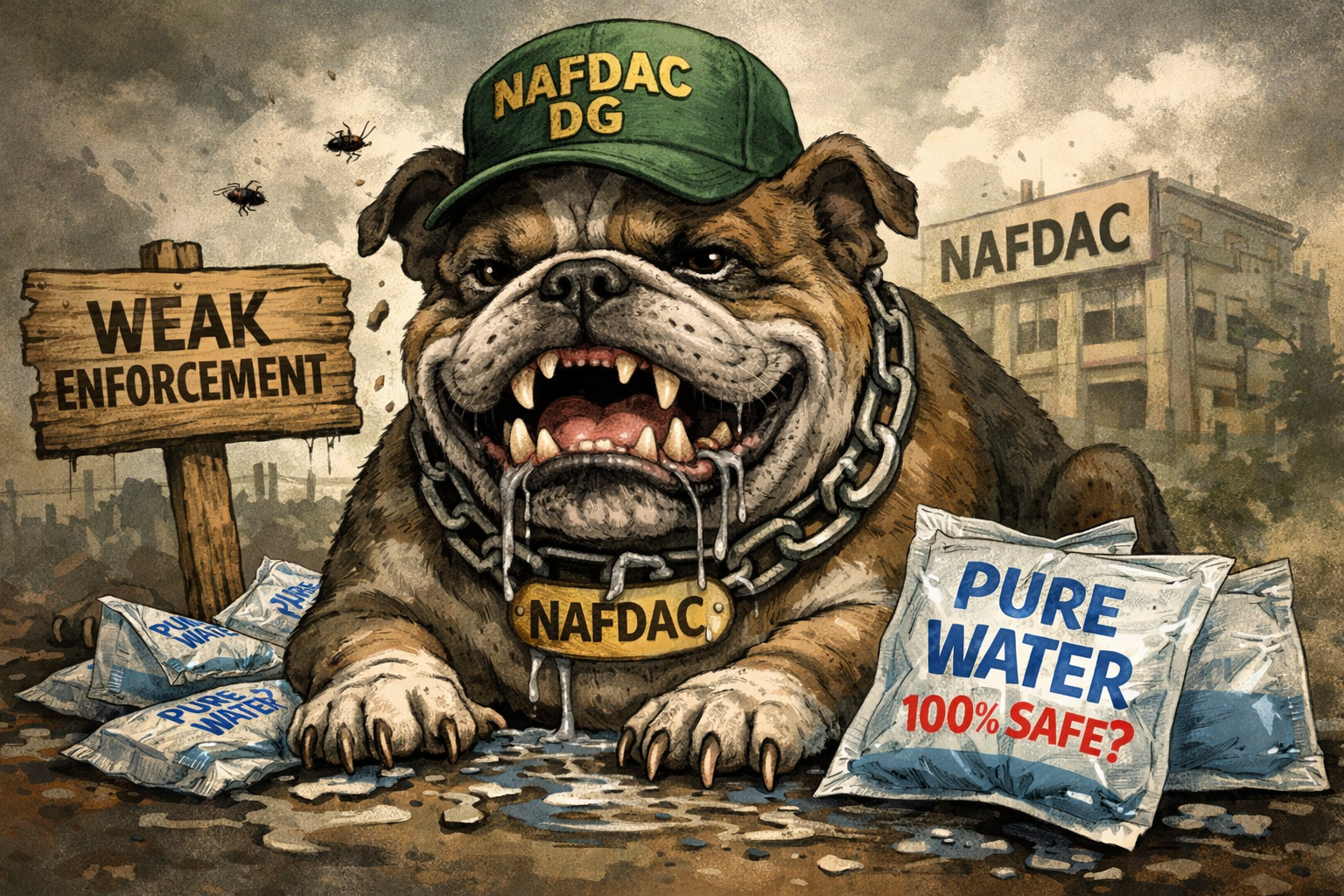
But critics say enforcement has weakened over the years.
During the tenure of Dora Akunyili, the agency gained international recognition for aggressively tackling counterfeit drugs and unsafe products.
Factories were raided. Illegal producers were shut down. Offenders were prosecuted.
Her tough stance earned widespread respect and restored confidence in regulatory oversight.
Today, however, many public health advocates say that momentum has faded.
Mrs Enimola did not hide her frustration.
“NAFDAC needs to step up its actions. There should be regular inspections to fish out unrecognized pure water factories and ensure the water produced is safe,” she said.
“Right now, their approach appears weak and ineffective.”
Several stakeholders interviewed for this report echoed similar sentiments.
Some described the agency as a “toothless bulldog”—an institution with the authority to regulate but lacking the enforcement power needed to eliminate unsafe producers.
The Hidden World of Illegal Factories
Nigeria’s sachet water industry is vast and fragmented.
Thousands of small-scale factories operate across the country, producing millions of sachets every day.
While many comply with regulations, others operate without proper licensing or quality control.
In some cases, production takes place in converted residential buildings or hidden industrial spaces.
Without frequent inspections, such facilities can remain undetected for long periods.
Environmental health officers say limited manpower and funding make it difficult to monitor every producer.
Danger Beyond the Factory
Even when water leaves factories safely, contamination risks do not disappear.
Most sachet water is sold by street vendors who store the products under challenging conditions.
Stacks of sachets are often exposed to direct sunlight for hours.
Public health experts warn that heat exposure can degrade plastic packaging and encourage bacterial growth.
Dust, repeated handling and poor storage conditions further increase the risk of contamination.
Yet vendors often have few alternatives.
For many, selling sachet water is a vital source of income.
Families Paying the Price
When contaminated water leads to illness, families often bear the financial and emotional burden.
Parents may spend scarce resources on medical treatment while losing valuable workdays.
Children, meanwhile, face repeated bouts of illness that can affect school attendance and development.
For households already struggling with rising living costs, a simple drink of water can trigger a chain of economic hardship.
The Bigger Water Crisis
Nigeria’s reliance on sachet water reflects a deeper structural problem: limited access to safe public water systems.
In many cities, municipal water supply is unreliable or nonexistent.
Residents therefore depend on private boreholes, vendors and sachet water producers.
The sachet water industry has filled this gap—but often without the robust regulation needed to guarantee safety.
Public health advocates say the long-term solution lies in strengthening both water infrastructure and regulatory enforcement.
Reclaiming Public Trust
Experts say restoring trust in sachet water will require decisive action.
Key recommendations include:
Regular factory inspections by NAFDAC
Random laboratory testing of sachet water brands
Strict penalties for illegal producers
Improved storage standards for vendors
Public awareness campaigns on safe water consumption
Many believe Nigeria’s regulatory institutions must rediscover the fearless enforcement that once defined the era of Dora Akunyili.
Her legacy, they say, proves that strong leadership can transform public health protection.
A Sip of Uncertainty

As dusk settles over Abuja, vendors continue to sell sachet water to commuters heading home.
The familiar ritual repeats across the city.
A plastic sachet is torn open.
A quick drink follows.
For millions of Nigerians, it is a moment of relief from the heat.
But until stronger safeguards guarantee the safety of what lies inside the plastic bag, every sip carries a lingering question.
Is the water truly pure—or a hidden public health gamble?



Join the conversation