
Under the Gun: Northern Nigeria’s Villages Trapped in a New Cycle of Blood, Kidnappings, Fear
 Hussaini Ibrahim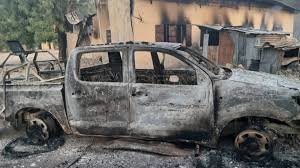
Aftermath of insurgent attack in Ngoshe community, Borno State.
KANO, Nigeria – In the quiet farming communities scattered across Northern Nigeria, nightfall once meant rest after long hours in the fields. Today, it often signals something else: the rumble of motorcycles, the crack of gunfire, and the desperate scramble for survival.
Across villages in Zamfara State, Katsina State, Kaduna State, and parts of Borno State, communities say they are once again living under the shadow of violent attacks and mass kidnappings.
Within the first two months of 2026 alone, at least five major attacks across Northern Nigeria have left more than 270 people dead and over 215 abducted, according to local accounts and security monitoring groups. In some cases, entire villages have been emptied overnight as terrified residents flee into forests or nearby towns.
For many families, however, the numbers barely capture the depth of the crisis. Behind every statistic is a story of shattered households, anxious parents, and communities struggling to hold on to normal life amid recurring violence.
Recent attacks—including a deadly assault on Ngoshe—have renewed fears that armed groups, including bandits and insurgents, are regaining momentum in parts of the region.
Survivors recount a night of terror
In this report, Hussaini Ibrahim reports that for survivors of the January attacks in rural Kaduna, the memories remain raw.
Gunmen reportedly stormed a community in the dead of night, firing sporadically and abducting dozens of residents.
Thirty-two-year-old farmer Musa Yakubu said the attack plunged the village into chaos.
“They came heavily armed and started shooting into the air. People were running in different directions. Some of us escaped into the forest, but many others were taken away,” Yakubu told AHR.
According to him, the assault lasted for hours as villagers hid in surrounding bushes, unsure whether the attackers had left.
Another survivor, Zainab Abdullahi, who was later rescued after days in captivity, described the ordeal in harrowing terms.
“They tied our hands and forced us to walk for hours into the forest,” she said. “We had little food and water. Some elderly people could not continue walking and were beaten by the kidnappers.”
Even after regaining her freedom, the trauma lingers.
“Even now, whenever I hear the sound of motorcycles at night, I panic,” she said quietly.
A Deadly Raid in Borno Deepens Fear
The anxiety across Northern Nigeria intensified on 4 March, when suspected fighters linked to Boko Haram and Islamic State West Africa Province reportedly invaded Ngoshe in Gwoza Local Government Area.
Residents say the attackers arrived on motorcycles and gun trucks before opening fire.
Local sources confirmed that at least 20 people, including civilians and security personnel, were killed during the raid.
Among the victims was a local imam who was reportedly shot when insurgents stormed a mosque during the assault.
Villagers say the attackers abducted more than 300 residents, mostly women and children, forcing thousands to flee to nearby Pulka and surrounding settlements.
One resident who escaped described the panic.
“The terrorists came around the evening time. They were shooting everywhere and people started running into the mountains. Many women and children were taken away,” the source told AHR.
Security analysts say the attack underscores renewed insurgent activity around the Mandara Mountain range, a rugged terrain straddling Nigeria’s border with Cameroon.
Following the assault, Babagana Umara Zulum assured residents that security agencies had intensified search and rescue operations.
Yet the attack has unsettled communities in the North-East who had only recently begun returning home after years of displacement.
Families Left Waiting
Across affected states, the pain of uncertainty continues to haunt families whose loved ones were taken.
In Katsina State, Ibrahim Sani said his younger brother was abducted during an attack on their village.
“We have not heard from him since the day he was taken,” Sani said in a telephone interview with AHR. “Every day our mother cries and asks if there is any news.”
According to him, the kidnappers later contacted the family demanding a ransom they could not afford.
“They asked for millions of naira. We are farmers. Where can we get such money?” he asked.
A similar story is unfolding in Zamfara State, where Aisha Muhammad says her husband was abducted alongside several villagers while returning from their farm.
“My children keep asking when their father will come back,” she said softly. “I have no answer for them.”
When Ransom Fails
The brutality of kidnapping networks was further highlighted in a case that has spread widely across northern communities.
A National Youth Service Corps member identified simply as Abba was reportedly abducted while travelling from Zamfara to Sokoto.
Family sources say the kidnappers demanded ₦10 million, which was paid. Yet the abductors allegedly refused to release him, instead demanding three additional motorcycles before cutting communication.
Relatives waited for days, hoping for news that never came.
For many residents, the incident symbolises the deepening cruelty of criminal networks operating across Northern Nigeria.
Alarm from Community and Religious Leaders
Traditional and religious leaders say the resurgence of attacks exposes serious security gaps in rural communities.
A traditional leader in northern Zamfara, Alhaji Bashir Bello, said remote villages remain especially vulnerable.
“Our villages are far from major towns, and security presence is limited,” Bello told AHR. “When attackers strike, it takes hours before help arrives, if it arrives at all.”
He called for permanent military formations in vulnerable areas.
“We need permanent security formations in these communities, not occasional patrols,” he said.
Religious leaders also warn that fear is reshaping everyday life.
An Islamic cleric in Kaduna, Sheikh Abubakar Muhammad, said insecurity is disrupting livelihoods.
“People are afraid to travel to farms, markets, or even attend social gatherings,” he said. “Insecurity affects every aspect of community life.”
The debate has even spilled into religious circles.
In Damaturu, cleric Sheikh Alkali Abubakar Salihu Zaria was recently suspended from delivering Ramadan Tafsir after publicly criticising political leaders over insecurity.
In sermons that circulated widely online, the cleric lamented the rising wave of abductions, saying victims were being treated “as though they were cattle”.
Officials of Jama’atu Izalatil Bid’ah Wa Iqamatis Sunnah later said the suspension was intended to prevent tensions from escalating.
Experts Warn of Evolving Threats
Security analysts say the resurgence of violence suggests armed groups are adapting their tactics.
Abuja-based security expert Dr Kabiru Sulaiman said many groups regroup after military operations.
“Many of these armed groups operate in difficult terrain such as forests and border regions,” he told AHR. “When security pressure reduces, they tend to reorganise and launch new attacks.”
He noted that kidnapping for ransom has become a major financial engine for criminal networks.
“These groups rely heavily on ransom payments to sustain their operations. This makes kidnapping a persistent threat.”
Retired security officer Col. Abba Lawan (retd.) added that intelligence gathering must improve.
“Security agencies cannot succeed without cooperation from local communities,” he said. “People must be encouraged to share information about suspicious activities.”
Civil Society Demands Stronger Protection
Civil society organisations argue that the crisis requires deeper structural solutions.
A programme officer with the Resource Centre for Human Rights and Civic Education, Hajiya Fatima Idris, said repeated attacks reveal systemic failures.
“Communities across Northern Nigeria are facing repeated violence,” Idris said. “The government must strengthen preventive strategies rather than responding only after attacks occur.”
She stressed that protecting vulnerable communities must remain a priority.
“Every life lost in these attacks represents a failure of the system to protect citizens,” she added.
Human rights lawyer Barrister Musa Garba said the roots of insecurity also lie in economic hardship.
“Poverty, unemployment, and weak governance structures contribute to the problem,” he said. “Security measures must be combined with social and economic interventions.”
A Region Living with Uncertainty
For millions across Northern Nigeria, daily life has become a balancing act between survival and fear.
Farmers hesitate to venture into distant fields. Traders worry about travelling between towns. Parents remain anxious about the safety of their children.
In a rural Kaduna community, Malam Suleiman Ibrahim said the atmosphere has fundamentally changed.
“In the past, people slept peacefully,” he said. “Now many villagers take turns staying awake at night to watch for possible attackers.”
A Crisis Still Unfolding
The resurgence of kidnappings and violent raids is a stark reminder that insecurity remains one of Nigeria’s most complex national challenges.
Security experts, community leaders, and civil society groups say addressing the crisis will require sustained military pressure, improved intelligence, and deeper collaboration between authorities and local communities.
For families still waiting for abducted relatives, however, the urgency is painfully personal.
Until meaningful change arrives, many villages across Northern Nigeria remain suspended between hope and fear—unsure whether the next night will pass quietly, or erupt once again into violence.
About the Author

 Oluwafunbi Bello
 Hope Ajayi
 Mirian Gom
 Edino Chubiyo Cornelius