
 Mirian Gom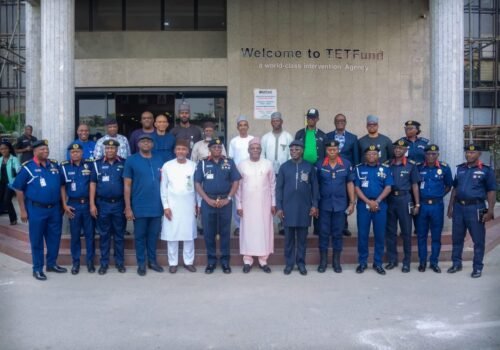
Abuja, Nigeria – Nigeria faces a deepening school safety crisis as over 60,000 of the country’s 81,000 schools remain porous and poorly secured, according to the Nigeria Security and Civil Defence Corps (NSCDC).
The disclosure means more than 74 per cent of Nigerian schools lack basic fencing or trained security personnel, leaving millions of pupils vulnerable despite ongoing government interventions.
The Commandant General, NSCDC, Dr Ahmed Audi, reveals the findings during a courtesy visit to the Tertiary Education Trust Fund (TETFund) on Thursday in Abuja.
“Our survey identifies over 81,000 schools nationwide, with more than 60,000 lacking fencing or security personnel,” Audi says. “School safety must be a whole-of-society responsibility, not left to the government alone.”
Although Audi said that the attacks on schools decline since the launch of the Safe Schools Initiative, he warns that gaps in infrastructure and manpower continue to expose learning environments to threats. He says the Corps intensifies collaboration with the military, police, local communities and traditional institutions to sustain recent gains.
TETFund Executive Secretary, Arc. Sonny Echono, welcomes the NSCDC’s engagement and pledges institutional support. “We will do everything possible to ensure Nigerian students are safe while learning,” he says, stressing that security remains fundamental to educational development.
Echono also addresses the Federal Government’s decision to extend the Tertiary Education Research and Application Service (TERAS) platform to private tertiary institutions, describing it as a move towards inclusive education. “We are not building facilities for private universities,” he says. “We are promoting an inclusive system where every Nigerian child has access to quality academic content.”
The TERAS platform provides free access to global academic resources, online lectures, journals, plagiarism checkers and subsidised data. Echono confirms that over 300 private institutions, including 120 private universities, are now eligible.
On funding reforms, Echono says the transition from education tax to a development levy broadens revenue generation, adding that TETFund funding grows by more than 100 per cent under the current administration.
About the Author



 Hope Ajayi