Stolen Classrooms, Stolen Futures: How Educating Girls Could Rewrite Northern Nigeria’s Destiny
 Hussaini Ibrahim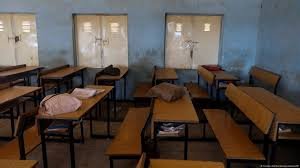
A deserted classroom in Zamfara State — a stark reminder of Nigeria’s unfulfilled promise to make schools safe for every child. (Image: Internet)
KANO, Nigeria – On a quiet morning in Tsafe, Zamfara State, the silence inside a once-bustling secondary school tells a brutal story. Desks sit empty. Chalkboards gather dust. The laughter of girls who once filled the classrooms has faded, replaced by the weight of early marriages, unpaid labour and fear driven by poverty and insecurity. This is not an isolated scene but a portrait of Northern Nigeria’s unfolding crisis—one in which tens of thousands of adolescent girls are denied the chance to complete secondary school. According to new evidence presented by UNICEF in Abuja in December 2025, the cost of this exclusion is staggering, not only for the girls themselves but for the nation’s social and economic future.
The data is unequivocal. If every girl in Northern Nigeria completed secondary school, child marriage could fall by as much as two-thirds, while adolescent pregnancy rates would drop sharply. Beyond the social gains, the economic case is striking: a targeted investment of $114 million in out-of-school girls aged 10 to 18 in just two northern states could generate up to $2.5 billion—about ₦3.6 trillion—in long-term societal benefits. That is a 21-to-1 return. For a region grappling with poverty, displacement and insecurity, such figures offer a rare glimmer of hope. Hussaini Ibrahim, writes.
A region left behind
Northern Nigeria carries one of the heaviest global burdens of child marriage. UNICEF estimates that more than 3.7 million Nigerian women aged 20 to 24 were married before their 18th birthday, with rates in the North-East and North-West approaching 50 per cent. At the same time, of Nigeria’s 7.6 million out-of-school girls, roughly half live in the North.
The reasons are complex but deeply rooted. Poverty forces families to make painful trade-offs, often prioritising boys’ education or immediate survival over girls’ schooling.
Insecurity—particularly in states affected by banditry and insurgency—keeps many girls away from classrooms. Cultural norms and social expectations, meanwhile, continue to frame early marriage as an acceptable or even desirable path.
In Tsafe, these pressures converge. “Most of my students dropped out last year to get married or to work and support their families,” said Amina Bello, a teacher who runs a small girls’ empowerment club in the community. “They were bright, curious girls. Now many of them are wives before they are adults.”
Dreams deferred
Behind the statistics are individual lives shaped by difficult choices. Fatima Ibrahim, 15, still clings to her ambition of becoming a doctor. But her future is uncertain. Her father, struggling to feed his family, is considering marrying her off to ease the household burden.
“I want to stay in school,” Fatima said softly. “But sometimes it feels like my dreams don’t matter.”
Her words echo across the region. In Kano, mother-of-four Hajara Yusuf described the impossible decisions facing many parents. “I want my daughters to learn,” she said. “But when money is short, marriage seems easier. School does not put food on the table today.”
Such testimonies underline the human cost of systemic failure—one that perpetuates cycles of poverty, ill health and limited opportunity.
The power of education
Yet evidence consistently shows that education is one of the most powerful tools for breaking these cycles. Studies cited by UNICEF and development partners indicate that each additional year of secondary schooling can increase a girl’s future earnings by 15 to 25 per cent. Educated girls are more likely to marry later, have healthier children and contribute productively to their communities.
The benefits ripple outward. Lower rates of child marriage and adolescent pregnancy reduce maternal and infant mortality. Higher female participation in the workforce boosts household incomes and national productivity. Over time, these gains translate into stronger economic growth and social stability.
“This is not charity,” said Omoniyi, Programme Director at the Resources Centre for Human Rights and Civic Education (CHRICED). “It is a smart investment. Empowered girls grow into women who strengthen families, communities and economies. The returns are measurable.”
Civil society steps in
With government resources stretched thin, civil society organisations have stepped in to fill critical gaps. CHRICED works across northern states to keep girls in school through mentorship programmes, community engagement and policy advocacy.
“We engage parents, traditional leaders and policymakers,” Omoniyi explained. “When communities understand that educating girls benefits everyone, resistance begins to soften.”
These interventions, though impactful, operate on limited budgets. Advocates warn that without broader state and federal commitment; progress will remain fragmented.
The role of government
Officials in state ministries of education, gender and social development acknowledge the scale of the challenge. Some progress has been made through school rehabilitation projects and conditional cash transfer programmes designed to support vulnerable families. But experts caution that such initiatives must be expanded and sustained.
“Adolescent girls must be prioritised in budgets and programme design,” said one education official in Abuja who was not authorised to speak on record. “Without long-term planning, we risk losing another generation.”
The stakes are high. More than three million children have been displaced by conflict in the North-East alone, while poverty remains widespread in the North-West. In this context, failing to invest in girls’ education is not merely a social oversight—it is a development risk.
A national imperative
UNICEF-backed evidence and the lived experiences of girls like Fatima point to a clear conclusion: closing the education gap for girls in Northern Nigeria is essential for national progress. The cost of inaction—measured in lost potential, stunted growth and entrenched inequality—is far greater than the price of intervention.
“The data is clear,” Omoniyi said. “Northern Nigeria’s future hinges on turning evidence into action. Every girl kept in school represents a stronger, healthier and more prosperous society.”
As Nigeria looks to secure its future, the empty classrooms of Tsafe stand as both a warning and a possibility. With targeted investment, political will and community engagement, those rooms could once again fill with voices—girls learning, dreaming and shaping a destiny that benefits the entire nation.
About the Author


 Hope Ajayi
 Mirian Gom