


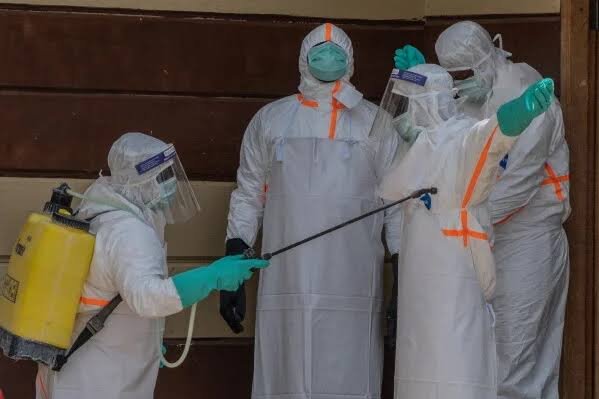
ABUJA, Nigeria – Nigeria’s efforts to prevent an imported Ebola infection from triggering a fresh outbreak are facing a critical test, even after the infected traveller was evacuated to Switzerland. From airport QR-code screening and quarantine to contact tracing and emergency funding, Oluwatobi Adu examines the people, public health systems and preparedness gaps shaping the country’s response as 62 contacts remain under surveillance.
BEYOND AIRPORT SCREENING: TRAVELLERS FACE NEW HEALTH CHECKS
For Nigerians arriving from abroad, the Ebola case has introduced another layer of public health checks into the routine airport experience.
Folashade, an entrepreneur and media aide to a senator who recently returned from France, told Africa Health Report that she first learnt about the case through online reports while still abroad. A day later, her travel agent sent her an online health declaration form from the Nigeria Centre for Disease Control and Prevention (NCDC). She provided her personal information and travel details, completed a health assessment and received a QR-code certificate.
She welcomed the arrangement, describing it as a useful tool for identifying travellers and supporting contact tracing if an infection is detected. “I think it is a very good measure, and it will make it easier to trace any case and their contacts. According to my agent, the form would be used for contact tracing if any traveller develops symptoms. It is a useful way of ensuring that information about travellers is available when needed,” she said.
Mrs. Cynthia Olakunle, an ITF official and entrepreneur travelling to China to source goods, also underwent the additional screening procedures. She said she had seen reports of the Ebola case online before travelling. At the airport, officials checked her temperature and instructed her to scan a QR code linked to an NCDC health declaration form.
The form required her personal and travel information, a health assessment and the generation of a QR-code certificate. Olakunle described the measures as encouraging but stressed the need for regular public updates. “If you ask me, the measures put in place are solid, since the symptoms will not show until after 21 days. All I want from the government is to keep us updated about it,” she said.
Their experiences show how digital health declarations and temperature checks are being used to strengthen information gathering at Nigeria’s entry points. However, airport screening alone cannot guarantee that every infected traveller will be identified.
WHY AIRPORT SCREENING ALONE CANNOT STOP EBOLA
Epidemiologist Dr Charles Adeyemo told Africa Health Report that screening at entry points has limitations, particularly when infected travellers have yet to develop symptoms. “No screening system can guarantee that every infected person will be identified at the point of entry, particularly when the person has not developed symptoms,” he said.
Ebola disease has an incubation period of two to 21 days. Consequently, an infected person may arrive in Nigeria without symptoms and become ill several days later. Adeyemo said effective outbreak investigation must consider a traveller’s arrival date, exposure history, symptom onset, information provided at the airport and the timeline of clinical assessment and laboratory confirmation. He stressed that temperature checks and health declaration forms must be supported by post-arrival surveillance, early clinical recognition, contact tracing and clear referral pathways.
The accuracy of information supplied by travellers is also critical. People who report possible exposure but have no symptoms require risk assessments by trained health personnel. Depending on their exposure, they may need active monitoring or other public health measures.
Anyone who develops symptoms must receive prompt medical evaluation under appropriate infection prevention and control procedures.
Adeyemo identified contact tracing as one of the most important measures for preventing an imported infection from developing into a wider outbreak. However, he warned that incomplete travel information, delayed reporting, inadequate personnel, poor coordination and difficulties reaching contacts could undermine the response.
Stigma may also discourage people from cooperating with health authorities. Reflecting on Nigeria’s successful containment of Ebola in 2014, he cautioned against assuming that past achievements automatically guarantee present readiness.
He said the country must continually assess its workforce, equipment, funding, laboratory capacity and emergency coordination systems. Digital tools can accelerate information collection and sharing, but their effectiveness depends on accurate records, staff training, data protection, reliable systems and consistent follow-up.
INSIDE NIGERIA’S EBOLA RESPONSE: WHAT THE NCDC BOSS REVEALED
In an interview on Channels Television’s Politics Today, monitored by Africa Health Report, NCDC Director-General Dr Jide Idris provided details of the imported case, the investigation and the measures introduced to contain the infection.
According to Idris, the patient arrived in Nigeria without symptoms on 3 October and became ill approximately four days later. She visited two hospitals before the infection was identified. The NCDC received information about the suspected case on 19 October, requested samples and confirmed Bundibugyo virus disease on 20 October.
By then, the patient had interacted with several people, making contact identification and monitoring a priority. Idris said health authorities identified primary contacts through the hospitals the patient visited and placed them under 21-day monitoring. The process included twice-daily temperature checks and laboratory testing if symptoms developed. Authorities were also investigating secondary contacts.
At the time of the interview, approximately 40 contacts were in quarantine facilities in Abuja, while six lower-risk contacts were undergoing home-based self-quarantine. Three people tested at the time had returned negative results. The index patient remained positive following retesting in Nigeria but had improved clinically, including recovery from multi-organ complications, before her evacuation to Switzerland.
Her husband tested negative.Idris listed contact tracing, quarantine, laboratory testing, infection prevention and control, surveillance and public education among the measures being implemented. He also clarified that Ebola spreads through direct contact with the blood and other bodily fluids of an infected person or contaminated materials. It does not spread through the air like some respiratory infections. He urged Nigerians to practise hand hygiene, avoid unnecessary physical contact with anyone suspected of having the disease and maintain appropriate hygiene in workplaces and public spaces.
THE HUMAN COST OF QUARANTINE: WHY THE NCDC IS PAYING ₦100,000
Beyond the medical and logistical demands of outbreak control, quarantine has created financial and emotional challenges for people placed under monitoring. Idris disclosed that the NCDC introduced a weekly allowance of ₦100,000 after some quarantined individuals complained that their absence from normal activities was affecting their families and businesses.
He said the allowance was not originally included in the budget. “That was not budgeted for. Those people in the quarantine area were people who never planned to be there. We took them out of their comfort zones and put them there for public health reasons. So we are responsible for their feeding and accommodation,” he said.
According to Idris, the NCDC was already providing accommodation and feeding. The additional financial support was introduced on compassionate grounds. He explained that the arrangements under discussion were largely within the Federal Capital Territory, while state governments ordinarily bear responsibility for quarantine support within their jurisdictions.
Adeyemo said financial assistance could encourage compliance with public health instructions, particularly when quarantine affects people’s ability to earn a living or meet family responsibilities. However, he called for clear information on the allowance’s purpose, eligibility criteria, geographical coverage, administering agency, documentation and payment timelines.
He added that financial support should complement medical advice, psychosocial assistance, essential supplies and regular communication.For outbreak control to succeed, he stressed, people under monitoring must understand why the measures are necessary and receive adequate support to comply.
NIGERIA’S ₦10 BILLION EBOLA INTERVENTION: WHAT THE MONEY WILL FUND
Idris also disclosed a broader ₦10 billion intervention fund designed to strengthen Nigeria’s capacity to respond to infectious disease threats beyond the current Ebola case. According to him, the funding will support preparedness and response to diseases including Lassa fever and yellow fever. It will also cover the rehabilitation of isolation centres and improvements in surveillance and contact tracing.
Other priorities include laboratory reagents, personal protective equipment and operational requirements for public health response teams. The intervention highlights the need to strengthen outbreak preparedness before infections enter the country. Laboratories must be equipped to test suspected cases promptly. Health facilities must recognise unusual symptoms, while public health teams need sufficient personnel and equipment to investigate and monitor contacts.
However, the impact of the ₦10 billion intervention will depend on more than the amount announced. Its timely release, deployment, accountability and measurable improvements in frontline response capacity will determine whether the funding delivers lasting results.
62 CONTACTS UNDER SURVEILLANCE: WHY NIGERIA IS NOT OUT OF THE WOODS
Nigeria’s Ebola investigation has expanded since the first suspected contacts were identified. The number of people listed for monitoring increased from an initial 44 to 53 and subsequently to 62, according to official updates supplied for this report. The monitoring period was expected to conclude on 13 November 2026, provided all identified contacts completed the required follow-up without developing symptoms.
No secondary case had been confirmed in Nigeria by the early-November reporting period. However, the evacuation of the index patient did not signal the end of the public health response. Authorities still needed to monitor exposed individuals, investigate possible additional contacts and ensure that the required follow-up was completed.
Idris emphasised this during his television interview. “We are not out of the woods yet until we are sure that all the contacts have been followed up. The fact that the index case has left does not mean that we don’t have contacts to monitor. We still have to follow them up,” he said. His warning highlights a critical principle of outbreak control: success depends not simply on treating or evacuating an infected person but on preventing further transmission.
NIGERIA’S PUBLIC HEALTH DEFENCES MUST GO BEYOND EMERGENCY MEASURES
Nigeria’s experience with Ebola in 2014 demonstrated the importance of early detection, rapid contact tracing, coordinated response and public cooperation.
However, the current case has again exposed the need to maintain these systems between outbreaks. The country continues to face pressure on its healthcare workforce, laboratories, surveillance networks and emergency response infrastructure. Shortages of trained personnel, brain drain, insecurity and inadequate funding can weaken public health surveillance across a large population. For an imported infection, the challenge extends far beyond airports.
Health facilities must recognise symptoms and take appropriate precautions. Laboratories must confirm suspected cases, while surveillance teams must be able to locate and monitor people who may have been exposed.
Adeyemo warned that Nigeria must not become complacent because of its previous success in containing Ebola. He called for sustained investment in personnel, equipment, laboratory capacity, emergency coordination and reliable digital systems. The challenge is to ensure that the systems activated during the current response remain functional and adequately funded after the immediate threat has passed.
THE REAL TEST: CAN NIGERIA SUSTAIN ITS EBOLA RESPONSE?
The experiences of travellers completing digital health declarations, people undergoing contact monitoring, clinicians treating the index patient and public health teams tracing dozens of contacts reveal the demands of containing an imported infectious disease.
Nigeria’s response has demonstrated the importance of combining airport screening with post-arrival surveillance, rapid laboratory confirmation, effective contact tracing and transparent public communication.
But these measures must continue beyond the immediate emergency. People under monitoring need appropriate medical, financial and psychosocial support. Healthcare workers require adequate training and protective equipment, while federal and state authorities must coordinate their responsibilities.
Digital tools can improve information collection and sharing, but their value depends on reliable systems, accurate records and personnel capable of acting on the information. As Adeyemo emphasised, every imported case provides an opportunity to review public health systems and address weaknesses. Idris, meanwhile, made clear that the response cannot be considered complete until all identified contacts have completed monitoring.
For travellers scanning QR codes at airports, families awaiting updates and health workers on the frontline, the measure of success is straightforward: early detection, interrupted transmission and lives protected. Nigeria’s response must therefore become more than a temporary emergency mobilisation. It must strengthen the country’s long-term investment in outbreak preparedness, patient safety and accountable public health institutions.


Join the conversation