 Korede Abdullah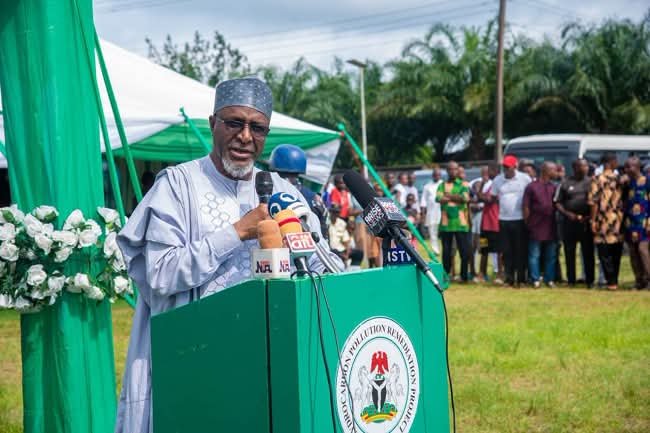
Minister of Environment, Balarabe Abbas-Lawal
ABUJA, Nigeria – Nigeria requires an estimated $237 billion between 2026 and 2030 to finance climate change mitigation and adaptation measures, the Federal Government has said.
The Minister of Environment, Balarabe Abbas-Lawal, represented by the Director of the Department of Climate Change, Dr Inyogwa Adeleye, disclosed this on Saturday at the Climate Change and Circular Economy Africa 2026 conference in Abuja.
Adeleye said climate change was increasingly affecting Nigeria’s economy, food security and livelihoods through flooding, drought, rising temperatures and other extreme weather events.
He said Nigeria could no longer depend mainly on the conventional “take, make and dispose” economic model.
He called for increased investment in renewable energy, sustainable agriculture, recycling, waste management, green buildings, sustainable transportation and climate-resilient water systems.
The director also said Nigeria’s commitment to global climate action must be supported by stronger policies and regulations capable of driving the country’s transition to a greener economy.
The conference convener, Zigwai A. Fanda, said the estimated $237 billion financing requirement should not be viewed only as a funding challenge.
She said it could also create opportunities for Nigerian businesses and technologies to develop solutions around waste and resource recovery.
According to Fanda, plastics, electronic waste, discarded food and agricultural residues could be converted into valuable raw materials.
Senator Ireti Kingibe, represented by her Head of Office, Becky Frank, said Nigeria could unlock an estimated $15 billion circular economy market and create hundreds of thousands of sustainable jobs.
Kingibe called for stronger legislation on extended producer responsibility, tax incentives for green technology businesses and integrated waste management.
She also advocated gender-responsive climate programmes to ensure that women and other vulnerable groups benefit from the green transition.
Kingibe noted that Africa contributes less than 4% of global greenhouse gas emissions but remains highly vulnerable to the effects of climate change.
About the Author


 Mirian Gom