
On the Brink: How Years of Official Neglect Turned a Mararaba Community into an Erosion Disaster Zone
 Abah Felicity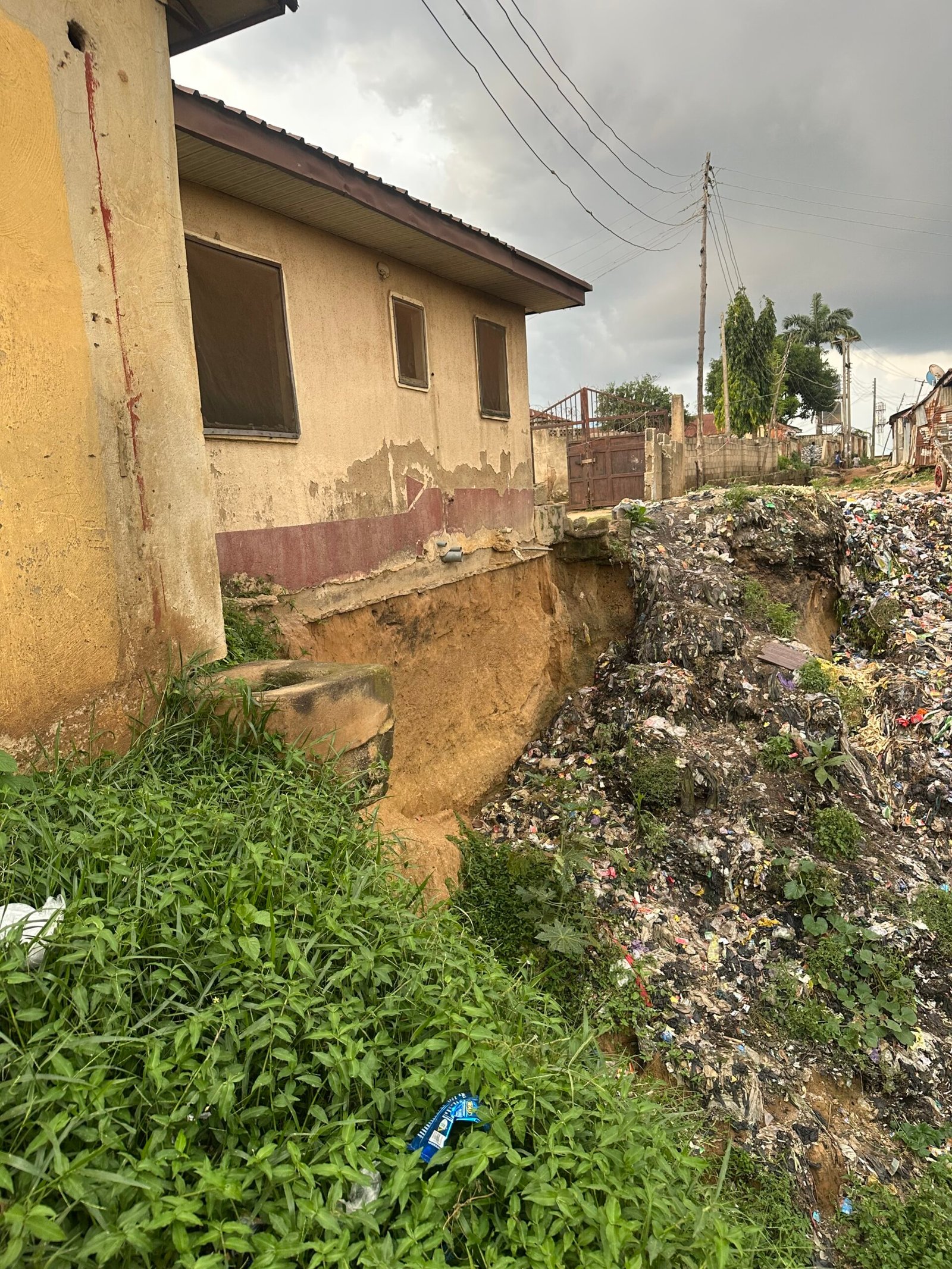
NASARAWA, Nigeria – Every time dark clouds gather over Mararaba, anxiety settles over Calavary Road in Aso Pada. Residents no longer see rain as a blessing but as the beginning of another battle against an ever-expanding gully that has steadily swallowed land, threatened homes and forced families to flee. For decades, appeals have been made, officials have visited and assessments conducted, yet little has changed. In this report, Abah Felicity examines how years of delayed intervention, inadequate drainage and official inaction have pushed one community to the brink, leaving families fearful that the next downpour could cost them their homes—or their lives.
A Community Under Siege
Behind Galaxy Academy on Calavary Road, the scars of erosion are impossible to ignore. What was once stable residential land has been carved into deep channels by years of unchecked floodwater.
Residents say the erosion has existed for decades, but its destructive pace accelerated around 2010, particularly around homes closest to a nearby stream.
For many families, every heavy downpour brings fresh uncertainty. Cracks appear on walls, the ground shifts beneath buildings and fears of structural collapse grow stronger.
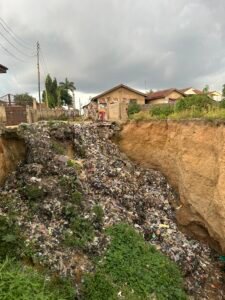
Community Chairman, Matthew Peter, blamed the worsening crisis on the absence of a properly engineered drainage system capable of channelling the enormous volume of rainwater flowing through the community.
He said, “more than 30 houses had been affected over the years,” with several families forced to relocate after the expanding gully rendered their homes unsafe.
Decades of Appeals, Little Action
For residents, the erosion is not simply the result of nature. They believe it is also the consequence of years of delayed government intervention.
Peter said the community had repeatedly written to government authorities, including the member representing Karu Constituency in the National Assembly, while a formal request was submitted to the Ecological Fund Office in 2022.
According to him, officials from the Nasarawa State Government later visited the community to assess the erosion, with the inspection receiving media coverage.
He added that “the House of Representatives member representing the constituency also visited after residents sought clarification on whether an erosion-control project had been captured in the government’s budget.”
The response, however, was disappointing.
Peter said residents were informed that the proposed intervention had not been included in that year’s budget, although the lawmaker reportedly pledged to pursue the matter with the Ecological Fund Office.
Years after those promises, the erosion continues to widen.
When Environmental Degradation Becomes a Humanitarian Crisis
The crisis on Calavary Road extends far beyond damaged infrastructure.
Without a properly designed drainage network, stormwater continues to cut deeper into the soil, widening the gully with every rainy season.
Residents have attempted to slow the damage by digging temporary channels to divert floodwater away from homes. But these improvised solutions offer only short-term relief against a problem that requires comprehensive engineering intervention.
The consequences are becoming increasingly severe.
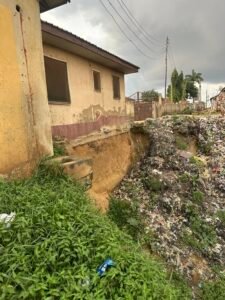
Homes stand dangerously close to collapsing edges. Road’s risk being cut off. Families face displacement, while low-income households struggle to find the financial means to relocate or rebuild.
Urban planners warn that uncontrolled erosion often triggers a chain reaction—destroying infrastructure, reducing property values and increasing disaster risks for surrounding communities.
‘Those Left Behind Are the Elderly and Widows’
For 73-year-old Ishola Abiodun Rimi, the transformation of the neighbourhood reflects what happens when environmental problems are ignored for too long.
Having lived in the community for about 25 years, he remembers when children played football on land that has since disappeared into the expanding gully.
According to him, the destruction became particularly severe three to four years ago, forcing several families to abandon their homes.
Rimi said successive administrations had received petitions, including during the tenure of former Nasarawa State Governor Abdullahi Adamu. Government officials and journalists had also visited the site over the years.
Yet little changed.
“Many houses have been affected, and some people have moved away because they feared the erosion could claim lives. Those of us who are left behind are mostly elderly people and widows who cannot afford to relocate. I am using two walking sticks, and even feeding is difficult. We are pleading with the government to help us before more lives are put at risk,” he said.
His testimony reflects the plight of vulnerable residents who remain trapped between poverty and an environmental threat they cannot escape.
Homes Built on Hope, Now Shadowed by Fear
Among those living with constant uncertainty is Mrs Veronica Ruben.
She recalled that her husband purchased their land in 2009 when the area was considered safe for residential development.
Today, that confidence has disappeared.
The advancing erosion has split the family’s property and brought the edge of the gully dangerously close to their home.
She said family members now regularly change where they sleep during the rainy season, fearing that weakened ground could suddenly collapse.
“My husband bought this land in 2009 when the area was safe, but today the erosion has divided our property. We live in fear every day because we do not know what may happen next. We appeal to the government to come to our aid and save our lives,” she said.
Her experience mirrors that of many homeowners whose lifetime investments have become vulnerable to an environmental crisis beyond their control.
Government Acknowledges the Problem
To establish the government’s position, our reporter visited the office of the Karu Area Planning and Development Agency (KAPDA) on Abacha Road, Mararaba.
The General Manager and Chief Executive Officer, ESV Yakubu Auta Haurna, confirmed that the former Community Chairman and his executive members petitioned the Deputy Governor of Nasarawa State in 2024 over the worsening erosion.
According to him, the Deputy Governor subsequently directed the agency to investigate the matter.
Haurna said officials visited the community and carried out a survey of the affected area.
The findings, he explained, showed that the proposed erosion-control project had not been included in the government’s budget for that year, and the community was informed accordingly.
Although he declined a formal interview and further comments, the agency’s position reinforces residents’ long-standing frustration: the erosion has been identified, documented and assessed several times, but a permanent engineering solution has yet to materialise.
A Disaster Waiting to Happen
Across Nigeria, climate change, rapid urbanisation and inadequate drainage infrastructure have intensified flooding and erosion, exposing communities to increasing environmental risks.
For Calavary Road, however, residents argue that the warning signs have existed for years.
Every rainy season deepens the gully.
Every delay increases the danger.
Every inspection without implementation erodes public confidence alongside the land itself.
Unless urgent engineering works are undertaken—including proper drainage construction, erosion-control measures and long-term environmental management—the community fears the next heavy rainfall could trigger irreversible destruction.
For now, residents say they are no longer asking for another assessment.
They are asking for action before another home, another family or another life is lost.
About the Author


 Oluwatobi Adu

 Hope Ajayi