
From Hustle to Hashtag: How Nigeria’s Smartphone Generation Is Rewriting the Future of Work
 Koko Maxwella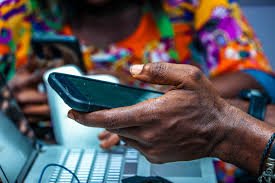
ABUJA, Nigeria — In a small, sunlit room in Benin City, 24-year-old Ijeoma Nwosu props her smartphone against a stack of books, adjusts her ring light, and hits record. Within minutes, her confident voice fills the room as she teaches her 50,000 TikTok followers how to style vintage thrift pieces for everyday wear. Koko Maxwella, writes.
What began as a lockdown hobby has now become a thriving full-time career
“I never imagined I could earn in dollars just by sharing what I love,” Ijeoma says, her smile lighting up the frame. “Brands from the UK and South Africa now reach out for collaborations. My phone became my office.”
Across Nigeria, millions of young people like Ijeoma are turning smartphones into survival kits — and, increasingly, springboards for innovation. As inflation bites and traditional jobs shrink, a generation once labelled “unemployed” is discovering global opportunities that fit in the palm of their hand.
The Rise of the Smartphone Economy
Nigeria’s official unemployment rate stood at 5% in early 2025, according to the National Bureau of Statistics (NBS). But beneath the numbers lies a starker reality: underemployment and informal work dominate the landscape.
A 2025 Jobberman report revealed that more than 60% of Nigerian youths now earn part or all of their income online — from freelance design and tutoring to content creation and digital marketing.
For Abdulrasheed Sule, a 27-year-old graduate from Kaduna, frustration turned into innovation.
“I started on Fiverr with just ₦20,000 to buy data,” he recalls. “Now, I’ve designed logos for clients in Canada and Dubai. I earn in foreign currency, and it’s helping me support my family.”
He laughs softly.
“My mother still doesn’t really understand what I do — she just knows I no longer ask her for money.”
This quiet digital hustle is fuelling an unexpected transformation of Nigeria’s youth economy — one upload, one gig, and one smartphone at a time.
Powering Innovation, One Tap at a Time
According to DataReportal (2025), Nigeria’s internet penetration now stands at 55.4%, one of the highest in Africa. The International Labour Organization (ILO) estimates that Africa’s digital economy could create up to 230 million jobs by 2030, with Nigeria as a key hub.
Dr. Tunde Akinola, a technology and innovation consultant, says what’s happening is more than a trend — it’s a redefinition of labour itself.
“Smartphones are no longer just communication tools — they’re economic tools,” Akinola explains. “From video editing to online tutoring, these devices are giving young Nigerians access to global markets that were once out of reach.”
From Lagos’ buzzing co-working spaces to quiet homes in Jos, young creators are pushing boundaries — building apps, selling art, editing music, and running virtual classrooms.
The Shadows of the Digital Dream
Yet, for every success story, there’s another fighting through the barriers of unreliable infrastructure.
Erratic electricity, high data costs, and online scams continue to frustrate aspiring digital workers.
Blessing Orji, a 22-year-old online tutor from Abuja, shares her struggle.
“Sometimes I spend more on data than I earn in a week,” she admits. “When there’s no electricity, I go to a café to teach my students. But quitting is not an option.”
The National Information Technology Development Agency (NITDA) says it has trained over one million young Nigerians in digital skills since 2023. However, access to affordable internet remains uneven, particularly in rural areas.
“Talent is everywhere,” Akinola adds, “but opportunity isn’t. Until infrastructure matches ambition, we’ll keep losing potential innovators to system failure.”
Bridging the Divide: Government Push for Digital Inclusion
To tackle these challenges, the Federal Government, through the Ministry of Communications, Innovation and Digital Economy, has rolled out initiatives such as the 3 million Technical Talent (3MTT) programme and the Digital Nigeria Initiative.
Both projects aim to equip young Nigerians with tech-driven skills for remote and global employment.
“Digital literacy is the new oil,” says Akinola. “If Nigeria invests in youth and infrastructure, we could see an explosion of innovation that rivals any in the world.”
These policies echo the United Nations Sustainable Development Goals (SDGs), particularly Goal 8 (Decent Work and Economic Growth) and Goal 9 (Industry, Innovation and Infrastructure) — signalling Nigeria’s attempt to future-proof its economy.
Beyond Survival — Towards Self-Expression
For many creators, digital work isn’t just an income source; it’s a medium for identity and self-expression.
Through fashion, art, music, and education, young Nigerians are leveraging digital tools to tell their stories and shift narratives about their country.
“We used to dream of travelling abroad to make it,” Ijeoma reflects. “Now, we can connect to the world from our phones. That’s powerful.”
Social media, once dismissed as a pastime, has evolved into a multi-billion-naira ecosystem — merging creativity, entrepreneurship, and activism.
“It’s more than work,” says Sule. “It’s proof that we can create our own opportunities, even when the system doesn’t.”
The Smartphone Revolution Is Here to Stay
As inflation and limited formal jobs continue to test resilience, the digital economy has become both a lifeline and a launchpad for millions of Nigerian youths.
From TikTok tutorials to tech startups, a generation is showing that innovation doesn’t need a boardroom — sometimes, all it takes is a smartphone and a dream.
While policy gaps, high data costs, and poor power supply remain hurdles, the momentum is irreversible.
“This is our time,” says Ijeoma, adjusting her camera for another recording. “We’re showing the world that even in Nigeria, dreams can go viral.”
About the Author


 Edino Chubiyo Cornelius
 Chukwu Obinna

 Hussaini Ibrahim