
Tollgates of Fears: How Nigeria’s Checkpoints Turn Security into a Daily Tax
 Edino Chubiyo Cornelius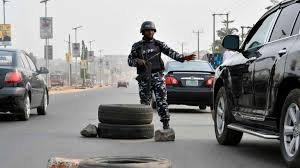
On a humid morning along the Nyanya–Keffi road in Abuja, traffic slows not from accidents but from the routine presence of a police checkpoint, where drivers, traders, and passengers brace for yet another stop. For many Nigerians, this has become a daily negotiation — one that reflects not just security enforcement, but the economic and emotional toll of simply moving from one place to another.
While checkpoints are officially designed to maintain order, deter crime, and protect citizens, everyday experiences often tell a different story. Many Nigerians describe a system marked by hidden costs, delays, and growing unease, revealing a widening gap between the police mandate and public reality — and raising deeper questions about trust, power, and accountability in law enforcement. Edion Cornelius, writes.
A Mandate Rooted in Protection
By law, the Nigeria Police Force is tasked with protecting lives and property, preventing and detecting crime, and maintaining public order. Checkpoints, within this framework, serve as strategic tools to monitor movement, verify documentation, and intercept criminal activity.
At their best, they function as visible deterrents — a reminder that the state is present and alert.
Officers stationed at these points are expected to conduct professional, limited checks: verifying vehicle documents, performing visual inspections where necessary, and ensuring compliance with safety regulations.
Importantly, police authorities have repeatedly clarified operational boundaries. Routine searches of personal mobile phones, for instance, fall outside standard procedure unless backed by lawful grounds such as a court order or credible suspicion linked to an investigation.
The distinction is critical. Policing, at its core, is meant to protect — not intrude.
Yet, for many Nigerians, the lived reality diverges sharply from this ideal.
The Hidden Cost of Movement
For traders whose livelihoods depend on time and turnover, checkpoints have become an unspoken line item in daily expenses.
Chioma Eze, a foodstuff trader navigating routes between markets, describes a system that quietly eats into her profit margins.
“Before I even leave the market, I already know I’ll spend something on the road. If you don’t cooperate, they can delay you, and that delay can cost you your profit.”
Her concern is not only financial. Perishable goods lose value with every passing hour, and delays at multiple checkpoints can mean the difference between profit and loss.
What emerges is a pattern: movement is no longer just logistical — it is transactional.
Drivers Under Pressure
For commercial drivers, the experience is amplified by frequency. A single journey can involve multiple stops, each carrying its own uncertainty.
Musa Abdullahi, a commercial driver, speaks with the resignation of routine exposure.
“You meet checkpoints back-to-back. If you argue at every stop, you won’t complete your trips. Most drivers just pay something small and move on.”
The phrase “something small” recurs in conversations — a euphemism that masks a systemic reality. Individually negligible, collectively significant.
Long-distance driver Sunday Okafor adds nuance to the experience:
“Some checkpoints are strict about documents, which is fine. But others are different. You just prepare yourself for anything before starting your journey.”
Preparation, in this context, extends beyond documentation. It includes expectation — of delays, negotiations, and unpredictable demands.
Youths and the Question of Privacy
If traders and drivers speak of financial costs, young Nigerians often describe something more intangible: a sense of vulnerability.
Encounters at checkpoints, they say, can extend beyond routine checks into personal scrutiny — particularly involving mobile phones.
Daniel Adeyemi, a student at the University of Abuja, recalls one such experience:
“They asked for my phone and started going through it. I didn’t feel like I had a choice. It’s not right — that’s my private life.”
For many youths, mobile devices are repositories of identity — containing conversations, financial data, and personal history. Unauthorised access, therefore, feels less like a search and more like an intrusion.
Aisha Bello, a recent graduate, describes the psychological impact:
“It creates fear. You’re not sure what they’re looking for or how they’ll react. It feels like you’re already being treated like a suspect.”
The result is behavioural change. Some avoid certain routes; others consciously alter their appearance or digital presence.
In a country with a youthful population, these experiences carry broader implications for civic trust and engagement.
Inside the Force
Within the police, there is acknowledgement — albeit cautious — that the system is not without flaws.
Officer Emeka Nwosu, speaking on condition of general representation, emphasises the importance of checkpoints while conceding inconsistencies in conduct.
“Checkpoints are important for security. They help us monitor movement and prevent crime. But there are rules guiding how officers should behave, and not everyone follows them.”
His statement reflects a familiar tension: the gap between institutional intent and individual execution.
For the police, checkpoints are operational necessities. For citizens, their value is judged not by intention, but by experience.
A Systemic Question
Civil society actors argue that the issue cannot be reduced to individual misconduct. Rather, it points to structural weaknesses — in oversight, accountability, and reporting mechanisms.
Ibrahim Lawal, Youth President in Katampe, Abuja, frames it as a systemic failure:
“When people expect to pay before they can pass, it shows something is wrong. This isn’t just about individuals — it’s about a system that allows it to continue.”
He highlights a critical barrier: silence.
Fear of retaliation, lack of trust in complaint systems, and the normalisation of these encounters often prevent victims from speaking out. The result is a cycle that sustains itself — unchallenged and, over time, institutionalised.
Between Security and Intrusion
At the heart of the issue lies a fundamental question: what is the true purpose of checkpoints?
In theory, they are instruments of safety. In practice, their perceived function is shifting in the minds of many Nigerians.
When stops involve financial demands, prolonged delays, or invasive searches, the line between protection and intrusion becomes blurred.
This erosion of clarity carries consequences. Trust — once diminished — is difficult to rebuild.
And yet, the solution is not the removal of checkpoints. Nigeria’s security challenges make their presence necessary. The issue, rather, is reform: ensuring that implementation aligns with principle.
Rebuilding Trust
Bridging the gap between policy and practice requires more than directives. It demands enforcement, transparency, and accountability.
Clear guidelines must not only exist — they must be visible, understood, and consistently applied. Officers who uphold standards should be supported; those who breach them must face consequences.
Equally important is the role of citizens. Accessible, credible reporting channels can empower individuals to speak without fear — transforming isolated complaints into actionable data.
Technology, too, offers possibilities: from body cameras to digital verification systems that reduce discretionary interactions.
Ultimately, the goal is not merely efficiency, but legitimacy.
The Cost of Everyday Movement
For now, however, the reality persists.
On roads across Nigeria, checkpoints continue to function as both security measures and, for many, points of negotiation. Each stop carries a question: will this be routine — or something more?
For traders, it is a calculation of profit.
For drivers, a matter of time.
For youths, a question of dignity and privacy.
And for the nation, it is a test of trust.
Because when safety measures begin to feel like burdens, the social contract weakens. And when those tasked with protection are viewed with suspicion, the very foundation of policing is at risk.
For everyday Nigerians, the expectation remains modest yet profound: that the road ahead is governed not by informal tolls, but by fairness, professionalism, and respect.
Until then, the journey continues — measured not just in kilometres, but in costs quietly paid.
About the Author

 Chukwu Obinna
 Korede Abdullah
 Oluwatobi Adu