
Nigeria’s Classroom Emergency: Who Should Pay for the North’s Out-of-School Children Crisis?
 Mirian Gom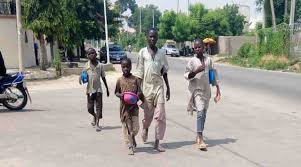
Out-of-school children walking on the street in Northern Nigeria, highlighting the country’s education crisis. (Photo Credit: Internet)
ABUJA, Nigeria – A child who is not in school is not just missing lessons — they are missing language, logic, protection, and possibility. When education is denied early, the future does not merely slow down; it quietly collapses.
Across Nigeria, millions of children wake each morning not to the discipline of a timetable or the promise of a classroom, but to hunger, street begging, farm labour, or forced adulthood through early marriage. To a layperson, “out-of-school children” simply means boys and girls who should be learning but are instead excluded from the education system — often for life. To the nation, it means something far graver: a deepening crisis that threatens security, economic survival, and social cohesion.
Nigeria’s classroom emergency is no longer a statistic. It is a national reckoning. Gom Mirian, writes.
Why Nigeria Is Failing Its Children
Nigeria’s out-of-school children crisis is driven by a lethal combination of poverty, insecurity, displacement, weak governance, cultural practices, and poor accountability. Armed conflict in the North-East, banditry in the North-West, child labour, and early marriage all play their part. But beneath these visible factors lies a more uncomfortable truth: successive governments and communities have failed to treat basic education as a non-negotiable right.
According to UNICEF’s 2025 data, Nigeria has 10.2 million out-of-school children, one of the highest figures in the world. Disturbingly, Katsina, Kano, and Jigawa alone account for 16 per cent of this number. The epicentre of the crisis is northern Nigeria — not by accident, but by long-standing policy neglect and social tolerance.
Despite education being constitutionally recognised as a public responsibility, Nigeria has consistently underfunded the sector. Federal budget allocations to education have hovered between 5 and 7 per cent in recent years — far below UNESCO’s recommended 15–20 per cent benchmark. In several northern states, enforcement of compulsory basic education laws remains weak or symbolic, with few recorded prosecutions for keeping children out of school.
The Almajiri System: Faith Without Safeguards
At the heart of the northern education crisis lies the Almajiri system, in which young boys are sent away from home to study Islamic teachings under clerics. In theory, the system is rooted in religious instruction. In practice, its poorly regulated and largely abandoned form has become a pipeline to street begging, exploitation, and illiteracy.
Islamic education itself is not the problem. The problem is abandonment — of responsibility by parents, oversight by authorities, and reform by political and religious elites. Children are sent away, communities look aside, and governments respond with statements rather than enforcement.
The outcome is predictable: a generation growing up without literacy, employable skills, or state protection — fertile ground for crime, radicalisation, and long-term poverty.
When Good Intentions Meet Local Resistance
Development partners and non-governmental organisations have attempted to plug the gaps left by government failure. UNICEF’s conditional cash transfer programme, which provides about ₦8,000 per child to parents or guardians in some northern states, is designed to remove economic excuses for keeping children out of school.
The logic is sound: if poverty is the barrier, subsidise education.
Yet the numbers remain stubbornly high. Many parents still refuse to enroll their children. Local power structures quietly undermine reforms. Weak monitoring allows abuse. Political will remains thin.
This raises a deeply uncomfortable question: Can donor funding solve a crisis sustained by local neglect and cultural resistance?
A Tale of Two Regions
The contrast with southern Nigeria is stark. In the South-West and South-South, out-of-school figures are significantly lower despite limited donor intervention. Stronger enforcement of compulsory education laws, community accountability, and widespread acceptance of formal education have produced better outcomes.
This comparison exposes a critical truth: poverty alone does not explain the northern crisis. Governance choices, elite responsibility, and parental accountability matter just as much.
Gumi’s ‘Marshall Plan’: Reform or Cost Transfer?
The debate took a new turn when Islamic scholar Sheikh Ahmad Gumi proposed a “Marshall Plan” to phase out the Almajiri system. He argued that Northern Nigeria, with nearly 150 universities, could lead the nation’s education sector within 15 years if peace and reform are prioritised.
Explaining how his proposal differs from existing structures such as the Almajiri Commission, Gumi said: “The almajiri issue is bigger than a commission. In fact, it may require an entire ministry. What truly matters, however, is funding and priority. Look at how much we spend on security — trillions of naira — yet insecurity persists. When I say Marshall Plan, I mean the government must mobilise every possible resource and invest it massively in education. There could even be a special education tax, so every Nigerian contributes to removing children from the streets.”
It was this call for new national taxes that ignited public anger.
Who Should Pay for Neglect?
Gumi’s proposal raises hard ethical and policy questions that Nigeria can no longer avoid.
Should Nigerians be taxed to fix a crisis rooted in decades of regional neglect?
Why should a trader in Aba or a teacher in Akure pay for failures sustained by northern elites, clerics, and parents?
Why can’t the regions that created and tolerated the system take the lead in funding and enforcing its reform?
Without honest answers, education reform risks becoming a redistribution of blame rather than responsibility.
Lessons from Broken Promises
Nigeria has been here before. Under former President Goodluck Jonathan, about 165 Almajiri Model Schools were built to integrate Islamic and Western education. Many were later abandoned, repurposed, or left to decay under subsequent administrations.
Their fate illustrates a familiar pattern: ambitious policy launches followed by neglect, poor maintenance, and political discontinuity. Recent attempts to revive the schools underscore how easily good intentions are sabotaged by weak follow-through.
Voices from the Street
Public reaction to Gumi’s proposal has been largely sceptical.
“Why should my taxes fix what parents and leaders refused to fix for years?” asked Yakubu Wahab, a commercial driver in Abuja. “Education starts from home. The government cannot replace responsibility.”
Clement Nbueze, a civil servant, was even more blunt: “Taxing Nigerians is injustice. If northern leaders are serious, let them fund schools, enforce laws and stop street begging,” he continued, ” if we all leave our children to fend for themselves and marry more wives for government to train them then, the government will not do any meaningful project again, let’s take responsibility for the children we brought into this world and give birth to the number you can take care of.”
Education expert Ikechi Cinfores warned of long-term consequences: “This crisis is not just about classrooms. Out-of-school children today become unemployed adults tomorrow. Without accountability, any Marshall Plan will fail.”
The Question Nigeria Must Answer
Nigeria’s out-of-school children crisis persists not because the country lacks money or ideas, but because responsibility has been repeatedly outsourced — to donors, to federal agencies, and now potentially to taxpayers — while those closest to the problem evade accountability.
Until responsibility is clearly owned and enforced, education reform will remain trapped in a cycle of conferences, committees, and abandoned schools — while millions of children remain outside the classroom and outside the nation’s promise.
The real question is no longer what should be done, but who is finally willing to take responsibility — and pay the price of inaction if they do not.
About the Author

 Otamere Gladness
 Koko Maxwella
 Edino Chubiyo Cornelius