
Mountains at the Doorstep: How Lagos’ Waste Crisis Is Choking Life, Health and Dignity in Alimosho
 Korede Abdullah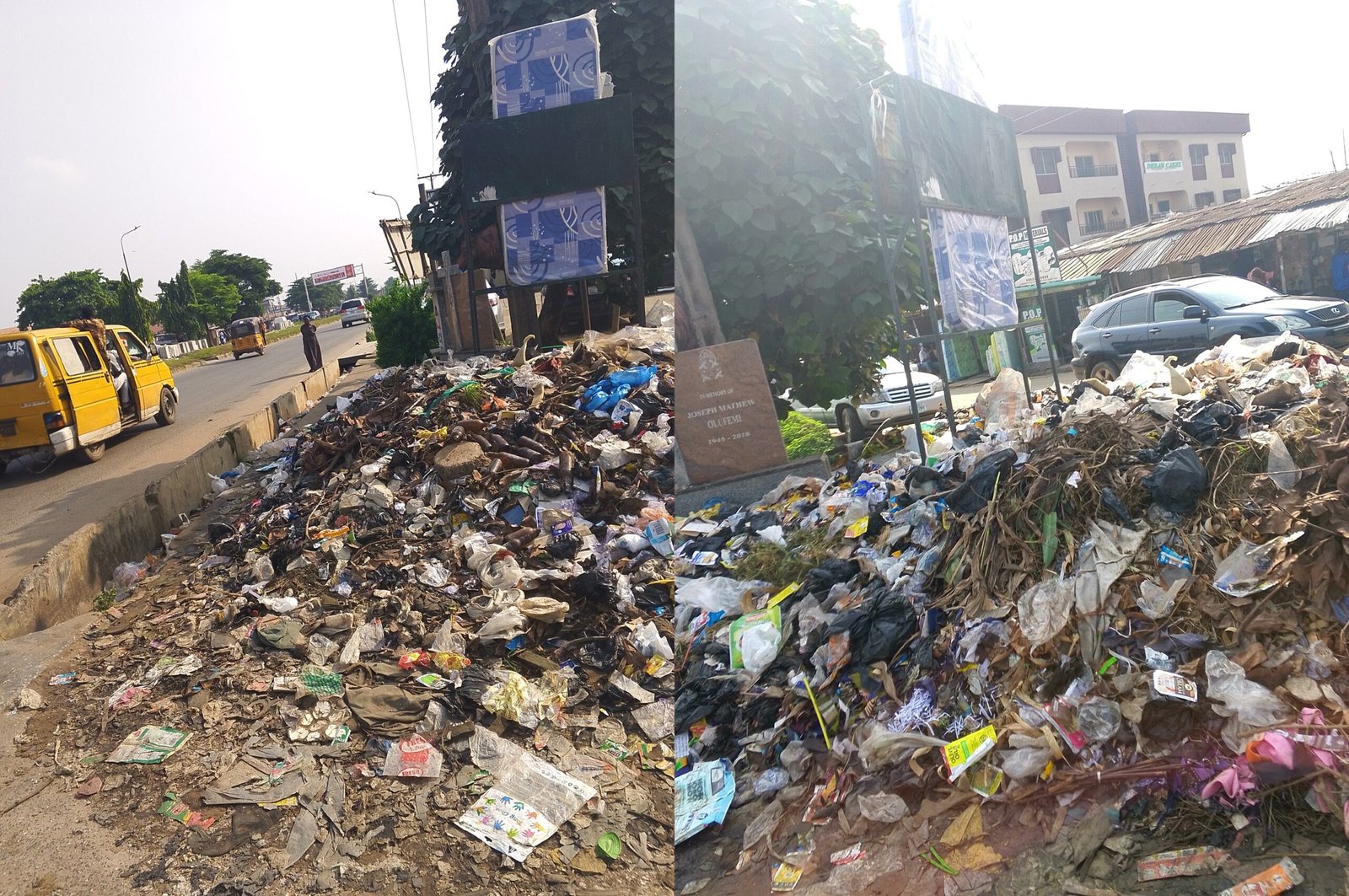
Uncollected refuse piling up along a street in Alimosho, Lagos. (Photo Credit: Korede Abdullah/AHR, 2025)
LAGOS, Nigeria – The stench arrives before the sight. In the sprawling suburbs of Alimosho, Lagos’ most populous local government area, decomposing refuse announces itself long before the heaps come into view. For millions of residents, this is no longer an occasional nuisance but a daily confrontation with filth, fear and official neglect. In this report, Korede Abdullah examines how uncollected waste is reshaping lives, livelihoods and public health in the shadows of Africa’s largest megacity.
A Crisis You Can Smell
In Igando, Akesan, Ikotun Odo-Eran and adjoining neighbourhoods, refuse piles have become grim landmarks. They sit by markets, sprawl across street corners and clog drainage channels, fermenting under the tropical sun. The air is thick with rot; flies swarm with impunity.
Residents told Africa Health Report that weeks can pass without evacuation. What was once a sanitation issue has hardened into something more profound — a struggle for dignity and survival. “People complain about flies settling on food,” said Mrs. Bose Adebayo, a food vendor in Igando. “I cover everything, but how do you fight the environment?”
Her question hangs unanswered in communities where survival already balances on thin margins.
Living With Filth — and Fear
Parents now warn children away from play areas near refuse heaps. Traders complain of declining patronage. Tenants speak of sleepless nights as rodents scurry through nearby dumps.
In Ikotun Odo-Eran, a youth leader described the despair after the last heavy rainfall. “The water entered our rooms,” he said. “The refuse blocked the gutter. We had no choice but to pack some of it ourselves.”
The labour of sanitation, residents say, has been quietly transferred to those least equipped to bear it.
Why Alimosho Suffers More
With its dense population, overstretched infrastructure and limited public services, Alimosho appears disproportionately affected. Urban planners note that high-density, low-income districts often sit at the end of the sanitation priority queue.
“Waste management failures are not evenly distributed,” one planner told Africa Health Report. “They follow poverty lines, turning refuse into another marker of social exclusion.”
While some upscale districts experience quicker intervention, Alimosho residents say they are left to adapt — or endure.
A Public Health Time Bomb
Health experts warn that the consequences of prolonged waste accumulation are severe. Rotting refuse attracts rodents, flies and mosquitoes — vectors for cholera, typhoid, malaria and dengue fever.
A public health physician, Dr Simbo Ayodele, said densely populated areas face heightened risks. “When waste is not evacuated promptly, outbreaks are only a matter of time,” he warned. “Children and the elderly are especially vulnerable.”
Blocked drains also worsen flooding, spreading contaminated water into homes and increasing exposure to disease.
When Survival Fuels Illegality
Despite government warnings, indiscriminate dumping persists. Residents admit that some neighbours patronise informal cart pushers who dump refuse illegally, often under cover of darkness.
Environmentalists argue that this behaviour reflects desperation more than defiance. Inconsistent collection services, they say, push households towards cheaper, illegal alternatives, creating new waste black spots almost overnight.
Weak enforcement only compounds the cycle.
The PSP Breakdown
The Lagos State Waste Management Authority (LAWMA) last month terminated the contracts of 22 Private Sector Participation (PSP) operators over poor performance — a move meant to restore efficiency, but which has left visible gaps in service delivery.
LAWMA has announced plans to procure 500 mobile tricycle compactors in 2026, yet for residents staring at overflowing bins today, the promise feels distant.
“The refuse doesn’t wait for policy timelines,” one resident said bitterly.
Government Explains the Bottlenecks
Lagos Commissioner for the Environment, Tokunbo Wahab, has acknowledged public concern. He attributed part of the crisis to the ongoing decommissioning of the Olusosun landfill, once the city’s largest waste disposal site.
Waste previously taken there is now transported to Epe and Badagry, increasing turnaround times for PSP operators. Wahab said LAWMA has been directed to intervene directly in overwhelmed areas, with emergency operations underway at identified black spots.
“We are not oblivious to the situation,” he said, insisting that temporary disruptions will give way to long-term efficiency.
Task Forces and Tough Talk
The commissioner also disclosed the establishment of a Special Sanitation Task Force to combat illegal dumping and roadside trading linked to waste accumulation. “The task force will operate 24-hour surveillance and enforce environmental laws without exception,” Wahab said. Additional trucks are being considered to strengthen LAWMA’s evacuation capacity and reduce response times.
Residents remain sceptical, citing years of similar assurances.
A Yuletide Warning
As Lagos slips into its frenetic “Detty December” season, LAWMA spokesperson Mrs Folashade Kadiri warned that a filthy environment carries health and reputational risks.
“A dirty city during the festive season exposes residents and visitors to preventable diseases and undermines Lagos’ image as a global city,” she said, urging responsible disposal as visitors arrive from around the world.
Cleanliness, she stressed, is a shared responsibility — but one that requires functioning systems.
Counting the Hidden Costs
Beyond health, the economic toll is substantial. Households spend scarce income hiring informal collectors. Traders lose customers. Flooded streets damage goods and property.
Lagos generates an estimated 13,000 tonnes of waste daily, with nearly 60 per cent reportedly uncollected. Each failure translates into lost productivity, higher healthcare costs and deeper urban inequality.
For residents, the price is paid in quieter ways — missed meals, closed shops, sick children.
Towards Solutions That Last
Experts agree that lasting solutions demand more than emergency evacuations. Strengthened oversight of PSP operators, expanded disposal facilities, investment in recycling and consistent enforcement of environmental laws are essential.
Community engagement, they argue, must sit at the heart of reform. Residents who feel abandoned are unlikely to comply with rules that seem selectively enforced.
For the people of Alimosho, however, the demand is simple: regular waste collection that restores safety, health and dignity.
Until then, the refuse remains — a daily monument to policy failure, and a reminder that in Lagos, inequality can be measured not only in income, but in waste.
About the Author


 Oluwafunbi Bello
 Chukwu Obinna