Seeds of Suspicion: Inside Nigeria’s GMO Food Fight Between Fear, Facts and the Future
 Oluwatobi Adu
ABUJA, Nigeria – In the crowded alleys of Nigeria’s food markets and the endless debates on WhatsApp groups, one three-letter acronym has quietly become a lightning rod for fear, hope and misinformation: GMO.
For some Nigerians, genetically modified food is viewed as a foreign experiment imposed on local diets. For others, it represents a scientific lifeline in a country grappling with climate shocks, pests and rising hunger. Yet for millions more, the term means almost nothing at all.
In this report, Oluwatobi Adu, travels from open-air markets in Abuja to expert laboratories and regulatory offices, peeling back the myths and mistrust around genetically modified organisms. It asks a simple but urgent question: Are Nigerians afraid of GMOs because they are dangerous – or because they are poorly understood?
Voices from the Market: “I No Sabi Am”
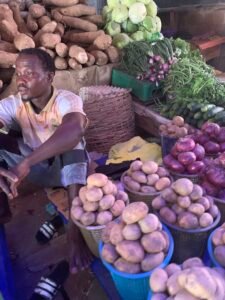
At Utako Market in Abuja, the heart of everyday food commerce, awareness of GMOs is almost non-existent.
Mohammed, a farmer arranging produce in his modest stall, looked puzzled when asked about genetically modified foods.
“I don’t know anything about GMO foods. Wetin be that? I no sabi am oo,” he said, shaking his head.
Just a few metres away, food crop seller Garuba Yahaya, who buys directly from farmers across northern Nigeria, offered the same response.
“That is new. I have never heard of it before.”
In nearby Gwarinpa, Mrs Bello, a resident interviewed at First Avenue, echoed the sentiment with quiet curiosity.
“I have not heard of it before,” she said.
These are not isolated reactions. They reflect a profound information gap at the grassroots, where food is bought, sold and consumed daily, but where modern agricultural science rarely reaches in plain language.
What Are GMOs – And Why the Confusion?
To untangle the confusion, Africa Health Report spoke with plant scientist and phytomedicine specialist Hassan Mary Ayotosimi, whose work focuses on food safety and public health.
She breaks it down simply.
“‘Genetically’ refers to genes. Humans have genes; plants also have genes. ‘Modification’ simply means changing something to improve it,” she explained.
Instead of relying only on traditional breeding, scientists take seeds into controlled laboratory environments to adjust specific traits.
“The aim is to help crops resist pests, tolerate drought, grow faster or produce better yields,” Ayotosimi said.
According to her, ignorance – not evidence – fuels fear.
“Many people depend on what they hear from friends, family or social media, not from scientists. There is not enough simple explanation at the grassroots, and that allows rumours to grow.”
On the most common fear – cancer – she was unequivocal.
“There is no strong scientific evidence that approved GMO foods cause cancer.”
She stressed that GMO crops approved for consumption undergo years of rigorous testing before reaching farms or markets.
“People should not make decisions based on fear. Read food labels, ask questions and rely on trusted sources. Education and transparency are everything.”
Regulation and Oversight: Who Is Watching the Watchers?
In Nigeria, GMO regulation falls under the National Biosafety Management Agency (NBMA), established by law in 2015.
The agency insists that no genetically modified crop enters Nigerian farms or markets without exhaustive scientific scrutiny. Risk assessments cover toxicity, allergenicity and environmental impact, conducted by multidisciplinary committees that include experts from National Agency for Food and Drug Administration and Control (NAFDAC) and universities.
Nigeria approved its first GMO crop, Bt cotton, in 2018. This was followed by Bt cowpea (SAMPEA 20-T) in 2019 and TELA maize – engineered for drought tolerance and insect resistance – in 2024.
NBMA says its processes align with global standards set by bodies such as the World Health Organization and the Food and Agriculture Organization.
In August 2025, NAFDAC Director-General Prof. Mojisola Adeyeye reinforced the importance of transparency.
She stressed that clear and proper labelling of all GMO food products is essential, so consumers know exactly what they are buying.
Myths, Cancer Fears and Scientific Consensus
Public health analyst Musa Abdullahi Sufi, speaking in an exclusive interview, says misinformation has outpaced facts.
“GMOs are crops whose DNA has been carefully changed to add useful traits like pest resistance or drought tolerance,” he said.
On cancer claims, Sufi was blunt.
“There is no credible scientific study that shows approved GMOs cause cancer.”
He cited decades of reviews by institutions including the European Food Safety Authority and the National Academy of Sciences, all finding no causal link.
He also addressed the infamous 2012 French rat study that once dominated headlines.
“That study was later withdrawn due to serious scientific flaws, but the fear it created never fully disappeared.”
Sufi added that many Nigerians mistakenly conflate GMOs with herbicides.
“They are not the same thing. Concerns about chemical overuse are valid, but they are separate from the science of genetic modification.”
Beyond the Science: Trust, Culture and Power
Still, opposition to GMOs is not purely about health. It is also about trust.
Critics worry about seed patents, corporate control of agriculture and farmer dependence. These concerns, experts say, deserve open discussion – but should not be confused with claims of inherent danger.
“People need honest conversations, not propaganda,” Sufi said. “From what we know so far, approved GMOs are safe, but continuous research and monitoring must continue.”
The Path Forward: Talking to Nigerians, Not at Them
For GMO policy to succeed in Nigeria, experts agree that science alone is not enough.
“Nigeria is guided by culture and religion,” Sufi noted. “The government must engage traditional rulers, religious leaders, pastors, imams and community heads.”
Scientists, journalists, regulators and civil society groups must also work together, translating technical data into everyday language and pushing information beyond conferences and press statements.
Grassroots outreach, proper labelling, media literacy and strict enforcement against fake or unapproved products are key to building trust.
Facts Over Fear
Genetically modified foods will remain controversial in Nigeria – but controversy should be driven by evidence, not whispers.
The report finds no proof that approved GMOs are harming Nigerians. What it does reveal is a dangerous vacuum of public understanding.
In a country battling food insecurity, climate stress and population growth, Nigerians deserve clear facts, honest choices and transparent regulation.
The debate over GMOs is not just about food. It is about trust, knowledge and who controls the future of what ends up on our plates.
About the Author

 Otamere Gladness
 Koko Maxwella
 Edino Chubiyo Cornelius