Nigeria’s Housing Dream on the Brink: Inside the Relentless Rise of Building Costs
 Chukwu Obinna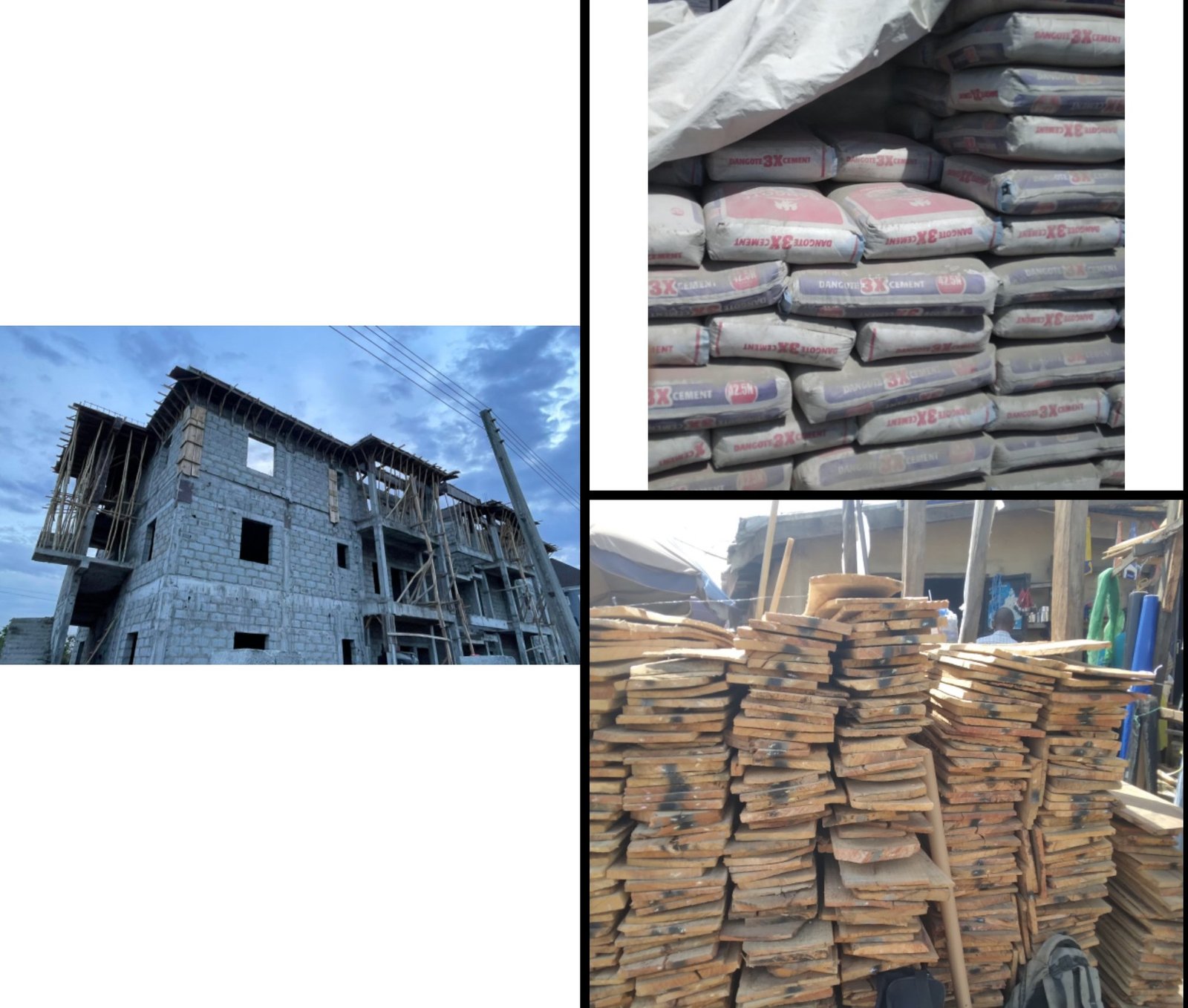
ABUJA, Nigeria – On a dusty stretch of Kubwa, where half-built homes stand like abandoned promises, the price of a single plank tells a bigger story — one of a nation where the dream of owning a home is quietly slipping out of reach.
For builders, traders, and families alike, Nigeria’s construction sector has become a battlefield of shifting prices, broken budgets, and hard choices. What was once a predictable path to homeownership has turned into a gamble — one tied to fuel costs, inflation, and a volatile economy. Chukwu Obinna, writes.
At a modest shop stacked with timber and roofing sheets, Samuel Chinedu, owner of Chidi Best Ltd, gestures towards a pile of planks as if pointing to the problem itself.
“Some materials like the 2 by 2 plank are now ₦800 and it used to be ₦500,” he says.
Yet, in a twist that reflects the market’s instability, not all prices are rising.
“The roofing sheet that was ₦60,000 before is now ₦38,000,” he adds. “The thick type of roofing sheet that used to be ₦90,000 – ₦100,000 is now ₦55,000.”
Then he pauses, offering a summary that captures the confusion gripping the sector:
“Some building materials increased while some reduced.”
A Profession Under Pressure
For quantity surveyors, whose job depends on precision and predictability, the volatility has become more than an inconvenience — it is a professional crisis.
Engr. Uche Chibuduke, a quantity surveyor with over three decades of experience, describes a reality where budgets collapse almost as soon as they are drafted.
“I just bought cement for ₦12,000 and my budget is ₦10,000,” he says. “I’ve been facing things like this a lot and I just have to make do with the budget I gave my client.”
The strain is not just on spreadsheets — it is on credibility.
When costs spiral beyond agreed figures, professionals are left to either absorb losses or renegotiate contracts in a market where clients themselves are already stretched thin.
Granite, a basic construction material, tells the same story.
“Granite that we buy for ₦6,500 has increased to ₦10,000 per ton, not to talk of the transportation,” Chibuduke explains.
For him, the cause is unmistakable:
“Once fuel increases, every other thing will increase too.”
The Fuel Effect
Across Nigeria, fuel prices have become the invisible hand reshaping the construction industry.
From quarry sites to urban markets, the cost of moving materials now dictates their final price. Every kilometre travelled adds another layer of expense — and uncertainty.
Emmanuel Esico, who runs a building materials business in the same Kubwa axis, has watched prices change almost in real time.
“Dangote cement is now ₦11,500 and it was ₦9,000 last December,” he says. “In February it was ₦10,500, but with the inflation of fuel it has increased again.”
Even finishing materials — often considered the final step in construction — are no longer immune.
“Even POP is now ₦10,000 and it was ₦8,000 before,” he adds.
What emerges is a chain reaction: fuel drives transport costs, transport inflates material prices, and rising material costs stall construction projects.
A National Crisis, not a Local One
Hundreds of kilometres away in Abakaliki, Ebonyi State, the same pressures are unfolding — with even harsher consequences.
Engr. Silvanus Eze, a civil engineer with over 15 years of experience, describes a construction environment where survival itself has become uncertain.
“The cost of executing projects here in Ebonyi has gone up drastically,” he says. “A bag of cement that I used to factor into my bills of quantities at around ₦9,000 is now going for ₦11,500 to ₦12,000.”
Contracts signed just months earlier are now liabilities.
“When you have already signed a contract with a client at the old rate, you find yourself in a very difficult position,” he explains.
The price surge extends far beyond cement.
“Iron rods have more than doubled in price over the past two years. Sand and granite are also affected because the trucks… are spending far more on diesel,” he says. “Every material that requires transportation has gone up, and in Ebonyi, almost everything requires transportation.”
For smaller contractors, the impact has been devastating.
“Some of my colleagues have had to down tools on ongoing projects,” Eze says. “The client gives you a mobilisation fee based on last year’s prices, and by the time you go to the market, that money cannot carry even half of what you planned to buy.”
The Human Cost of Inflation
Beyond the numbers lies a quieter, more painful reality — the emotional toll on Nigerians trying to build homes.
“People come to me with savings they have gathered for years, sometimes decades,” Eze says. “I have to sit them down and explain that the same house that would have cost ₦8 million two years ago now requires at least ₦15 to ₦18 million.”
He pauses, reflecting on those conversations.
“The look on their faces is something I find very difficult. Housing is a basic need, not a luxury, and inflation is turning it into one.”
Across the country, similar stories are unfolding — families abandoning projects midway, skeleton structures left exposed to the elements, and lifelong savings eroded by rising costs.
The Data Behind the Struggle
The lived experiences of builders and buyers are backed by stark national data.
Nigeria’s inflation rate surged to 29.90% in January 2024, driven largely by the removal of fuel subsidies and currency devaluation. By September 2024, it had climbed further to 32.70%, reflecting rising transport and food costs.
Although inflation eased to 15.06% by February 2026 — its lowest level since November 2020 — the relief has been uneven. Food inflation has begun to rise again, and the cost of construction materials remains stubbornly high.
The impact on the construction sector has been severe. Industry growth slowed from 3.6% in 2023 to just 1.2% in 2024, weighed down by inflation, high interest rates, and escalating material costs.
At the same time, Nigeria’s housing deficit continues to widen.
More than 28 million Nigerians lack access to adequate housing, while over 11,856 construction projects have been abandoned nationwide.
Material prices tell their own story: within a year, the cost of a 12mm iron rod jumped from ₦8,000 to ₦19,000, while steel door prices surged by up to 290%.
A Threat to Sustainable Development
The implications stretch beyond individual hardship — they strike at the heart of national development.
The crisis directly undermines efforts to achieve key global targets, including poverty reduction and sustainable urban development.
As construction costs rise, more Nigerians are priced out of formal housing, pushing them into informal settlements and deepening cycles of poverty.
At the same time, the vision of building inclusive and sustainable cities becomes harder to realise.
Government targets — such as constructing hundreds of thousands of housing units annually — are increasingly unrealistic in a market defined by price volatility.
What Needs to Change
For industry players, the solutions are as clear as the problems.
“If fuel comes down, transportation comes down, and then materials come down,” Eze says. “It is that simple.”
But beyond fuel pricing, experts argue that Nigeria must invest in local production of building materials to reduce dependence on imports and shield the sector from foreign exchange shocks.
Without such reforms, the current cycle is likely to persist — one where every economic shift reverberates through the construction industry, and ultimately, into the homes Nigerians can no longer afford to build.
A Dream Deferred
Back in Kubwa, the unfinished buildings stand as quiet evidence of a deeper crisis.
Each structure tells a story — of ambition paused, of savings exhausted, of plans deferred indefinitely.
For millions of Nigerians, the dream of owning a home is no longer just difficult.
It is becoming distant.
About the Author


 Hope Ajayi
 Oluwatobi Adu
 Korede Abdullah