


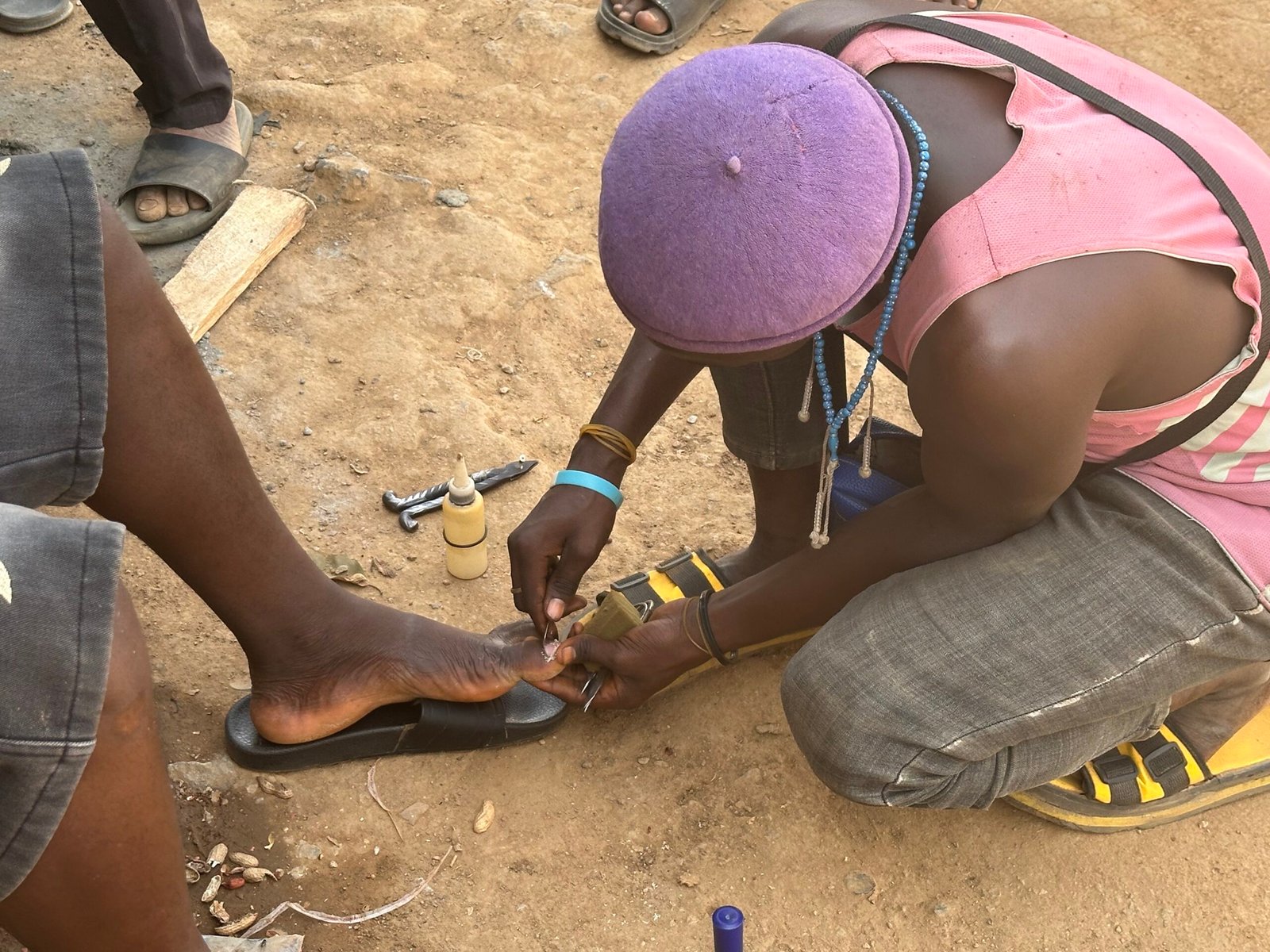
ABUJA, Nigeria – On a typical afternoon in Nigeria’s bustling cities, it is common to see men seated on small stools by the roadside, one foot raised as a pedicurist trims toenails with metal clippers and scrapes hardened heels with a blade.
From crowded markets to busy motor parks, roadside pedicure services have quietly become part of everyday urban life.
For a few hundred naira and in less than ten minutes, customers can have their feet cleaned without stepping into a formal salon.
Yet behind the convenience and affordability lies a growing public health concern. Medical experts warn that the widespread use of shared grooming tools—often without proper sterilisation—may expose customers to infections ranging from minor skin conditions to more serious diseases.
In this report, Edino Cornelius explores the experiences of operators, customers, and medical professionals to understand the health implications of the expanding roadside pedicure trade in Nigeria’s cities.
Survival On the Roadside
Along a dusty roadside in Katampe, a young pedicurist, Maikasuwa Abdullah, sits beside a small plastic bucket filled with water and a handful of metal tools.
For him, the job is less about grooming and more about survival.
“I no go lie for you, the reason I dey do this work na because nothing de make I do,” he said.
Abdullah explained that limited employment opportunities pushed him into the trade, which requires little capital to start.
Despite concerns about hygiene, he insists he tries to clean his tools before using them on customers.
“My tools wey I de use, I de burn am first before I use am for anybody wey I dey do him leg for. If market dey that day, I fit do like 15 people leg for them,” he said.
On busy days, he can attend to more than a dozen clients—each using the same set of instruments.
For many operators like Abdullah, roadside pedicure work offers a daily income in a difficult economic environment.
Convenience Draws Customers
Customers say convenience is the main attraction.
Unlike beauty salons that may require appointments or higher fees, roadside pedicurists offer instant service at a fraction of the cost.
One regular customer identified simply as Sokoyebom admitted he uses the service largely because it saves time.
“I think the reason I come here is because I am too lazy to groom my toenails, that’s why I often come here to do it,” he said.
For many low-income residents, affordability also matters. A roadside pedicure may cost only a small amount compared with salon services.
But while the quick service appeals to customers, health professionals warn that the lack of sanitation standards poses potential risks.
Shared Tools and Hygiene Worries
Concerns about hygiene are not limited to pedicure services.
A barber working in the same area, Noel Eboh, said the repeated use of shared grooming tools can sometimes lead to skin problems.
“As a barber, I have cut many people’s hair using salon clippers and other tools,” he said. “But it will be better for individuals to have their own clippers to prevent problems like rashes or eczema after a haircut.”
Eboh believes personal grooming equipment could reduce the risk of infections caused by tools used on multiple customers.
In roadside pedicure setups, however, tools are typically reused throughout the day, often cleaned only with water or briefly heated.
Public health experts say such methods may not be sufficient to eliminate harmful microorganisms.
Doctors Warn of Infection Risks
Medical professionals say improper sterilisation can expose people to several infections.
At the University of Abuja Teaching Hospital, dermatologist Dr Sabastine Egwenagwu warned that contaminated tools used on the skin can easily transmit pathogens.
“Fungal infections like scalp ringworm and sporotrichosis can enter the body through small cuts created by unsterilised equipment,” he said.
According to him, bacterial infections are also common where hygiene standards are poor.
“Bacterial infections such as barber’s itch and cellulitis are quite common when hygiene standards are poor,” he explained.
More serious health risks may arise if sharp instruments contaminated with blood are used on multiple people.
“In some cases, infections like hepatitis B, hepatitis C, and even HIV may be transmitted when tools are shared between different people without proper sterilisation,” he added.
Dr Egwenagwu advised individuals to be cautious about where they receive grooming services.
“In the case of pedicures, it may be safer for individuals to take care of their feet themselves,” he said.
He also recommended that people consider purchasing personal grooming tools when possible.
An Informal Trade on the Rise
Despite the potential health risks, roadside pedicure services continue to grow across Nigerian cities.
High unemployment and limited economic opportunities have pushed many young people into informal trades that require minimal investment.
For operators, the business offers a means of survival. For customers, it remains one of the cheapest grooming options available.
Yet the sector largely operates outside regulatory oversight.
Without formal licensing or hygiene training, safety practices vary widely among operators.
Balancing livelihood and safety
Public health experts say the challenge lies in balancing economic realities with health protection.
Many operators rely on the trade to earn a living, while customers depend on its affordability.
However, specialists believe basic hygiene education could significantly reduce risks.
Simple measures—such as proper sterilisation of tools, using disinfectants, and encouraging personal grooming kits—could improve safety standards.
Local authorities and health agencies could also play a role by offering training or monitoring informal grooming services.
A Quiet Health Question on City Streets
For now, roadside pedicures remain a common feature of urban life in Nigeria.
On the pavement, customers continue to sit patiently as pedicurists scrape heels and trim nails under the open sky.
To many, it is just another routine service in the informal economy.
But health experts caution that the practice may carry hidden dangers.
As the trade expands across Nigerian cities, residents may increasingly face a choice between convenience and caution—between the quick fix of roadside grooming and the unseen risks that may come with it.




Join the conversation