
Ashes of Enterprise: Inside Kano’s Singer Market Inferno That Shook a City
 Hussaini Ibrahim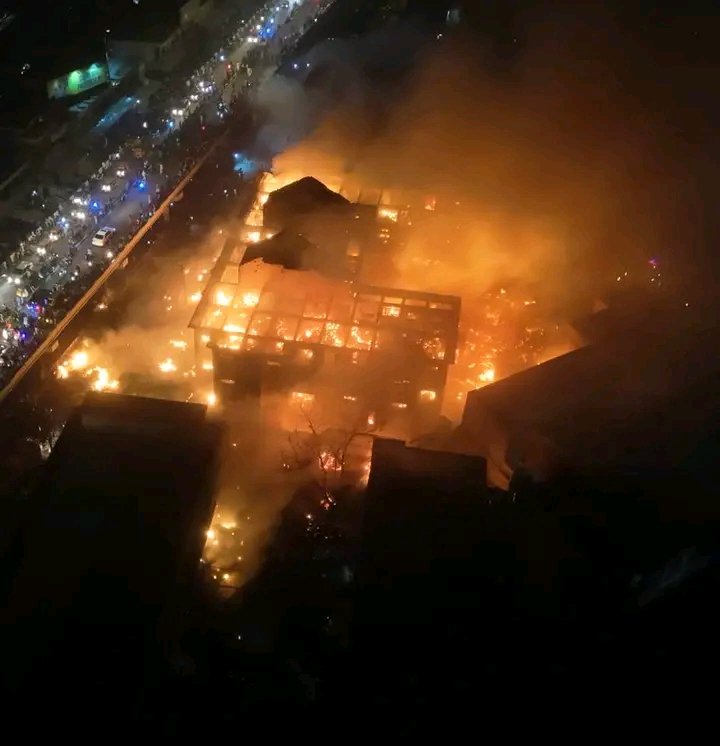
KANO, Nigeria – On a humid Saturday afternoon, when trade should have been winding down into prayer and rest, panic tore through Singer Market in Kano like a violent wind. Within minutes, flames swallowed Gidan Glass, a multi-storey commercial building at the heart of the market, leaving behind twisted metal, charred ceilings and the unbearable smell of loss. By nightfall, an estimated ₦5 billion worth of goods lay in ashes, more than 1,000 businesses were affected, and seven people were feared missing.
What unfolded was not just another market fire. It was a rupture in Kano’s commercial bloodstream — a moment that exposed how fragile livelihoods are in Nigeria’s bustling informal economy. Hussaini Ibrahim, writes.
“I Thought I Was Dreaming”
Alhaji Aliyu Mai Ashana, whose shop was identified as the point where the fire began, still struggles to put the experience into words.
“We were just sitting when people suddenly started shouting, ‘Inna lillahi wa inna ilaihi raji’un,’ saying fire had broken out upstairs. I honestly thought I was dreaming,” he recalled. “Then I saw smoke billowing from Gidan Glass. Within minutes, flames were everywhere.”
The fire fed hungrily on wooden fittings, electrical cables and aluminum panels. Traders watched, paralysed, as years of investment dissolved into smoke.
“Before the fire broke through the window, it had already grown so strong,” Mai Ashana said. “The heat was intense, the smoke made it hard to breathe. I was terrified for my life and my goods.”
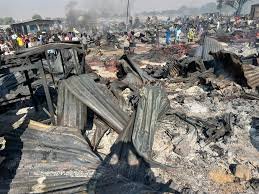
Photo caption: Burnt aluminum panels and collapsed roofing inside Gidan Glass after the inferno.
A Market on Its Knees
Singer Market is more than a trading hub. It is a livelihood engine that feeds families across Kano and beyond. From spare parts to electronics, textiles to household goods, its arteries run deep into northern Nigeria’s supply chain.
Barrister Junaidu Muhammad Zakari, Chairman of Singer Market, stood amid the wreckage as firefighters battled lingering embers.
“The fire service was alerted immediately, and they arrived promptly,” he said. “Honestly, they did their best under the circumstances. They even came back for three consecutive days to ensure the fire was fully extinguished.”
Yet the scale of the losses tells a deeper story.
“Many traders operate businesses worth millions or even billions of naira, but they don’t have insurance,” Zakari explained. “The requirements are stringent, and most traders are informal. The cumulative loss from repeated market fires in Kano is staggering.”
Economic Shockwaves Beyond the Market
For Ambassador Hamza Drama, President of the Kano Chamber of Commerce, Industries, Mines and Agriculture, the disaster is not confined to Singer Market’s boundaries.
“The impact is so devastating that it will take years for victims to fully recover,” he said. “This is not just about one market. It affects supply chains across Kano State and even neighbouring states.”
He warned that repeated market fires could quietly erode confidence in Kano as a regional commercial hub unless structural reforms are urgently implemented.
Government Steps In — But Is It Enough?
Governor Abba Kabir Yusuf’s visit to the scene sent a strong political signal. Standing before traders still in shock, he announced ₦100 million in immediate support.
“We are committed to helping traders recover from this tragedy and to ensuring that markets are safer moving forward,” the governor pledged.
A government spokesperson, Aisha Bello, outlined broader interventions.
“Federal and state delegations have contributed relief funds, including a special allocation of ₦8 billion from the state government and ₦100 million from Senator Barau Jibrin,” she said. “These measures are helping, but full recovery will take time.”
For traders who lost everything overnight, the assistance offers relief — but also raises questions about sustainability and prevention.
Photo caption: Governor Abba Kabir Yusuf inspects the fire-ravaged Singer Market during a condolence visit.
Firefighters Against the Odds
The Kano State Fire Service insists it acted swiftly. Fire Chief Ibrahim Garba described a gruelling operation.
“Our personnel did everything possible under extremely challenging conditions,” he said. “However, the market’s congestion and narrow pathways remain major obstacles for emergency response.”
Fire engines struggled to manoeuvre through tightly packed stalls and improvised extensions — a design flaw common to many Nigerian markets.
Zakari says changes are already underway.
“We have expanded the road network inside the market to allow smooth passage,” he noted. “Every warehouse and shop owner will now be required to have fire extinguishers. We are also reviewing the use of electrical and solar equipment.”
Congestion, Cables and a Culture of Risk
While investigations continue, traders openly acknowledge long-standing hazards. Overloaded sockets, tangled wiring and cramped stalls form a lethal combination.
Mai Ashana voiced a concern many share.
“I cannot directly link the fire to congestion, but it is a worry,” he said. “I have asked the leadership to rearrange the market tables to ease movement and emergency access.”
Experts argue that without strict enforcement, such promises risk fading once public attention shifts.
Photo caption: Narrow market pathways that hindered emergency access during the fire outbreak.
The Human Cost Behind the Numbers
Beyond billions in losses are stories of quiet devastation. Ibrahim Musa, a shop assistant, spoke with tears in his eyes.
“Our stall was destroyed. We lost everything — school fees, food, income,” he said. “This fire has left us devastated, but we still hope for support.”
For Mai Ashana, the pain lingers into sleepless nights.
“Honestly, I could not sleep that night. Everything I worked for was gone,” he said softly. “But as a Muslim, I accept it as destiny. Still, we must rebuild.”
A Turning Point or Another Forgotten Tragedy?
Singer Market’s inferno is part of a troubling pattern. From Sabon Gari to Kurmi, Kano’s markets have repeatedly burned — each time followed by outrage, sympathy and short-lived reforms.
Analysts say real change requires more than relief funds: urban redesign, enforceable safety codes, modern firefighting infrastructure and insurance schemes tailored to informal traders.
Mai Ashana offered a final warning.
“Market safety is not just about protecting goods,” he said. “It is about saving lives. If we act now, another tragedy like this can be prevented.”
As smoke clears over Singer Market, Kano stands at a crossroads: rebuild the same risks — or reimagine its markets before the next fire strikes.
About the Author


 Hope Ajayi
 Mirian Gom