
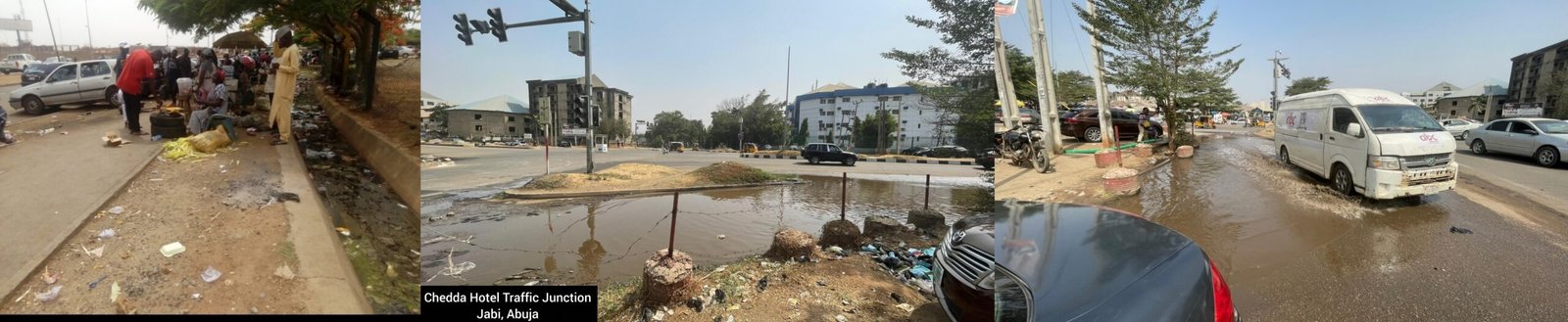
ABUJA, Nigeria – The smell reaches you before the water does. In Jabi, one of Abuja’s busiest districts, dirty water snakes across major roads, pooling at junctions and forcing commuters into an impossible choice: wade through sewage or risk being splashed by passing vehicles. For pedestrians, traders and road users, the daily commute has become a gamble with health.
On a recent afternoon, traffic slowed to a crawl opposite the AA Rano filling station, just after the Vehicle Inspection Office. Buses lurched forward cautiously, motorcycles zigzagged to avoid skidding, and pedestrians hugged the edges of the road, lifting their trousers and skirts as wastewater flowed freely from blocked drainages. At the Chedda Hotel junction and nearby streets, the scene repeated itself — foul-smelling water spilling onto walkways, disrupting movement and exposing residents to contamination.
Findings by African Health Report correspondent Chukwu Obinna show that these drainages have been overflowing for days. Each passing vehicle sends a fresh spray of filthy water onto anyone unlucky enough to be nearby. Some pedestrians detour into traffic to avoid contact; others have no choice but to step through the sludge.
Near one of the overflowing drainages, a car wash operates within metres of the road. As photographs were taken, its operator, Zubairu Ibrahim, moved quickly to distance himself from the mess.
“This dirty water is not from my car wash,” Ibrahim said. “There is sand blocking the drainage. When the environmental people came, I asked them to remove the stone and I will use a shovel to take out all the sand blocking it, but they didn’t come.”
According to him, the blockage prevents proper flow, forcing wastewater back onto the road whenever rainwater or runoff accumulates. His frustration mirrors that of nearby traders who say the problem resurfaces every rainy season, only to be addressed temporarily — if at all.
Beyond nuisance, a public health threat
What looks like an urban inconvenience carries far graver implications. Health experts warn that exposure to sewage-laden water significantly increases the risk of waterborne and sanitation-related diseases, particularly as Abuja approaches the peak of the rainy season.
Globally, the World Health Organization estimates that inadequate water, sanitation and hygiene account for about 1.4 million preventable deaths each year, largely from diarrhoeal diseases. Nigeria bears a heavy share of that burden.
In 2024, the Nigeria Centre for Disease Control reported more than 7,500 suspected cholera cases with 253 deaths across 33 states — a case fatality rate of 3.4 per cent. The Federal Capital Territory has repeatedly featured among areas reporting outbreaks.
Speaking to our correspondent, public health expert Treasure Ekaji said facilities in Abuja continue to see high numbers of patients with illnesses linked to poor drainage and sewage exposure.
“From what we’re seeing in Abuja health facilities, waterborne and sanitation-related diseases are still very common, especially in areas with poor drainage and frequent sewage overflow,” she said. “Conditions like cholera, typhoid fever and dysentery tend to increase during the rainy season, when sewage mixes with surface water and sometimes drinking water sources.”
The most vulnerable pay the highest price
Ekaji warned that not everyone faces the same level of risk. Children under five, pregnant women, the elderly and people with weakened immune systems are the most exposed.
“Children often come in with severe diarrhoea, dehydration and malnutrition, which can quickly become life-threatening,” she said. “Pregnant women are at higher risk of complications like anemia, infections and, in severe cases, poor pregnancy outcomes. Elderly people tend to have more serious illness and slower recovery, while immunocompromised individuals experience more frequent and severe infections.”
Data from UNICEF underscore the scale of the problem: diarrhoeal diseases kill an estimated 150,000 Nigerian children under five every year, making them the country’s second leading cause of child mortality after pneumonia. Unsafe water and poor sanitation are key drivers.
According to Ekaji, communities exposed to sewage do not just suffer isolated outbreaks; they endure cycles of illness.
“In these areas, health workers notice recurrent infections, poor growth in children and people falling sick repeatedly,” she said. “Residents may develop chronic stomach and intestinal problems, repeated infections, poor nutrition and stunted growth in children.”
A sanitation gap widening in cities
The situation in Jabi is not an anomaly. It reflects a broader sanitation deficit across Nigeria’s rapidly expanding urban centres. According to WaterAid, only 47 per cent of Nigerians have access to basic sanitation services, while 24 per cent still practice open defecation. In cities, population growth has far outpaced investment in drainage and waste management.
Ekaji also raised concern about a less visible but growing threat: antibiotic resistance.
“Antibiotic resistance is a big problem,” she said. “The more people are treated repeatedly for infections, the more their bodies get used to the drugs, which can lead to treatment failure.”
Studies published in medical journals have found resistance rates of between 70 and 100 per cent in Nigeria for some commonly prescribed antibiotics used to treat waterborne infections — a worrying trend that complicates treatment and drives up costs.
The hidden economic toll
Poor sanitation is not just a health issue; it is an economic one. A study by the World Bank estimates that inadequate sanitation costs Nigeria about ₦455 billion annually — roughly 1.3 per cent of its GDP. Health-related costs alone account for ₦234 billion, driven by medical expenses, lost productivity and premature deaths.
For residents and small business owners in Jabi, the impact is immediate and personal. Traders say customers avoid flooded areas. Commuters lose time navigating blocked roads. Families spend scarce income on treatment for illnesses that could have been prevented.
Targets slipping out of reach
The sewage running through Jabi’s streets also signals a deeper policy failure. Access to clean water and sanitation is central to the Sustainable Development Goals — particularly Goal 6 on clean water and sanitation and Goal 3 on good health and well-being.
Nigeria’s progress towards these targets remains off track. The latest SDG assessments suggest that, at current rates, the country will not achieve universal access to safely managed sanitation by 2030, with urban areas requiring urgent investment in infrastructure and maintenance.
As evening falls in Jabi, the sewage still flows. Children hop across puddles on their way home. Office workers roll up their trousers before stepping off the curb. The water, untreated and unchecked, continues its slow journey across the road.
Residents and health experts agree on what is needed: blocked drainages must be cleared, routine maintenance restored and sanitation regulations enforced. Without swift intervention, the cost will continue to be measured not just in naira, but in illness — and lives.
For now, in one of Nigeria’s most prominent cities, the streets tell a stark story: when infrastructure fails, it is ordinary people who pay the price.
Join the conversation