
 Chukwu Obinna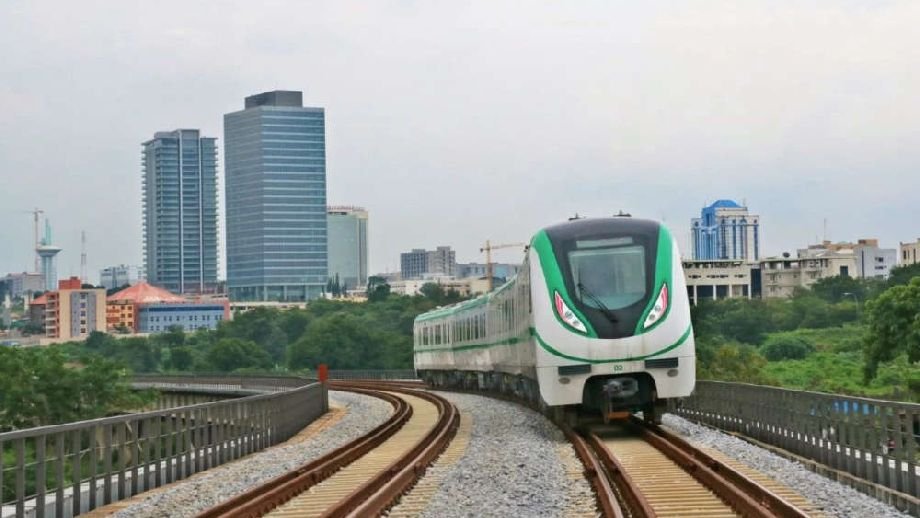
ABUJA, Nigeria – As dawn breaks over Nigeria’s capital, the familiar snarl of traffic builds along Abuja’s wide arterial roads. Car horns blare, buses jostle for space and commuters calculate — once again — what the day’s movement will cost them. Just above the gridlock, however, another rhythm has taken hold.
At rail stations across the city, passengers stream in without opening wallets or counting change. Trains arrive on time, doors slide open, and within minutes, hundreds are on their way — free of charge.
For thousands of Abuja residents, the Abuja Metropolitan Rail Service, now operating at zero fare, has quietly become one of the most tangible policy interventions in recent years. More than a transport scheme, it has altered how people budget, plan their days and imagine mobility in a city where rising living costs often dictate movement.
What began as a temporary government promise has evolved into a daily lifeline — and a test of whether free urban transport can endure in Africa’s most populous country. Chukwu Obinna, writes.
A surge on the tracks
Since its relaunch on 29 May 2024 by President Bola Tinubu, the metro has carried more than 250,000 passengers in its first 100 days, according to officials from the China Civil Engineering Construction Corporation (CCECC), which built and operates the system.
The figures mark a sharp reversal for a rail project that once symbolised unrealised ambition. Suspended in 2020 amid the COVID-19 pandemic, vandalism and operational setbacks, the Abuja Light Rail had struggled to attract consistent ridership. The removal of fares changed that almost overnight.
The 45-kilometre network runs across two lines with 12 stations, connecting the city centre to Kubwa satellite town and Nnamdi Azikiwe International Airport. Fourteen trips operate daily, with trains capable of carrying at least 700 passengers at speeds of up to 100 kilometres per hour.
For commuters, those specifications matter less than the certainty the service now provides.
‘Transport was draining my income’
For Kingsley Chibuzo, a white-collar worker, the impact is measured not in kilometres but in naira.
“Before the metro became free, I was using a different route entirely to get to work, and transport alone was draining my income,” he said.
Before the policy shift, Chibuzo spent about ₦60,000 each month commuting by road or personal vehicle — a significant share of earnings in a city where inflation has pushed up food and housing costs.
While he admits he has not created a formal savings plan, the relief is undeniable.
“The train has been helpful. Even if I haven’t boxed the money into savings, not paying transport every month makes a big difference,” he said.
Beyond affordability, Chibuzo points to safety — a growing concern on Abuja’s roads.
“The train is on its own track. There’s no traffic, no reckless driving, no collisions with other vehicles. As long as the tracks are well maintained, it’s one of the safest ways to move,” he said, rating the service “95 per cent effective”.
Movement without calculation
That sentiment resonates strongly with Jennifer Ubadigha, who says the free metro has changed not just how she travels, but how she thinks.
“Now, you don’t even think about transport,” she said. “It makes it easy to go anywhere you want to go. Before, you would calculate transport first.”
For her, the money once reserved for daily fares is now redirected to savings and personal needs.
“It’s significant,” she said.
Reliability, she added, has been just as transformative.
“The train is very reliable. You can’t come and miss the train unless you come late. The timing is predictable, and it’s very safe.”
Lucky Beetroot, another regular commuter, says his monthly transport costs once reached ₦80,000.
“That money is now going into other things,” he said. “You can travel more, go to more places, without worrying about cost.”
Even if fares return, he believes the metro has permanently changed his commuting habits.
“Even if they bring payment back, it won’t be anywhere near what I used to spend every month,” he said.
‘Everybody is coming’
At the stations, the transformation is visible. Platforms that once saw modest foot traffic now thrum with activity, particularly during morning and evening rush hours.
Madubuke Cornelius, a security officer at one of the rail stations, says the change was immediate.
“A lot of passengers will be coming in because the service is now free,” he said. “When it was not free, we used to come small. But now that it is free, everybody is coming.”
According to Cornelius, cost had been the single biggest barrier to rail usage. Once removed, civil servants, traders, students and airport travellers quickly shifted from road transport.
The result has been lighter congestion on some major routes, shorter travel times and a subtle redistribution of economic activity across the city.
Policy, politics and patience
The zero-fare policy was initially announced as a short-term measure. President Tinubu approved two months of free rides following a recommendation from Federal Capital Territory Minister Nyesom Wike. It was later extended through the end of 2024, and then for an additional six months — a signal of political confidence in its popularity.
Yet Abuja’s rail history tempers the optimism. The system, first opened in July 2018, cost about ₦840 million in its first phase and was partially financed through a 2.5 percent per annum loan from China’s Exim Bank. Years of delay, vandalism and neglect followed.
Those legacy shapes commuter expectations today. Gratitude is widespread, but so is realism.
“If it’s above normal transport, people will struggle,” Ms. Ubadigha said of any future fare reintroduction. “But if it’s below that, people will still patronise it.”
Others warn that high fares could quickly reverse the gains, forcing commuters back onto congested roads. The lesson, many argue, is not that public transport must always be free — but that it must be predictably affordable.
Beyond numbers
Policy analysts note that the initiative aligns with global development priorities. It supports Sustainable Development Goal 11 on inclusive, safe and sustainable cities, while also advancing SDG 1 (No Poverty) by reducing household transport costs, SDG 8 (Decent Work and Economic Growth) through improved access to jobs, and SDG 10 (Reduced Inequalities) by narrowing mobility gaps.
But the story of Abuja’s free metro is not ultimately told through development targets or ridership statistics.
It is told in quieter moments: a commuter arriving home earlier, a worker redirecting fare money to school fees, a city discovering that movement need not be a daily financial negotiation.
As trains continue to run without charge, Abuja is testing an idea with resonance far beyond Nigeria — that when mobility is made accessible, cities can change faster than expected.
Whether this experiment becomes a lasting model or a fleeting moment will depend on political will, funding and public trust. For now, the trains keep moving — and the city rides free.
About the Author

 Mirian Gom
 Korede Abdullah
 Oluwatobi Adu