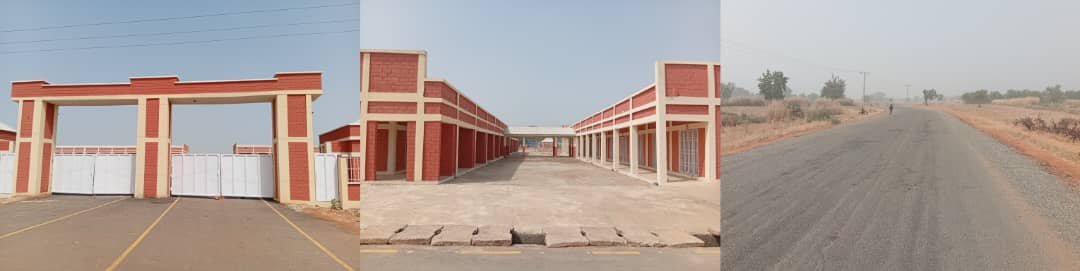
YOBE, Nigeria – The market stalls are new. The roads are freshly paved. The ambition is unmistakable. Yet across large swathes of Yobe State, silence has become the loudest verdict on a multi-billion-naira development drive meant to breathe life back into communities battered by years of Boko Haram violence. From Buni Yadi to Gambir and Yunusari, modern markets now rise where open fields once stood—concrete symbols of recovery after insurgency. But despite the state government’s heavy investment in infrastructure, many of these facilities remain eerily underused, undermined not by neglect or poor planning, but by a deeper, more stubborn force: fear.
Africa Health Report’s findings reveal a troubling paradox. While Yobe is building its way towards economic revival, residents say the psychological scars of insurgency continue to dictate daily life, hollowing out the promise of development and driving traders, farmers and young people away from rural communities. Hussaini Ibrahim, writes.
Development Meets Insecurity
Across Yobe State, modern markets now stand as symbols of a government determined to revive rural economies battered by years of insurgency. From Buni Yadi to Gambir and Yunusari, new commercial hubs are rising, designed to reconnect farming communities to trade and stimulate local livelihoods.
Yet, months after construction began, many of these markets remain eerily quiet.
While stalls are neatly arranged and access roads freshly paved, traders are scarce, buyers hesitant, and economic activity far below expectations. Residents say the challenge is not the absence of infrastructure, but the persistent fear of Boko Haram attacks.
Government’s Vision for Rural Growth
The Yobe State Government insists its development drive is deliberate and people-centred. According to the Commissioner for Home Affairs, Information and Culture, Hon. Abdullahi Bego, the projects form part of a broader strategy to open up rural communities and restore economic life disrupted by insurgency.
He explained that areas such as Gambir, an agricultural settlement about 16 kilometres away, have been prioritised through the construction of access roads aimed at boosting farming and commerce.
“His Excellency has been instrumental in opening up agricultural communities through rural and access roads,” Bego said. “The goal is to stimulate business, commercial, and economic development, because most of our people are farmers.”
Beyond commerce, he noted that the roads are also designed to improve rural healthcare by allowing faster movement in and out of remote communities. The Gambir road, he added, is 7.3 metres wide and 40 millimetres thick, built to modern standards as part of the administration’s comprehensive development plan.
On market infrastructure, Bego said the Buni Yadi Modern Market is one of several being developed across the state.
“It is an exact replica of the modern markets in Gombe and the ongoing Emojina market,” he said. “They have the same facilities and number of shops; only the land size differs.”
According to him, nine modern markets are currently under development in Yobe—four of the Buni Yadi model and five ultra-modern markets. The Buni Yadi project, he explained, commenced less than four months ago and is scheduled for completion within 12 calendar months.
Fear in the Midst of Infrastructure
On the ground, residents say the promise of these projects is being suffocated by fear.
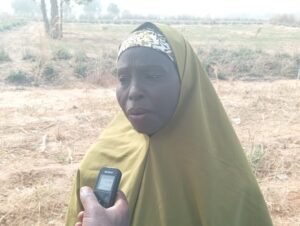
In Yunusari Local Government Area, 68-year-old resident Hajja Amina Lawan said insecurity has quietly reshaped daily life despite visible government efforts to revive commerce.
Hajja Amina Lawan speaking on insecurity in Yunusari
“The markets were meant to bring people together,” she said. “But people are afraid to gather. Even if there is no attack for a long time, the fear remains because we have seen what can happen.”
She explained that many families have relocated their children and younger relatives to safer urban centres, leaving rural communities with fewer people to sustain local markets.
“The government built the markets with good intentions, and we appreciate that,” she said. “But a market cannot work if people are scared to come out.”
According to her, intermittent security patrols provide little reassurance.
“When security reduces, fear comes back immediately,” she said. “Development will not succeed without security. We need peace before we can use what the government has built.”
Farmers Abandon Local Markets
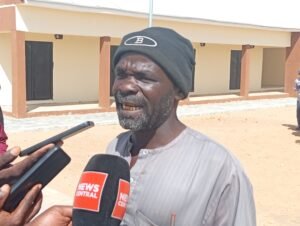
In Buni Yadi, farmer Malam Bukar Adamu, 72, said Boko Haram threats have fundamentally altered long-standing patterns of trade.
Malam Bukar Adamu, farmer affected by Boko Haram threats
“Before, buyers came to us,” he recalled. “Now we take our goods far away because we feel safer there.”
He explained that insecurity is fuelled not only by actual attacks but also by rumours and uncertainty, which can instantly shut down economic activity.
“When people hear any suspicious story, everyone withdraws,” he said. “The market becomes empty immediately.”
Malam Bukar warned that underutilised markets could eventually discourage farming and worsen food insecurity.
“If farmers cannot sell close to home, some will stop farming,” he said. “That affects everyone.”
Youthful Hopes, Stalled Futures
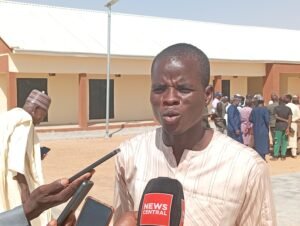
For young people, the impact is particularly stark. Sadiq Mohammed, a 26-year-old unemployed graduate from Gambir, said the modern markets were expected to create jobs, but insecurity has prevented those expectations from materialising.
“When the markets were built, we believed there would be work,” he said. “But traders are afraid to invest because of Boko Haram.”
Sadiq Usman, unemployed youth in Gambir
According to him, the lack of opportunities has fuelled frustration and migration.
“Many young people leave because there is nothing to do here,” he said. “Others stay idle and hopeless.”
Fear, he added, has also disrupted social life.
“We no longer stay out late or gather freely,” he said. “Everything ends early because people want to be safe.”
“Without safety, buildings are useless,” he concluded. “Security is what will make development meaningful.”
Expert Insight: Why Fear Defeats Infrastructure
Security analyst, Mohammed Kingimi, a counter-insurgency expert, said Yobe’s experience highlights a recurring weakness in development planning within conflict-affected regions.
“These markets reflect a well-intentioned economic strategy,” he said, “but one that underestimates the psychological impact of Boko Haram.”
According to Kingimi, security in insurgency-affected environments is not defined solely by the absence of attacks.
“Security is measured by the confidence of the people to live, trade, and move freely,” he said.
He explained that Boko Haram’s tactics have evolved into sporadic threats and intimidation, which are sufficient to paralyse economic activity.
“When people believe an attack can happen at any time, markets collapse on their own,” he said. “Traders withdraw, farmers avoid local sales, and investments become stranded assets.”
Kingimi warned that abandoned rural markets could deepen poverty and accelerate migration to urban centres.
“You end up with empty markets in villages and overcrowded markets in towns,” he said. “That imbalance undermines inclusive development.”
He stressed that infrastructure projects must be paired with visible, permanent, and locally trusted security measures, including intelligence-led patrols and community-based early warning systems.
“Occasional patrols do not build confidence,” he said. “They only remind people that danger still exists.”
Development at a Crossroads
Beyond economics, Kingimi cautioned that abandoned projects risk eroding public trust in government interventions.
“When people see empty markets, they see wasted resources or broken promises,” he said. “That perception quietly fuels resentment.”
His conclusion was blunt: “You cannot build prosperity on fear. Until people feel safe enough to return to these markets, development will remain on paper, not in practice.”
Yobe State’s modern markets now stand at a crossroads—symbols of ambition constrained by insecurity. While the government continues to invest in roads and commercial infrastructure, residents’ testimonies reveal a deeper truth: development cannot outpace fear.
As Boko Haram’s shadow lingers across rural communities, the success of Yobe’s development drive will depend not just on concrete and contracts, but on restoring confidence, safety, and trust. Without that, markets will remain empty—and development unfinished.








Join the conversation