
Heat, Homecomings and Hope: A Nigerian Christmas Road Diary Defying the Seasons
 Oluwatobi Adu
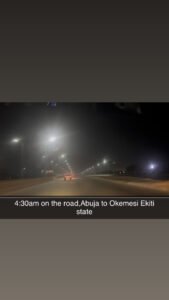
Early morning festive travellers departing Abuja on Christmas Eve. (Photo credit: Oluwatobi Adu/AHR, 2025)
ABUJA, Nigeria – At 4:00 a.m. on Christmas Eve, Abuja was unusually quiet. The familiar thrum of traffic that defines Nigeria’s capital had softened to a murmur as thousands of residents slipped out of the city under cover of darkness, chasing the same promise: home. Suitcases were wedged into boots, food flasks balanced on laps, and playlists queued for long journeys southwards. Like millions of Nigerians, Africa Health Report’s Oluwatobi Adu joined the annual festive migration that empties major cities and reawakens rural towns — a ritual as old as the modern Nigerian state.
Yet the 2025 festive season was anything but routine. It unfolded under an unforgiving sun, punctuated by unseasonal rains, shaped by economic strain, and sustained by a resilience that has become second nature to Nigerians. This is a travel log of that journey — across highways and hometowns, weather surprises and worship halls — capturing a country returning home amid change.
Waiting Out the Fear of the Road
In the days before Christmas, anxiety dominated conversations in Abuja. Reports of gridlock along the Abuja–Lokoja highway — a notorious choke point during peak travel periods — spread rapidly across WhatsApp groups and radio bulletins. Videos showing motionless traffic in parts of Kogi State fuelled fears of spending Christmas stranded on the road.
Like many others, our correspondent delayed departure, opting to wait until early Christmas Eve. The gamble paid off.
Leaving Abuja at exactly 4:00 a.m. on 24 December, the journey towards Okemesi-Ekiti unfolded with surprising ease. Traffic was heavy but fluid, a moving river of buses, saloon cars and SUVs packed with families, gifts and expectations. By 3:00 p.m., after roughly 11 hours on the road, the red earth and rolling hills of Ekiti came into view.
“It was busy, but it moved,” said a commercial driver taking a break in Kabba, Kogi State. “This year, God helped us. No serious hold-up.”
Motor parks in Kabba told their own story. Northbound vehicles lined up tightly, drivers stretching their legs as passengers bought roasted corn, bottled water and akara. The scale of the movement was unmistakable — Nigeria on wheels.
Only one minor accident was spotted on the road to Ibadan days later, its details indistinct from a distance. Otherwise, the highways remained calm, reflecting heightened security presence and the collective caution of travellers determined to arrive safely.

When Harmattan Failed to Arrive
If the roads behaved, the weather did not. Across Ekiti and Oyo states, the expected harmattan — dry winds, dusty skies and cooler nights — simply never came. Instead, the festive season arrived wrapped in heat. Relentless, sticky heat.
Residents of Okemesi-Ekiti spoke of sleepless nights and sweat-soaked afternoons. In Ibadan, fans whirred constantly, and light clothing replaced the sweaters that usually make their annual December appearance.
Then came the rain
Heavy showers fell on Christmas Eve in Okemesi-Ekiti, drumming loudly on rooftops as families prepared for Christmas Day. In Ibadan, rain returned on New Year’s Eve, soaking streets just hours before crossover services.
“For December, this kind of rain is strange,” said a trader in Ibadan, laughing as she pulled her goods under a tarpaulin. “But maybe it is a blessing for the new year.”
Opinions varied. Some worshippers interpreted the rain spiritually — a sign of divine favour and renewal. Others worried it pointed to deeper climate shifts. Across Nigeria, reports emerged of delayed or weakened harmattan conditions, aligning with growing scientific concerns about climate variability altering long-standing seasonal patterns.
The effect was practical as much as symbolic. Heat shaped daily routines, shortened outdoor gatherings, and reminded Nigerians that even their most familiar seasons are changing.
Counting the Cost of Coming Home
The joy of homecoming came at a price.
Transportation fares surged sharply as demand peaked. At motor parks, passengers grumbled openly about festive surcharges, especially for return journeys in early January. Many felt operators exploited the season, while drivers argued rising fuel and maintenance costs left them no choice.
“Everything is expensive now,” said a passenger negotiating a fare in Ibadan. “But you cannot stay away from home because of money.”
Government-subsidised train services, offering discounted fares on select routes, provided some relief. Still, road travel remained the dominant option, particularly for destinations not connected by rail.
Amid these pressures, a small economic relief emerged. In Ibadan, several residents noted a modest drop in food prices, easing the cost of festive cooking. Markets buzzed with cautious optimism as families managed to balance tradition with tightening budgets.
Towns That Came Alive
If Abuja grew quieter, towns like Okemesi-Ekiti and Ibadan pulsed with life.
Returning migrants — affectionately dubbed “IJGBs” (“I Just Got Back”) — infused local spaces with energy. Cafés, viewing centres and neighbourhood streets buzzed with laughter, music and storytelling. Old friendships were revived, family compounds filled up, and children listened wide-eyed to tales of city life.
Christmas Day itself unfolded gently: visits to relatives, shared meals, and countless phone calls to loved ones unable to travel. In Ibadan, streets glowed with festive decorations, a testament to the city’s enduring flair.
Faith anchored the celebrations. New Year’s Eve crossover services drew worshippers into churches across the southwest. At Christ Apostolic Church Oke-Ibukun in Ibadan, prayers of gratitude dominated the night.
“We are thanking God that we survived 2025,” said one congregant. “That alone is a testimony.”
Attendance appeared slightly lower than in previous years, perhaps reflecting economic strain or growing fatigue, but the mood remained reverent and hopeful.
A Journey That Still Matters
By 4 January, the flow reversed. Cars once again pointed north as travellers returned to Abuja, carrying leftovers, gifts and renewed resolve. The roads grew busy, but orderly. Urban centres slowly refilled, work routines beckoned, and the festive bubble gently deflated.
Yet something lingered.
Despite higher costs, strange weather and lingering uncertainty, Nigerians still came home.
They still travelled long hours, endured heat and rain, and prioritised connection over convenience. The 2025 festive season reaffirmed a powerful truth: homecoming remains a cultural constant, a ritual of belonging that adapts but does not fade.
In a changing climate and a pressured economy, the journey itself — smooth roads, shared prayers, unexpected rain — became part of the story. As Nigeria steps into 2026, the echoes of that journey speak of resilience, faith and an enduring commitment to togetherness.
About the Author


 Hope Ajayi
 Mirian Gom

This is well captured and captivating story!
No matter the economic condition we value Christmas home coming as Nigerian. It rekindled love and builds connection with one’s kinsmen.
Bravo ‘Tobi