Suicide is Not a Joke: Akpabio’s Legislatures Must Stop Criminalizing People Who Need Medical Help
 ifijehmartins
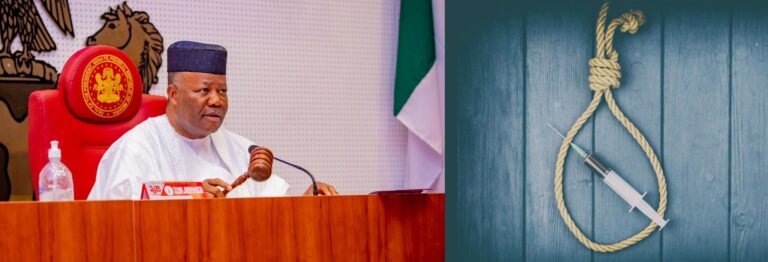
Editorial illustration on the decriminalisation of attempted suicide in Nigeria, featuring Senate President Godswill Akpabio and highlighting calls for compassionate mental healthcare and suicide prevention.
The recent remarks by Nigeria’s Senate President, Senator Godswill Akpabio, during deliberations on a bill seeking to decriminalise attempted suicide are deeply disturbing and raise serious concerns about how mental health issues are understood and addressed at the highest levels of government.
At a time when Nigeria should be strengthening its mental healthcare system, expanding access to psychological support and protecting vulnerable citizens, it is troubling to see such a sensitive issue discussed in a manner that appears to trivialise the suffering of people experiencing suicidal crises.
Suicide is not a laughing matter. It is a serious public health issue that demands compassion, medical intervention, informed policymaking and responsible leadership.
A person who attempts to take their own life is often experiencing an overwhelming crisis. Such distress may arise from depression, trauma, severe psychological suffering, financial hardship, family difficulties, social isolation or a combination of complex circumstances. The appropriate response should be to identify the underlying problems, provide necessary medical and psychological care, and help the individual recover.
How does imprisoning someone who has already reached a point of extreme emotional distress improve their mental health? How does threatening punishment encourage a struggling Nigerian to seek help? And how does criminalisation contribute to preventing future deaths? These are the questions our lawmakers should be asking.
Rather than deterring suicidal behaviour, the threat of prosecution may discourage people from seeking professional help, compel families to conceal suicide attempts and reinforce the stigma surrounding mental illness. It may also prevent health authorities from obtaining reliable information necessary for effective suicide prevention policies.
The World Health Organization has consistently advocated the decriminalisation of suicide attempts, recognising that punitive laws can create barriers to treatment and undermine public health interventions. Countries such as Ghana, which decriminalised attempted suicide in 2023, have already demonstrated that legal reform is possible in Africa.
Nigeria must not continue to treat a complex health emergency primarily as a criminal offence while other countries are adopting more humane and evidence-based approaches.
What makes the current situation particularly concerning is the contradiction within Nigeria’s own legal framework. While the National Mental Health Act recognises the importance of appropriate treatment and protection for people experiencing mental health crises, provisions of the Criminal Code and Penal Code continue to criminalise attempted suicide. This contradiction demands legislative reform, not political humour or dismissive commentary.
Indeed, the Federal Government has already acknowledged the need for change. In September 2026, the Federal Ministry of Health and Social Welfare announced that the Federal Executive Council had approved its position supporting the decriminalisation of attempted suicide. That progress deserves legislative support rather than resistance.
We acknowledge the efforts of Senator Asuquo Ekpenyong and other lawmakers supporting legislation that would replace punishment with medical assessment, treatment, rehabilitation and sustained support for survivors. The Senate’s decision to advance the bill to its second reading represents an important opportunity for meaningful reform.
However, decriminalisation must not exist merely on paper. It must be accompanied by meaningful investment in mental healthcare, adequately equipped psychiatric services, accessible counselling, crisis intervention programmes, trained healthcare professionals and public education to address harmful misconceptions surrounding suicide.
Nigeria must also strengthen suicide prevention services at the community level, where many people experiencing emotional distress have limited access to professional assistance. Primary healthcare facilities, schools, workplaces and community institutions should be equipped to identify warning signs, offer early support and facilitate timely referrals.
Political leaders have a particular responsibility to shape public attitudes through their words and actions. When discussions about suicide become occasions for insensitive remarks, the consequences extend beyond the legislative chamber. Such statements risk reinforcing the very stigma that prevents vulnerable individuals from seeking help.
At Africa Health Report, we firmly believe that surviving a suicide attempt should never be a reason for imprisonment. Survival should be an opportunity for treatment, recovery, renewed hope and another chance at life.
We therefore call on the National Assembly, the Federal Ministry of Health and Social Welfare, mental health professionals, civil society organisations and other relevant stakeholders to work together toward the complete decriminalisation of attempted suicide and the establishment of a comprehensive national suicide prevention framework.
Nigeria cannot claim to prioritise the health and well-being of its citizens while maintaining laws that threaten people experiencing suicidal crises with imprisonment.
The conversation must change. Our laws must change. And most importantly, our response to people in psychological distress must change. A person who survives a suicide attempt does not need a prison cell. That person needs care, understanding, professional support and a genuine opportunity to recover.
Suicide is not a joke. Mental health is not a joke. Human life must never be reduced to a political punchline. Nigeria must choose compassion over criminalisation, treatment over punishment, and prevention over stigma.
It is time to treat suicide prevention as the public health priority it deserves to be.
About the Author


 Korede Abdullah

 Oluwatobi Adu