Abuja Commuters Still Wait for CNG Fare Cuts as October 1 Deadline Nears
 Oluwatobi Adu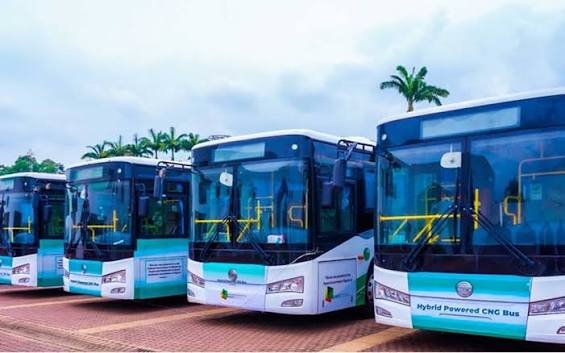
CNG-powered buses showcased by the Federal Government as part of the National Affordable CNG Transit Programme. (Image Credit: Internet)
(By Oluwatobi Adu and Hope Ajayi)
ABUJA, Nigeria – Two days before the Federal Government’s October 1 deadline for Nigerians to begin seeing measurable reductions in transportation costs, Abuja commuters are still paying thousands of naira daily to get to work.
The promise was straightforward: cheaper compressed natural gas (CNG) should translate into cheaper public transport. But interviews by Africa Health Report across motor parks in Wuse, Area 1 and the Federal Secretariat reveal a more complicated picture.
Some commuters said they spend between ₦2,500 and ₦4,000 a day, while drivers using CNG complained about long queues, inconsistent supply and price differences between refuelling stations.
For drivers yet to convert their vehicles, the cost of switching from petrol to CNG can also exceed ₦800,000.
The October 1 CNG Promise
The Federal Government has said the National Affordable CNG Transit Programme is already reducing fares on some routes.
In a September 19 statement, the State House said passengers using CNG-converted commercial vehicles on selected Abuja routes were already benefiting from fare reductions of up to 40%, citing examples including Wuse, Nyanya and Area 1-Gwagwalada.
The government said fares on some routes had fallen from ₦1,500 to ₦900, ₦700 to ₦420 and ₦400 to ₦240 respectively.
President Bola Tinubu had also set October 1 as a target for more Nigerians to begin experiencing measurable reductions in transportation costs.
But the question facing commuters interviewed by AHR is simple: Where is the reduction?
What AHR Found on the Ground
Despite the Federal Government’s claim that CNG-powered buses are already operating on selected Abuja routes, AHR correspondents who visited the affected areas during the reporting period did not observe any of the buses operating at the locations visited.
The absence of the buses during the interviews does not establish that they were not operating elsewhere or at other times. However, the observation raises questions about how visible and accessible the CNG-powered transport service is to commuters ahead of the October 1 target. The correspondents noted that the buses may become more visible on the roads as the October 1 deadline approaches.
‘Transport Fares Are Not Going Down’
Fatima, a 40-year-old civil servant who travels daily from Mararaba to Wuse, said her commute is costing her about ₦2,500 each day — one way. “From my house to work, I spend ₦2,500 every day. Coming alone, I’m not even talking about going back. I have to support myself because the salary is not enough.”
She said she has seen CNG buses in Mararaba and has used them occasionally, but they are not consistently available. “The only day we have access to CNG buses in Mararaba is maybe Friday. At times, I do enter.”
Her experience illustrates one of the central findings from the interviews: a cheaper bus is of limited value if commuters cannot reliably find one.
At Wuse Market Motor Park, Chief Segun Balogun, a commuter and consultant who is close to 70, said he had already spent more than ₦3,000 on transportation during his journey that day.
He knows about the government’s CNG programme. But he said awareness has not translated into relief. “Even though they reduce it, people are not feeling it. We are talking about the availability.”
Balogun wants CNG vehicles deployed across more routes, particularly those serving lower-income communities. “Make it available, make it everywhere, make it all routes. They are supposed to flood all routes, all major routes that lead to where lesser privileged people are living.”

Abuja Commuters Spend Up to ₦4,000 Daily
At the Federal Secretariat Motor Park, Theophilus, a 40-year-old commuter and driver, said he spent about ₦3,000 on transportation on the day he spoke with AHR. “I spent about ₦3,000 on transportation today.”
He said fares had not fallen. “Transport fares are going up; they have not gone down recently.”
Theophlius said he believes CNG is better than petrol but said he was unaware of the government’s planned 40% reduction for CNG-powered commercial transport. “CNG is better than petrol. As a driver, I can identify a vehicle using CNG from one using petrol.”
For Modupe, a 26-year-old NYSC member serving at the National Assembly, the numbers are even higher.
Living in Lokogoma, she said she spends about ₦4,000 every day commuting to and from work.
“I have been in Abuja for about two months, and I spend about ₦4,000 on transportation in a day, going to and returning from work. Today, I have spent about ₦2,000 getting here, and I expect to spend another ₦2,000 going back.”
Then she delivered the assessment many commuters repeated: “Transport fares are not going down; they are going up. Transportation is actually very expensive in Abuja.”
Modupe said she supports the idea of CNG-powered public transport if it actually lowers fares.
But she raised another question: can existing CNG stations cope if demand increases? “I know there are CNG stations around Abuja, including a mega station, but the question is whether they can accommodate the number of people who need them. If many people start using CNG vehicles, I think it could become a struggle because of the demand.”

At Area 1 Motor Park, 24-year-old NYSC member Adadi Faith Ojonugwa, who lives in Kuje, said she spends between ₦3,000 and ₦4,000 on transportation every day. “I spend between ₦3,000 and ₦4,000 on transportation every day, and transport fares have gone up significantly.”
She said she would readily use CNG-powered transport if it delivered cheaper fares. “If CNG can make transportation cheaper, I would definitely be willing to use it because it would help me save money. I have been spending a lot on transportation lately, so I would welcome anything that can reduce the cost.”

Drivers Face Long CNG Queues
The strongest challenge emerging from the driver interviews was not simply the price of CNG.
Adekunle Aluko, a commercial driver operating between the Federal Secretariat and Area 1, said passengers currently pay ₦700 per trip.
Before the rise in fuel prices, he said, the fare was ₦500. “We are flying from Secretariat to Area One and from Area One to Secretariat, and we charge ₦700 per passenger. Before CNG and fuel prices went up, we carried four passengers and charged ₦500. Now we carry five passengers at ₦700.”
Aluko said CNG could reduce transport costs — but only if drivers could obtain it reliably. “Using CNG for commercial transport is very good if it is available, but the problem is that it is not readily available.”
He estimated that privately converting his vehicle could cost about ₦800,000. “If I want to convert my vehicle myself, I may have to spend about ₦800,000. If I borrow that money, how do I recover the money if I don’t increase my transport fare?”
Then comes the queue. “Even when you go to a CNG station, you can spend three or four hours without getting it. Sometimes, you may not get it in a whole day. You could even have to sleep there and wait until the next morning.”
Aluko also described significant differences in what drivers pay for CNG at different stations. “The price is also not stable. NNPC is selling at about ₦380 per kilogramme, while some other stations sell for ₦500, ₦550 or even around ₦570. You want to go to where it is ₦380, but you may spend four or five hours there and still not get it.”
A driver who spends hours waiting for fuel is also losing hours that could have been spent carrying passengers. “If we could get CNG consistently at a cheaper rate, it would help us reduce the cost of transportation. But if I am using CNG and another driver is using petrol, we are still operating from the same park and have to charge the same fare.”
CNG Shortages Keep Drivers Using Petrol
Mohamod Mohammed, commercial driver and secretary of the PT Unit at Area 1 under Buhari Duste, said he uses both CNG and petrol because CNG is not consistently available. “Even though I use CNG, I still use petrol because CNG is not available everywhere. Sometimes you stay from morning until evening before you can buy it, and sometimes you don’t even get it.”
The long waits, he said, directly affect drivers’ ability to operate. “Because of these challenges, the cost of transportation has not reduced. Even if you are using CNG, you still have to work, and sometimes you may spend so much time at the station waiting to get gas.”
His proposed solution is straightforward: “The biggest challenge with CNG is availability. You can spend a long time at the station before you get gas. If the government can build more CNG stations, that will solve the major problem.”
‘Fuel is getting close to ₦1,500’
Kazim Adediji, 46, chairman of the branch at Area 1 Motor Park, said he witnessed the CNG conversion exercise at the park.
But he said availability remains a major obstacle. “But the problem is that CNG is not widely available. Because of that, transportation fares have not been reduced. Some drivers who got the CNG vehicles or converted their vehicles can use the gas for two, three, four or even five days, but later they struggle to find CNG.”
He said some drivers wait in queues only to discover that the gas pressure is too low to refill their vehicles.
Adediji said he had only recently heard about the government’s proposed 40% reduction and that the reduction had not been implemented at the park.
He also pointed to petrol prices as another factor. “Our major problem is the price of petrol. Fuel is getting close to ₦1,500 per litre. If the price of fuel comes down, passengers will also understand that transport fares should come down. But whenever fuel goes up, transport fares also increase.

Conversion Costs Keep Some Drivers Away
At Wuse Market Motor Park, 47-year-old professional driver Ikechukwu said petrol costs are eating into drivers’ earnings.
He said he can spend as much as ₦30,000 on petrol in a day, while his take-home income can fall to about ₦10,000 or ₦7,000 after expenses.
The fare from Wuse Market to Wuse 2, he said, is about ₦500. “Maybe the transportation wey dem dey pay, like from Wuse Market to Wuse 2 is ₦500 now because of fuel issue. Maybe the transport can come down.”
He said conversion costs were also keeping some drivers away from CNG. “If they make it easy for us now, the driver can be happy. Because if they use CNG, you can put CNG at about ₦7,000 and make use of it a day. But this one, like me now, I can use up to ₦30,000 fuel a day.”
‘It is few of us that got the CNG’
Muyideen Aminu, 61, vice chairman of Painted Abuja Taxi at Wuse Market Motor Park, converted his vehicle to CNG last year.
But conversion has not eliminated his biggest problem: access to fuel. “The CNG is not available again. Before it was free, but now you have to use money. It is only a few of us that got the CNG.”
Aminu said his current fare from Wuse Market is about ₦500.
But when he needs CNG, he said, the waiting can stretch into the next day. “To get the gas is the problem. It’s not available everywhere. If I go to the queue at the CNG station, I will have to wait until tomorrow before I can get gas for my vehicle.”

Another Wuse Market driver, who identified himself as Mosquito, said he had applied for CNG conversion more than three times.
He said his personal and vehicle details were collected, including his number plate, but he was not selected. “We applied more than three times. They took my information and my plate number, but they did not give me. They were giving some people, but they did not give me. They kept giving me fake promises.” His conclusion was blunt: “Nothing has reduced.”
Why Cheaper CNG Has Not Yet Meant Cheaper Fares
The Abuja interviews do not suggest that CNG cannot reduce transportation costs. Instead, they highlight the challenges involved in turning cheaper fuel into cheaper passenger fares.
For drivers with access to CNG, potential savings can be offset by conversion costs, limited refuelling infrastructure, long queues and inconsistent supply. Drivers who remain dependent on petrol continue to face higher operating costs.
For commuters, however, the key measure is not the price of a kilogramme of CNG. It is the amount they pay for each journey.
The Federal Government says the programme is expanding. The State House said in September that more than 120,000 vehicles had been converted nationwide, supported by more than 400 certified conversion centres and over 90 CNG refuelling stations.
But the experiences gathered by AHR in Abuja suggest that infrastructure and reliable access will determine whether those national figures translate into lower fares for commuters. With October 1 approaching, the central question for Abuja passengers remains: when will the savings from CNG consistently reach the fare they pay at the motor park?
About the Author


 Hope Ajayi