When Abuja Floods: Why Nigeria’s Capital Keeps Struggling with the Rains
 Hope Ajayi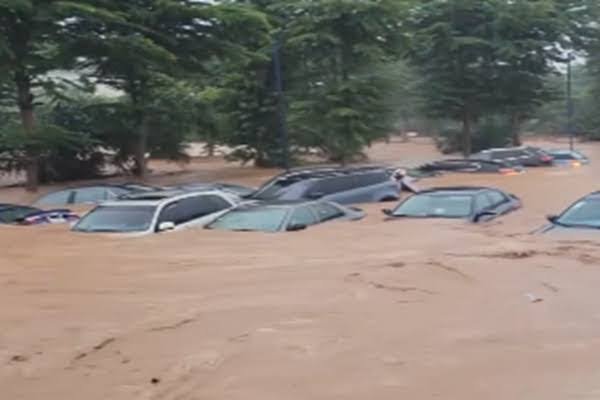
ABUJA, Nigeria- residents, motorists and business owners in parts of Nigeria’s capital, heavy rain can bring more than a temporary disruption. Roads disappear beneath floodwater, vehicles become stranded, businesses lose customers and residents are sometimes trapped in their neighbourhoods for hours. In Wuse 2, one of Abuja’s busy commercial districts, recurring flooding has raised a bigger question: why does a city designed around planned development continue to struggle with stormwater? Africa Health Report’s Hope Ajayi examines the human and economic cost of flooding in Wuse 2 and the drainage, urban development and environmental management challenges experts say are keeping the problem alive.
When the Water Takes Over
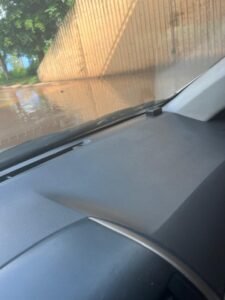
For one resident of Blantyre Street, near Barcelona Hotel in Wuse 2, the recent flooding turned an ordinary day into hours of uncertainty.
The floodwater became so extensive, the resident said, that vehicles could neither enter nor leave the area.
“That day was very, very terrible because for like three or four hours, no vehicle was coming in or going out because of the flood,” the resident said.
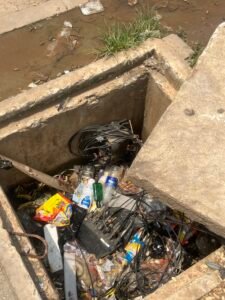
The resident also alleged that some drainage channels in the area were filled with waste and said one near the INEC office had remained in poor condition for months.
Those claims could not be independently verified.
But the account reflects a concern shared by residents across flood-prone parts of Abuja: that the problem is not simply the amount of rain falling from the sky, but what happens to the water once it reaches the ground.
A Rainy Day Can Mean a Lost Day’s Income
For businesses, flooding has consequences that continue long after the water begins to recede.
Okechukwu Osuji, who operates Goldus Green Barber Shop and Ice Bar Restaurant on Ademola Adetokunbo Road, Wuse 2, said customers could not reach his business during the recent flooding. Some motorists were also unable to retrieve their vehicles.
“We lost our turnover, customer turnover, making us also lose money. We were not able to make the number of sales we were supposed to make for the day,” Osuji said.
He said the problem had persisted for close to three years, particularly during the rainy season. On a previous occasion, he recalled, it took between six and seven hours for the floodwater to clear.
“It’s bad for business. Flood is bad for business because once the rain falls, you find it difficult to even do any business,” he said.
James Odiba, another business operator in Wuse 2, described the impact more bluntly.
“It cripples the business. It makes business go down,” Odiba said.
He added that some customers had become reluctant to return after experiencing flooding because of concerns about their safety and the possibility of damage to their vehicles.
For small businesses that depend on daily foot traffic, a flooded road can therefore become a direct threat to their income.
Stranded on the Road
The economic impact is also felt by people whose livelihoods depend on mobility.
Oscar Parker Idu, an Uber driver who had gone to Wuse 2 to drop off a passenger, said floodwater entered his vehicle, leaving him unable to continue working.
He eventually called a tow truck to move the vehicle for repairs and said he was stranded for almost an hour. WHEN ABUJA FLOODS: Why Nigeria’s Capital Keeps Struggling with the Rains
“I went outside to make a lot of money. I was so disappointed,” he said.
For Idu, the incident was more than an inconvenient journey. It meant lost income and an unexpected repair bill.
His frustration was directed at the authorities.
“Government, they have to come and do something. This is Abuja. It’s not a village. We are in a city, not a village.”
Another taxi driver operating around Wuse Market described a similar struggle while travelling towards Cash and Carry.
After encountering floodwater, he waited for the level to fall before deciding to abandon the route.
“Some people, their motor is not high. I wait. I turn back, go follow another road before I see the road,” he said.
For drivers using smaller vehicles, the calculation is particularly difficult: proceed and risk damaging the vehicle, or turn back and lose time, passengers and income.
A vehicle remains affected by floodwater at the central business distric as motorists navigate difficult road conditions after heavy rainfall.
For Residents, This Is Not New
Daniel Philip, a resident of Ademola Adetokunbo Road, Blantyre Street, said flooding has repeatedly disrupted movement in the area.
“There was heavy rain, flood everywhere. Cars cannot pass, even human beings cannot move,” Philip said.
He said residents had raised concerns about the flooding over the years and recalled seeing environmental officials visit the area after a recent incident.
What happened afterwards, however, remained unclear to him.
Philip also recalled floodwater sweeping away tables belonging to some women traders and affecting vehicles parked in the area.
For residents, these incidents reinforce a growing frustration: flooding may be treated as an emergency when it happens, but the conditions that allow it to happen appear to remain.
Why Does Abuja Keep Flooding?
The answer is unlikely to be found in a single blocked drain
Umar Nana Aisha, an Environmental Field Officer in the Environmental Compliance Monitoring Unit at Ashawa Consults Ltd., said several factors are contributing to the recurring flooding.
“Flooding continues to happen in Abuja because of poor maintenance and rapid urban development, a lot of developments and construction on natural waterways, and in some areas drainage infrastructure is simply not sufficient for the volume of stormwater,” Aisha said.
Rapid development can fundamentally change how rainfall moves through a city.
As buildings, roads, pavements and other hard surfaces replace areas where rainwater could previously soak into the ground, more water runs across the surface during storms.
When drainage systems cannot carry that volume quickly enough, water accumulates on roads and in low-lying areas.
Maintenance can make the difference between a drainage system that functions and one that fails when it is most needed.
Blocked channels, accumulated waste and other obstructions can reduce the space available for stormwater to flow, increasing the likelihood of flooding during intense rainfall.
Who Is Responsible for Keeping the Water Moving?
Flood management in Abuja involves several institutions rather than a single agency.
According to Aisha, the Federal Capital Territory Administration, Abuja Municipal Area Council and relevant environmental and infrastructure agencies have responsibilities ranging from drainage planning and maintenance to development control, waste management, emergency response and public education.
That division of responsibility also creates a challenge.
Effective flood management requires agencies to work together before, during and after heavy rainfall. Clearing a blocked channel after flooding has occurred may provide immediate relief, but it does not necessarily address why the area floods repeatedly.
The longer-term response involves infrastructure, maintenance, enforcement of planning regulations and protection of natural waterways.
Interventions Have Not Ended the Problem
Aisha said authorities have undertaken several measures, including drainage construction and rehabilitation and the clearing of blocked waterways.
She also pointed to demolitions in Maitama in response to concerns over overdevelopment.
But recurring flooding suggests that these measures have not fully resolved the underlying problems.
Among the weaknesses she identified are inadequate drainage capacity, irregular maintenance, blocked channels, weak enforcement of planning regulations and poor coordination among agencies.
The issue, therefore, is not simply whether intervention has taken place.
It is whether those interventions are sufficient, sustained and properly coordinated to match the pace of Abuja’s development.
The Cost of Waiting
The consequences of recurring flooding extend beyond damaged vehicles and lost business.
Aisha warned that continued flooding could result in loss of lives and property, damage to roads and vehicles, disruption of transportation and displacement.
She also identified waterborne diseases, soil erosion, environmental degradation and economic losses among the potential consequences.
For the people living and working in affected parts of Wuse 2, however, the consequences are already tangible.
A flooded road can mean a missed customer.
A damaged vehicle can mean days without income.
A blocked route can turn a short journey into hours of uncertainty.
And for residents, the arrival of dark clouds can bring a familiar question: whether the next downpour will once again leave them stranded.
A City That Must Prepare for the Next Rain
Abuja will continue to grow. More roads, buildings, businesses and paved surfaces will inevitably change how rainwater moves through the capital.
The challenge is whether flood-management infrastructure and urban planning will evolve at the same pace.
Aisha said authorities need to strengthen drainage planning and maintenance to reduce the risk of recurring flooding.
But lasting progress will require more than emergency clearing after a storm. It will require sustained maintenance, effective development control, protection of natural waterways and better coordination between the institutions responsible for managing the city’s environment.
For the residents and businesses of Wuse 2, the next heavy rainfall is not merely a weather event. It can determine whether a business opens, whether a driver completes a day’s work or whether a resident can get home.
Abuja cannot stop the rain.
But it can decide what happens when the rain comes.
About the Author

 Korede Abdullah

 Mirian Gom