
 Oluwafunbi Bello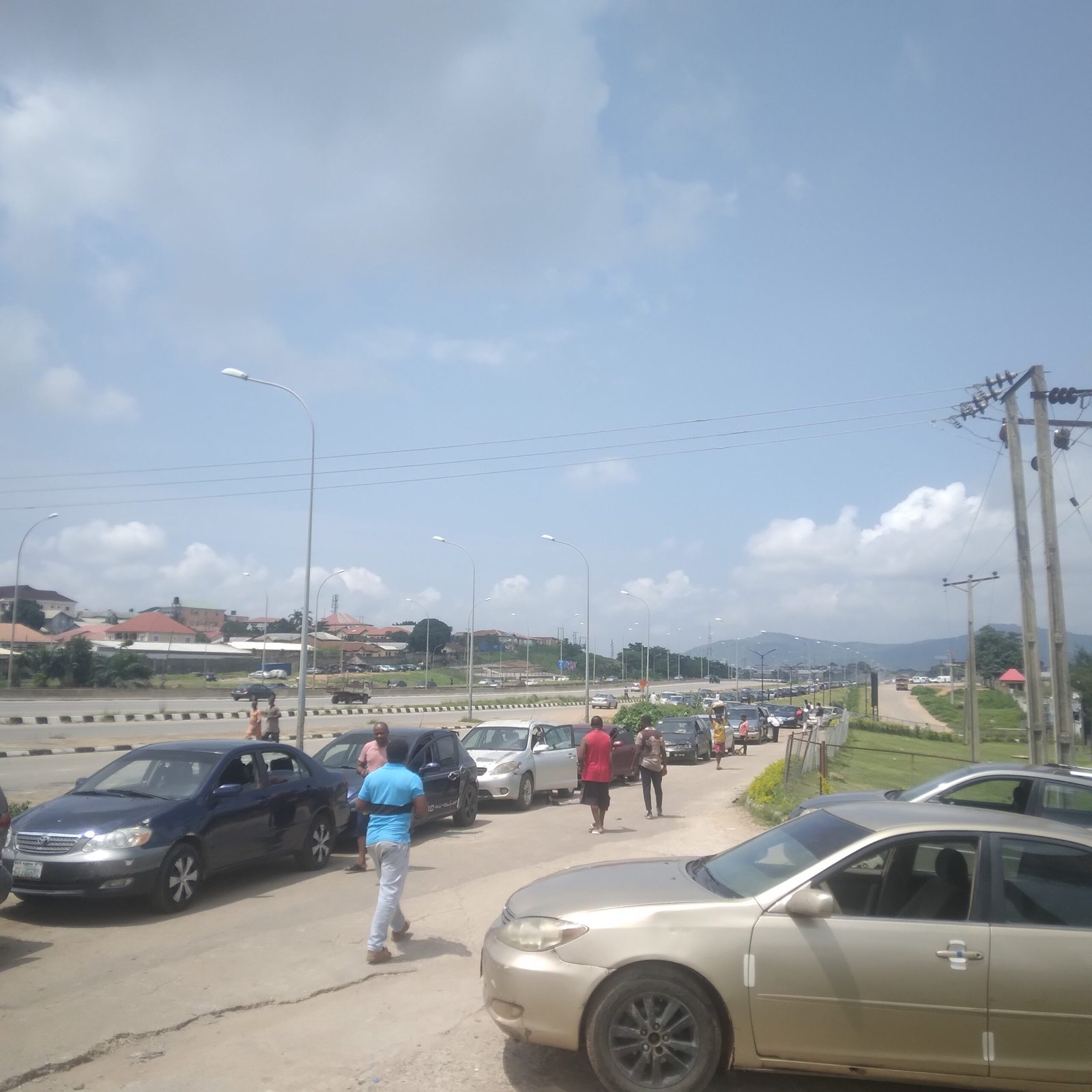
Cars on a queue to refuel their Cylinders at NIPCO refuelling gas station, Kubwa, Abuja.
ABUJA, Nigeria – At dawn, commercial drivers lined up outside Abuja’s handful of compressed natural gas (CNG) refuelling stations, hoping to fill their cylinders before the morning rush. Hours later, many drove away empty-handed after supplies ran out. The shortage—triggered by maintenance work hundreds of kilometres away in Ajaokuta, Kogi State—exposed a deeper question about Nigeria’s energy transition: is the country’s CNG revolution expanding faster than the infrastructure needed to sustain it? In this report, Oluwafunbi Bello examines how a temporary disruption exposed the vulnerabilities of a policy designed to make transportation cheaper for millions of Nigerians.
When President Bola Tinubu removed the petrol subsidy in May 2023, transport fares surged as petrol prices climbed sharply across the country. To cushion the impact, the Federal Government launched the Presidential Compressed Natural Gas Initiative (PCNGI), promoting CNG as a cleaner and cheaper alternative to petrol while encouraging motorists to convert their vehicles.
Nearly three years later, thousands of motorists have embraced the alternative fuel, attracted by significantly lower running costs. But a recent disruption in gas supply across the Federal Capital Territory has highlighted a critical challenge: infrastructure development is struggling to keep pace with growing demand.
When One Maintenance Operation Shut Down Supply
For several days, motorists across Abuja spent hours in long queues outside the few stations dispensing CNG. Some filling stations suspended sales completely after exhausting their supplies, forcing commercial drivers to abandon work while others reluctantly returned to petrol despite its much higher cost.
Findings by Africa Health Report showed that the disruption resulted from maintenance work in Ajaokuta, Kogi State—a key supply point that distributes gas to several CNG stations serving Abuja.
Mr. Oche Emmanuel, a gas operator at the NIPCO CNG Refuelling Station in Kubwa, said the station has witnessed overwhelming demand as more Nigerians switch to gas-powered transportation.
“There is always a long queue because CNG is much cheaper than petrol. We sell at about ₦380 per standard cubic metre (SCM), and many motorists have converted because of the savings,” he said.
According to him, once supplies from Ajaokuta were interrupted, only a few stations still had gas available, resulting in unusually long queues.
Government Explains the Shortage
The Presidential Compressed Natural Gas Initiative confirmed that the disruption resulted from maintenance work.
Speaking with Africa Health Report, Mr. Olatunji Prosper of the PCNGI said repairs had been completed and supply would soon normalise.
“It was a maintenance issue in Ajaokuta. It has been fixed, and gas supply will resume.”
He acknowledged, however, that demand is expanding much faster than refuelling infrastructure.
“In 2023, Abuja had only one CNG station. Today, there are more than 20. But PCNGI cannot build all the stations alone. We are partnering with NIPCO, Grenville and private investors to increase capacity.”
According to him, establishing a CNG station requires significant investment, including land acquisition, engineering works, specialised equipment, regulatory approvals and reliable gas supply.
His comments underscore one of the biggest challenges confronting Nigeria’s gas transition: while vehicle conversions are accelerating, refuelling infrastructure has not expanded at the same pace.
Drivers Counting Their Losses
For commercial drivers, the shortage translated directly into reduced income.
Thirty-six-year-old Bolt driver Okafor Samuel said he parked one of his two vehicles because operating on petrol became economically impossible.
“Since the scarcity started, one of my cars has been at home. If you buy ₦20,000 worth of petrol, you get only about 13 or 14 litres. The same amount can refill my 75-litre CNG cylinder about three times.”
Another commercial driver, Shuaib Yunus, who has operated on the Kubwa–Area 1 route for nearly 15 years, said the shortage forced him off the road.
“I have not been working for days because I couldn’t get gas. My vehicle can still use petrol, but petrol is too expensive. I cannot afford to buy it every day.”
Private motorist Temitope Kayode shared a similar experience.
“I converted because CNG saves money. Since this shortage started, I’ve had to buy petrol to get to work. Some days I simply use public transport because filling my tank is no longer affordable.”
A Public Health Challenge Beyond the Queue
While the immediate impact of the shortage has been economic, public health experts have long recognised that transport disruptions can affect health in multiple ways.
For commercial drivers, spending hours in queues means prolonged exposure to heat, fatigue and dehydration while reducing daily income needed to feed their families and pay for healthcare. Longer working hours to recover lost earnings can also increase stress and road safety risks.
For commuters, unreliable transport raises the cost of reaching hospitals, clinics and pharmacies, particularly for patients requiring regular medical appointments. Health workers who rely on private vehicles or commercial transport may also experience delays, affecting service delivery.
Public health specialists say affordable and reliable transportation is an important social determinant of health because it influences access to healthcare, employment, education and essential services. Consequently, disruptions in fuel supply can have ripple effects that extend well beyond filling stations.
A Growing Transition Facing Growing Pressure
The Federal Government introduced the Presidential CNG Initiative to reduce dependence on petrol, lower transportation costs and leverage Nigeria’s abundant natural gas reserves.
Most converted vehicles are bi-fuel, allowing motorists to switch between petrol and CNG whenever necessary. The programme has also attracted investments in conversion centres and refuelling stations.
Yet analysts have consistently identified inadequate infrastructure as the biggest obstacle to widespread adoption.
Nigeria’s gas expansion strategy is expected to receive further support from the 614-kilometre Ajaokuta–Kaduna–Kano (AKK) gas pipeline, designed to transport more than 2.2 billion cubic feet of natural gas daily through Abuja and northern Nigeria. Government officials believe the project will strengthen domestic gas supply and accelerate the expansion of CNG infrastructure nationwide.
However, the recent disruption demonstrated how dependent the current system remains on limited supply routes. A single maintenance exercise was enough to strand thousands of motorists and expose the pressure on existing infrastructure.
Beyond Cheap Fuel
Nigeria’s transition to compressed natural gas has already helped thousands of motorists reduce transportation costs while supporting the country’s broader clean-energy ambitions. Yet the events in Abuja suggest that affordability alone cannot sustain a nationwide energy transition.
Without significant investments in gas transportation, storage facilities, refuelling stations and supply redundancy, every disruption will continue to leave commuters stranded and businesses counting losses.
Nigeria’s CNG transition has convinced thousands of motorists that cheaper transport is possible. Yet the events in Abuja showed that affordability alone cannot sustain a revolution. Until supply networks, storage capacity and refuelling stations grow as quickly as vehicle conversions, every disruption risks turning hope into frustration.
For commuters who embraced CNG to escape soaring petrol prices, the real question is no longer whether the fuel works—it is whether Nigeria has built a system strong enough to keep it flowing.
About the Author

 Mirian Gom
 Oluwatobi Adu
 Korede Abdullah