Nigeria’s Deadly Highways: Inside the Ministry of Transportation’s Struggle to Keep Roads Safe
 Edino Chubiyo Cornelius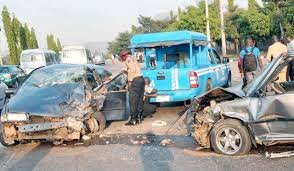
Wrecked vehicle on a Nigerian highway highlighting the country’s road safety crisis
ABUJA, Nigeria – Every morning, Nigeria’s roads awaken before the sun. Buses groan under the weight of passengers, motorcycles weave through traffic, trucks thunder across highways, and private cars inch forward in congested cities. Road transport is the bloodstream of Africa’s most populous nation. Yet, almost daily, that bloodstream spills into tragedy.
From mangled vehicles on expressways to fatal crashes on inner-city roads, road accidents have become a grim constant. What is most disturbing is not just the frequency of these crashes, but the growing consensus that many are avoidable. At the heart of this crisis lies a question Nigerians increasingly ask: what role is the Ministry of Transportation playing in keeping the nation’s roads safe? In this report, Edino Cornelius examines the Ministry’s oversight of road safety, the performance of the Federal Road Safety Corps (FRSC), and why enforcement gaps, weak driver education and poor road culture continue to cost lives.
A Nation on Wheels, a Nation at Risk
Nigeria relies overwhelmingly on road transport. For millions, it is the only affordable way to move goods and people. But heavy dependence has come with heavy consequences. Road traffic injuries and deaths have risen steadily, according to safety advocates and frontline officers.
Crashes occur on newly constructed highways and aging rural roads alike. Commercial buses collide head-on. Speeding trailers crush smaller vehicles. Motorcycles are flung aside in seconds of chaos. Each accident tells a personal story of loss, but together they reveal a systemic failure.
Under Nigeria’s transportation framework, the Federal Road Safety Corps operates under the Ministry of Transportation. The FRSC is mandated to enforce traffic laws, regulate speed, ensure vehicle roadworthiness and educate drivers. On paper, these responsibilities are robust. On the road, many Nigerians say the impact feels limited.
Driver Education: The Weakest Link
One of the most persistent problems is driver education. Across Nigeria, countless drivers never attended a certified driving school. Some obtained licences through informal means. Others drive without any licence at all.
The result is a population of drivers who often lack basic knowledge of road signs, right-of-way rules and defensive driving techniques. This knowledge gap turns routine journeys into high-risk ventures.
Mrs. Rose, a road safety personnel member with seven years of field experience, has witnessed the consequences firsthand.
“I have been on the road for about seven years now, and I have seen many situations where drivers clearly do not understand traffic signs,” she said. “Some drivers do not know when to slow down, stop or give way because they were never properly trained.”
Her experience echoes what accident scenes often reveal: drivers confused by signage, misjudging intersections or ignoring warnings altogether.
Speed, Silence and Selective Enforcement
Speeding remains one of the deadliest factors on Nigerian roads. Speed limit signs dot major highways, but enforcement is inconsistent. In some areas, speed monitoring equipment is missing. In others, patrol presence is rare.
This absence sends a dangerous signal. Drivers push their vehicles beyond safe limits, especially on long stretches of open road. Commercial drivers, under pressure to maximise daily earnings, are frequently accused of reckless speeding.
Poor road behaviour compounds the danger. Indiscriminate parking, sudden stops without warning triangles and misuse of emergency lanes are common sights. On highways, broken-down vehicles are often left unmarked, creating deadly obstacles at night.
Mrs. Rose believes enforcement alone cannot fix what is fundamentally a cultural problem.
“The FRSC has put many measures in place, but Nigerians themselves are mostly the problem,” she noted. “Some drivers refuse to follow the rules even when they know them, while others see road safety laws as optional.”
Her words highlight a painful truth: laws lose power when society treats them casually.
Policies Without Teeth
Over the years, the Ministry of Transportation has rolled out policies aimed at improving road safety. These include vehicle inspection exercises, public awareness campaigns and partnerships with driving schools. Officials often cite these initiatives as evidence of commitment.
Analysts agree Nigeria does not suffer from a lack of policies. Instead, it suffers from weak implementation. Traffic laws are unevenly enforced, and penalties for offenders are often insufficient to deter repeat violations.
In countries with strong road safety records, driving is treated as a privilege earned through rigorous testing. Licence issuance is transparent, standardised and difficult to bypass. Offenders face swift and certain punishment.
Many experts argue Nigeria must move in this direction. Strengthening driver testing, digitising licence systems and ensuring offenders face real consequences could drastically reduce accidents.
Beyond Roads: Rail Safety Concerns
While road transport dominates daily life, the report also examines the rail sector, another arm under the Ministry of Transportation. In the past year, Nigeria’s rail system has faced operational delays, safety concerns and infrastructure challenges.
Despite significant government investment in rail projects, passenger confidence remains fragile. Experts point to the need for better maintenance, stricter safety checks and clearer communication during disruptions.
Rail transport, if properly managed, could ease pressure on roads and reduce accident rates. But only if safety and reliability are prioritised.
Shared Responsibility, Urgent Choices
As Nigeria moves into 2026, calls for urgent action are growing louder. Stakeholders are demanding compulsory and verifiable driving school attendance, stronger speed enforcement, improved road signage and continuous public education. Yet the solution does not rest with the government alone. Road safety is a shared responsibility. Drivers must respect traffic laws. Enforcement agencies must apply rules consistently. The Ministry of Transportation must ensure its policies translate into real-world safety.
Until attitudes change and enforcement strengthens, Nigeria’s roads will remain dangerous corridors of loss. Each avoidable crash is not just a statistic, but a failure of a system meant to protect lives.
About the Author

 Otamere Gladness
 Koko Maxwella