
Silent Poison, Loud Questions: Nigeria’s Thallium Scare and the Price of Public Trust
 Korede Abdullah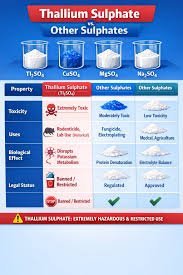
LAGOS, Nigeria – The word poison has a way of stopping people in their tracks. It carries fear, mystery and the sense that something invisible can-do irreversible harm. So, when allegations surfaced that a highly toxic chemical—thallium sulphate—had been imported into Nigeria by a government office, the reaction was immediate and visceral. Was the country facing a hidden public-health threat, or was this yet another case of politics fuelling national anxiety?
That question sits at the heart of a controversy that has drawn in politicians, security agencies, health experts and ordinary Nigerians, each grappling with what the allegation means in a country where trust in institutions is often fragile. Korede Abdullah, writes.
An Allegation That Travelled Fast
The storm began when former Kaduna State governor Nasir El-Rufai went public with a claim that the Office of the National Security Adviser had imported about 10 kilograms of thallium sulphate from Poland. He raised the issue during a television programme, describing it as a grave national matter requiring urgent clarification.
The allegation was striking not just because of its source, but because of the substance involved. Thallium sulphate is among the most dangerous chemicals known to medicine, a poison once used as rat killer and now tightly regulated across the world.
El-Rufai linked the alleged importation to the office headed by Nuhu Ribadu, a claim that instantly elevated the issue from a technical query to a national conversation.
Swift Denial from The Security Office
The response from the Office of the National Security Adviser (ONSA) was swift and emphatic. In a statement signed by Brigadier General O.M. Adesuyi, the office rejected the claim outright.
“ONSA has neither procured nor initiated any process for the purchase of such material, and has no intention of doing so,” the statement said, describing the allegation as false and misleading.
To underline the seriousness of the matter, the office said the issue had been referred to the Department of State Services for investigation, signalling that the government wanted the matter examined formally rather than argued in the media.
A Letter Framed as Civic Concern
El-Rufai, however, insists his intervention was not meant to inflame tensions. In a letter dated January 30, 2026, he said he was acting as “a concerned citizen” seeking reassurance.
“I am writing as a concerned citizen to seek clarification and reassurance regarding information available to the political opposition leadership about a procurement of approximately 10 kilograms of thallium sulphate,” he wrote.
He stressed that his inquiry was not an accusation, but a call for transparency in the interest of public safety. For him, the issue was not who was right or wrong, but whether Nigerians could be confident that dangerous substances were not entering the country without proper oversight.
Why The Questions Matter
Beyond the personalities involved, the former governor raised a set of pointed questions that resonated with many Nigerians. Thallium salts, he noted, are “highly toxic and tightly controlled substances” in most jurisdictions.
What was the purpose of importing such a chemical? Who was the supplier in Poland? Were the appropriate permits obtained? How would the substance be stored and secured? And crucially, were health and regulatory agencies such as National Agency for Food and Drug Administration and Control and the Nigeria Centre for Disease Control involved?
He also asked whether any public-health risk assessment had been carried out, given the extreme danger associated with the chemical.
“Public confidence in the integrity of national institutions is strengthened when potential risks are openly addressed and managed,” he wrote, a line that has since been widely quoted.
Experts Strip Away the Politics
While the political back-and-forth dominated headlines, health experts urged Nigerians not to lose sight of the real issue: the danger posed by thallium sulphate itself.
Speaking with Africa Health Report, a public-health physician and Medical Director of Ogunmodede Memorial Hospital, Ikotun, Dr Toke Ogunmodede warned that the substance is lethal even in minute quantities.
“Thallium sulphate is not an ordinary chemical,” he said. “Early symptoms such as stomach pain, vomiting and diarrhoea can easily be mistaken for food poisoning. That is what makes it especially dangerous—by the time you realise what it is, significant damage may already have occurred.”
According to him, delayed diagnosis is one of the biggest risks, particularly in settings where specialised toxicology tests are not readily available.
A Silent Poison with Lasting Damage
Rilwan Isiaka, a biochemist, described thallium sulphate as a “silent attacker”. Once it enters the body, he said, it targets multiple systems at once.
“Nerve damage, organ failure, paralysis, coma and even death can occur depending on the level of exposure,” he explained. “One of the most distinctive signs is sudden hair loss days or weeks later. By that time, internal damage may already be severe.”
Isiaka added that confirming thallium poisoning often requires specialised laboratory testing, something that remains limited in many parts of Nigeria.
Fear Beyond the Expert Circles
On the streets, the allegation has produced a quieter but no less powerful reaction: anxiety. In Lagos, food vendor Bosede Olatunji said the details matter less than the fear they generate.
“We may not understand the politics behind it, but when people hear about poison being imported, it creates fear,” she said. “People start wondering if food, water or medicine is safe.”
Pharmacist Muiz Babalola echoed that concern, warning that poor communication could make a bad situation worse.
“Transparency from investigators is very important,” he said. “If people feel information is being hidden, panic spreads faster than facts.”
Thallium sulphate is a colourless, odourless chemical, qualities that make it especially dangerous. Because it cannot be detected by taste or smell, exposure often goes unnoticed until symptoms appear.
Historically used as rat poison, it has been banned or heavily restricted in many countries due to its extreme toxicity. Even small amounts can be fatal to humans.
Early symptoms often resemble common illnesses—stomach pain, vomiting and diarrhoea—but as the poison spreads, it attacks the nervous system and vital organs. Victims may experience weakness, severe pain, hair loss, paralysis and, in severe cases, death.
It is precisely because of these risks that any report of its importation attracts intense scrutiny from health and security professionals alike.
Trust as the Real Casualty
As investigators work behind the scenes, the larger issue may not be whether the allegation is proven true or false, but how such claims are handled in the public space. In a country with a history of chemical scares and regulatory lapses, reassurance requires more than denial; it requires openness.
Health experts agree that clear, timely information is essential to calming public anxiety. Silence or vague statements, they warn, only deepen suspicion.
For now, the thallium sulphate controversy remains unresolved in the public eye. But it has already served as a reminder that when it comes to substances capable of killing quietly, transparency is not a luxury—it is a public-health necessity.
About the Author


 Edino Chubiyo Cornelius
 Oluwatobi Adu
 Oluwafunbi Bello