
Lagos Begins Eight-Month Overhaul to Fix Failing Water Treatment Plants
 Oluwafunbi Bello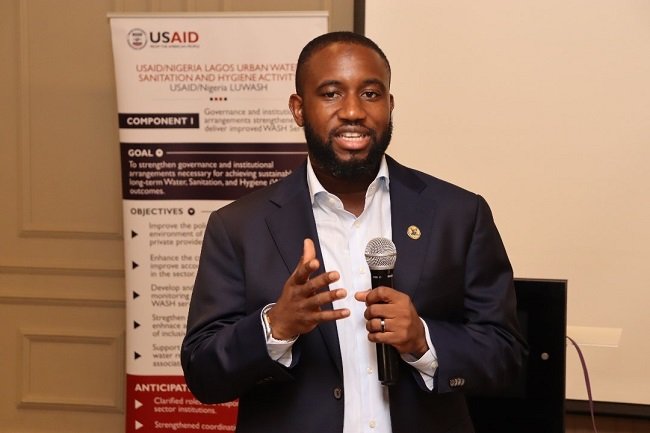
Managing Director, Lagos Water Corporation, Mukhtaar Tijani
LAGOS, Nigeria – The Lagos State Government begins an eight-month rehabilitation of its two largest water treatment facilities, signalling a decisive push to stabilise potable water supply for millions of residents.
The Lagos Water Corporation confirms that major upgrades are underway at the Iju and Adiyan waterworks, facilities that form the backbone of the state’s public water network. The intervention, scheduled for completion in October, focuses on replacing ageing mechanical systems and expanding raw water intake capacity.
Speaking at a contractor engagement in Lagos on Tuesday, the corporation’s Executive Director, Omolanke Taiwo, says the project marks a shift from emergency repairs to long-term infrastructure renewal.
“This programme is about sustainability, not patchwork fixes. We are rebuilding systems that Lagos will depend on for decades,” Taiwo says.
Officials acknowledge that years of underinvestment and rapid population growth have strained the water network, resulting in erratic supply across several districts. Lagos, Africa’s fastest-growing megacity, now faces a widening gap between water demand and treatment capacity.
The corporation’s Head of Production, Agiri Mustapha, says lessons from past equipment failures inform the new procurement process.
“We now apply strict performance benchmarks to suppliers to guarantee durability and efficiency,” Mustapha states.
The rehabilitation contracts are split among KSB Pumps & Valves Nigeria Ltd, Wilo Pumps Nigeria Ltd, and Springfield Electric Ltd, each handling specialised components of the upgrade. Company representatives pledge compliance with delivery timelines and technical standards.
The project aligns with the Lagos Water Corporation’s multi-year development blueprint, endorsed by Governor Babajide Sanwo-Olu’s administration in late 2024. Analysts describe the investment as critical to preventing a deeper urban water crisis.
Once completed, officials expect improved pressure stability, higher output volumes and more reliable access to treated water for households and businesses statewide.
About the Author

 Mirian Gom
 Hope Ajayi
 Korede Abdullah
 Oluwatobi Adu