


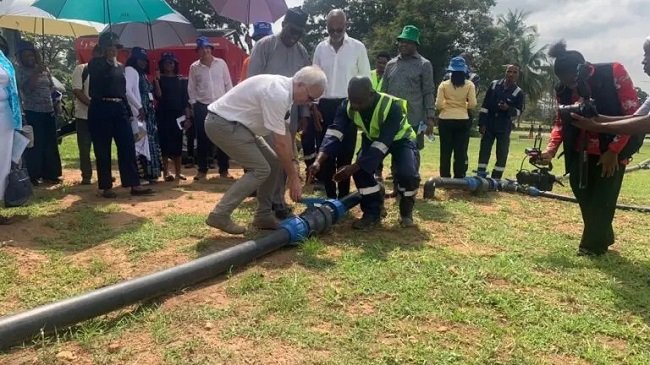
IBADAN, Nigeria – The International Institute of Tropical Agriculture (IITA) has unveiled advanced irrigation systems and mechanised farm equipment designed to accelerate the development of improved crop varieties across Africa.
Speaking on Thursday at the commissioning of facilities, funded by the Crops to End Hunger initiative in Ibadan, IITA Director-General, Dr Simeon Ehui, says the infrastructure represents a transformative upgrade to the organisation’s research capabilities. “This means we will be able to develop and deliver improved varieties to farmers faster and at a greater scale,” he says.
Ehui describes the systems as foundations for a more resilient and sustainable agricultural ecosystem. “These facilities will serve as platforms for innovation, training and partnership across the region,” he adds, praising the support of global partners including the German Government.
The newly commissioned equipment includes GPS-enabled tractors, planters, manure spreaders and combine harvesters, alongside a fully mechanised irrigation network designed to support year-round research and breeding trials.
Chairman of IITA’s Board of Trustees, Dr Roel Merckx, says mechanisation remains a critical challenge in Africa, but the new irrigation capacity will ease water-access barriers. “It allows researchers to focus more on breeding additional varieties rather than managing water constraints,” he says.
Head of Farm Management and Breeding Operations, Mr Alick Mulenga, notes that manual farm activities have long slowed research. “Everything—planting, spraying, harvesting—is done manually. We are very inefficient,” he explains. The new systems, he says, will “dramatically improve speed, reliability and productivity”.
The irrigation upgrade will also enable multiple cropping cycles per year, reducing reliance on rainfall and improving research timelines.

Join the conversation